



Abstract
Induction based fluidics (IBF), a new, simple patented approach for transporting liquids in the micro and the macro world, is discussed. Electric fields are shown to energize liquid/s in a container/s to execute an array of purposes. IBF is shown uniquely to energize N liquids in simple off the shelf devices, inductively. We discuss calibration and other issues, as we demonstrate how simple devices can dispense nanoliters and microliters with high precision and accuracy. Furthermore, we show preliminary single and eight channel data for the Zip Tip™ made by Millipore where the device transports liquids “electrically.” We briefly consider how such new devices, “electric” Zip Tips™, might automate desalting and the placement of digests for MALDI TOF analysis.
INTRODUCTION
Recently we introduced the new, simple technique, Induction Based Fluidics, IBF. 1 The approach is discussed in the reference and at nanoliter.com where information, pictures and video are available from a wide array of experiments. In IBF, an electric field imparts energy inductively, into (i.e., through) a container such that the liquids take on a higher level of order. Subsequently, such energy can be released kinetically to a locale or a receiver be it a surface such as a MALDI target, a microtiter plate, microscope slide or other surface or container. It has been shown 1 that when an electric field deposits energy into what amounts to an inanimate object containing a liquid, highly accurate and precise flows can result from inexpensive materials such as capillaries, Zip Tips™, microliter syringes and other “inanimate” or static objects. Moreover, such objects can transport one or more liquids when so energized simultaneously, and since such containers (e.g., cylinders) can have contents that perform functions (e.g., desalting media for MALDI TOF experiments, SPE, etc), composite inanimate objects can be energized to perform functions.
We have shown that energy, deposited inductively into static devices, can cause such objects to become dynamic and perform dispensation or other useful functions. As such, simple inexpensive devices which have no moving parts other than the liquid itself, offer the potential for high reliability and excellent accuracy and precision in, for example, liquid dispensing. For this and other reasons such devices can be operative across an enormous dynamic range from the μL/sec to pL/sec flow regimes facilitating interaction of the micro and macro world.
Consider the implications of this very simple arrangement shown in Figure 1. Objects such as Zip Tips™, glass microliter syringes, and capillaries (singular or plural) can be made to be “electric” simply by appropriately placing them in an electric field. Just as in an ion source of a mass spectrometer, where the potential of gas phase ions is accelerated to lower energy, an analogous approach can be employed to “fly” liquids to lower areas of energy through simple holding devices like pipette tips to appropriately targeted receivers (a beaker, vial, or plastic array). This simple approach is executed without using exotic and costly devices manufactured from silicon wafers in expensive clean rooms and sold at great premiums or as per chemistry labs on chips where the eventual device costs as much as a real lab to develop.
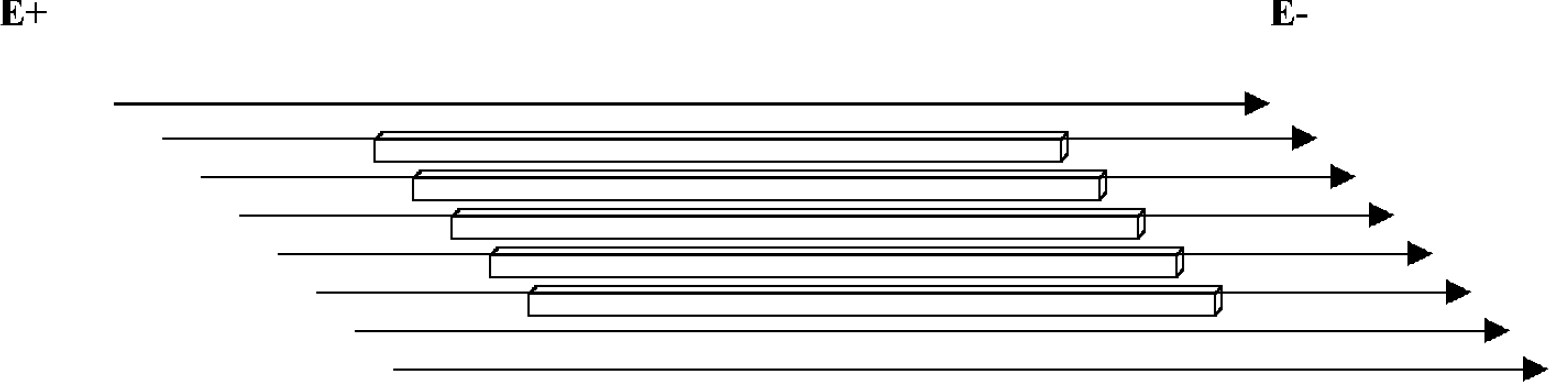
Electric field inductively coupling with five containers holding liquids.
To illustrate the principle, we show five Gaussian surfaces, square tubes we imagine containing five liquids which may be the same or different (if these were cones, they would physically resemble Zip Tip™). Note the electric field pointing from positive to negative inductively couples this energy into the liquids with them not being physically electrically connected. This inductive coupling provides energy which eventually can be released through flow. Since fields can be activated and deactivated rapidly. Such energy deposition can be rapid and time sliced to yield a wide range of accurate flows. Consider a device where the number of tubes is N, and they have the same/different physical parameters (can be multiples), hold different liquid/s, have other content/s (e.g. resins) or are made of the same or different material/s and have other different properties or attributes. As such, this simple experimental setup can have innumerable configurations and hence flow rates and functions. Moreover, since many static devices can be inexpensive and since they only need one source of power, instruments built on this base can be extraordinarily inexpensive. Below we show some data morphing off the shelf devices into “electric” versions, employing capillaries and Zip Tips™, as we utilize our instrument base beta prototype, the Nanoliter 2002.
NANOLITER CALIBRATION OF A CAPILLARY TO A MICROLITER SYRINGE
Figure 2 is an image of blots produced on nitrocellulose from a 50 percent ethanol/water solution containing a blue food dye. Blots were produced onto a nitrocellulose strip by the Nanoliter (left most, at fixed energy and dispense time) and by five dispenses from a standard microliter syringe (five dispenses at 1.0, 1.0, 1.0, 0.5 and 2.0 μL), rightmost. The capillary had a radius of 150 microns and the energy level from the Nanoliter was set at 5.0 with one second dispense times. After production, the blots on the media were scanned as a jpg file. Then rapid interactive analysis using National Instrument's Vision Builder (VB) software, was performed on that file. VB's particle analysis option produces a list of the number of pixels (and other data) for all blots shown by both dispensers. These data were automatically imported to Excel for all subsequent graphics and elementary calculations.
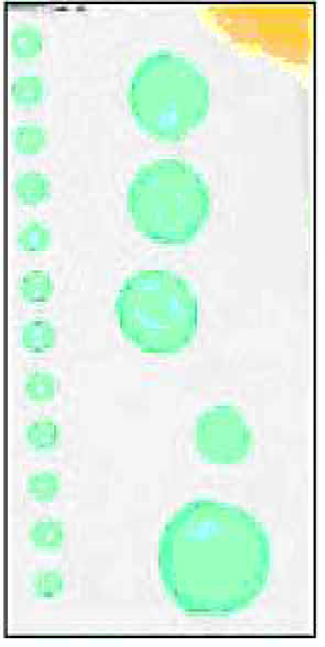
IBF produced blots (leftmost) and five blots from a microliter syringe.
From the syringe data, a calibration curve was produced as shown in Figure 3. This curve was then employed to derive a function for estimating the dispensed volume from a list of pixels (and other data) from the right most blots by VB. This calibration procedure assumes that the size of the blots is directly related to the volume and dispense time (at a given energy and configuration), that the system is functionally continuous and that, of course, NI's particle analysis option accurately reflects these assumptions in the output.
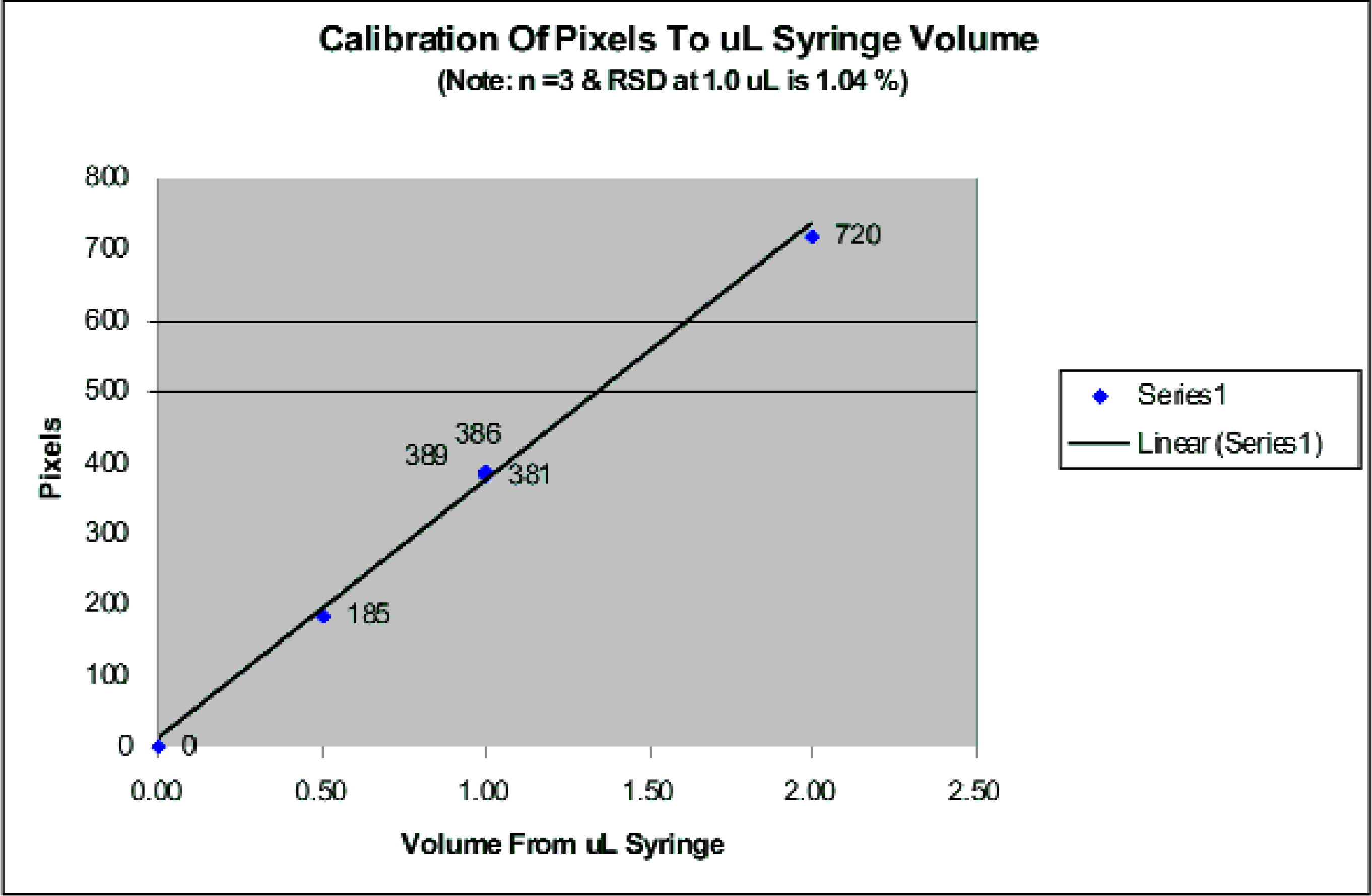
Dispensed volume of a glass microliter syringe to pixel calibration.
In Figure 3 we show that the data from the syringe “appear” linear on first pass inspection. Note that the triplicate determinations at 1.0 μL seem well determined. These observations indicate that the ability to produce results for dispensings from a standard device, using the entire procedure, can be consistent with expected errors (see reference 1 and nanoliter.com for other examples).
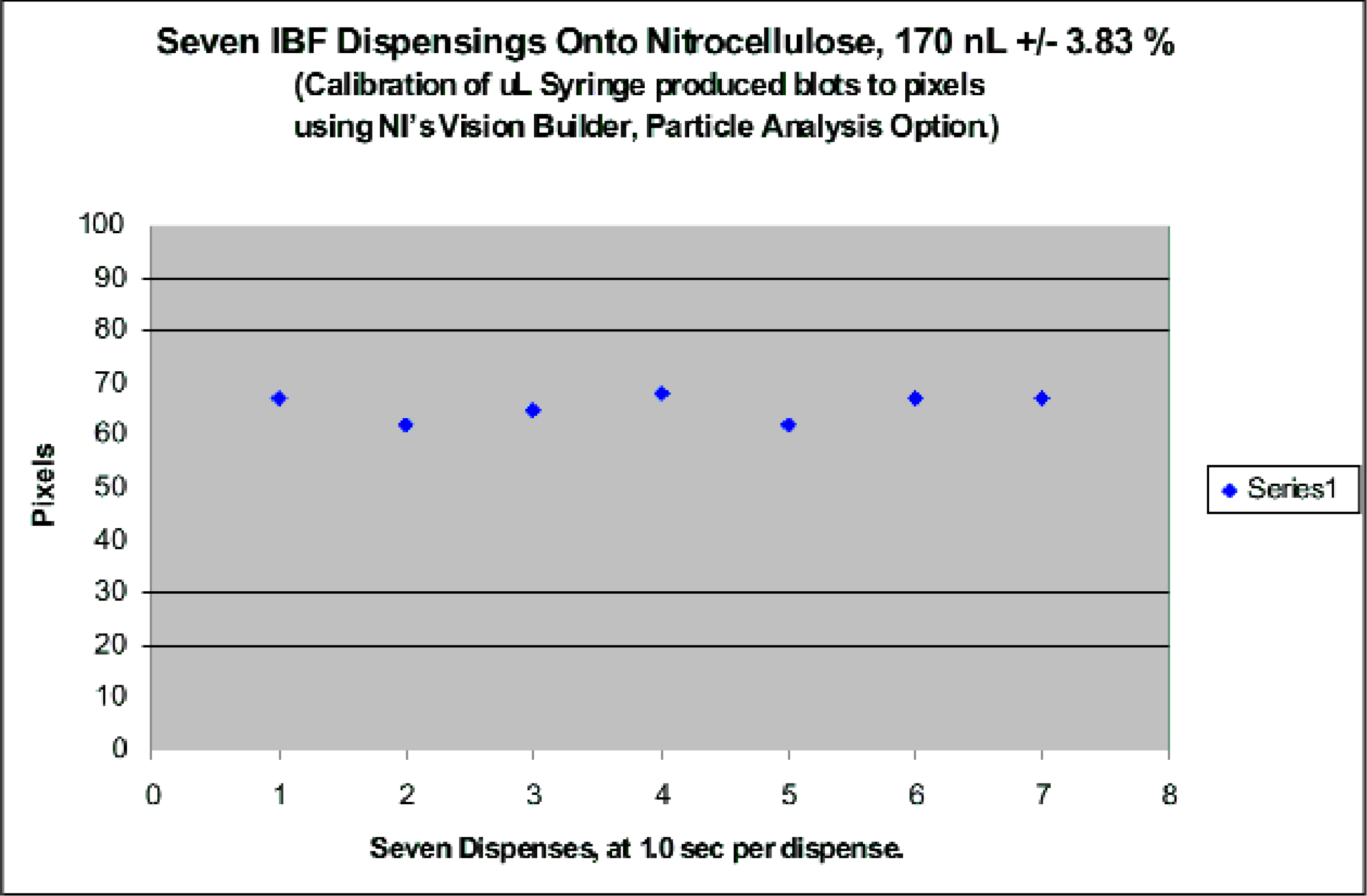
Next in Figure 4 we graph the results for seven consecutive dispensings from the Nanoliter. The data gave a mean value of 170 nL +/− 3.8 percent at one SD. For all of the Nanoliter data, n=12, a value of 164 +/− 8.3 percent at one SD was realized. So if all assumptions hold, medium level nL dispensings can approach a few percent or easily be less than ten percent. In many important nanoliter applications this is more than enough precision and accuracy. Also, given that there was no special precaution taken in the work and that the capillary was not optimally designed for nanoliter dispensation and no atmospheric or other special precautions were taken from a simple un-optimized glass capillary, these results are quite reasonable.
“ELECTRIC” ZIP TIP™ PRELIMINARY RESULTS
Given the above, the work of reference 1 and the importance of sample preparation for the production of good MALDI TOF spectra, we decided to see if we could use and activate IBF in commercially available Zip Tips™. Such devices are plastic pipette tips containing resin that “cleanup” various digests to produce spectra devoid of alkali metal and other resolution-degrading matrix materials for MALDI TOF experiments, among the most important technique in the field of proteomics.
As an aside, in addition to the ability of IBF to economically dispense liquids with excellent accuracy and precision across a wide dynamic range rapidly (seconds, milli seconds and lower), is the ability to exactly place or direct liquids to a given locale, be it a surface or a container. Recognizing that other factors can impact such placement (e.g., surface properties of the target), it was also hoped that such directed dispensation might eventually lead to a much needed increase in the ability of MALDI TOF to execute quantitative analysis, and to increase spatial resolution of such depositions given that many more samples can be placed on a MALDI target (10 to 20 X) meaning vacuum doesn't need to be broken as many times, increasing throughput, a major issue with those in proteomics.
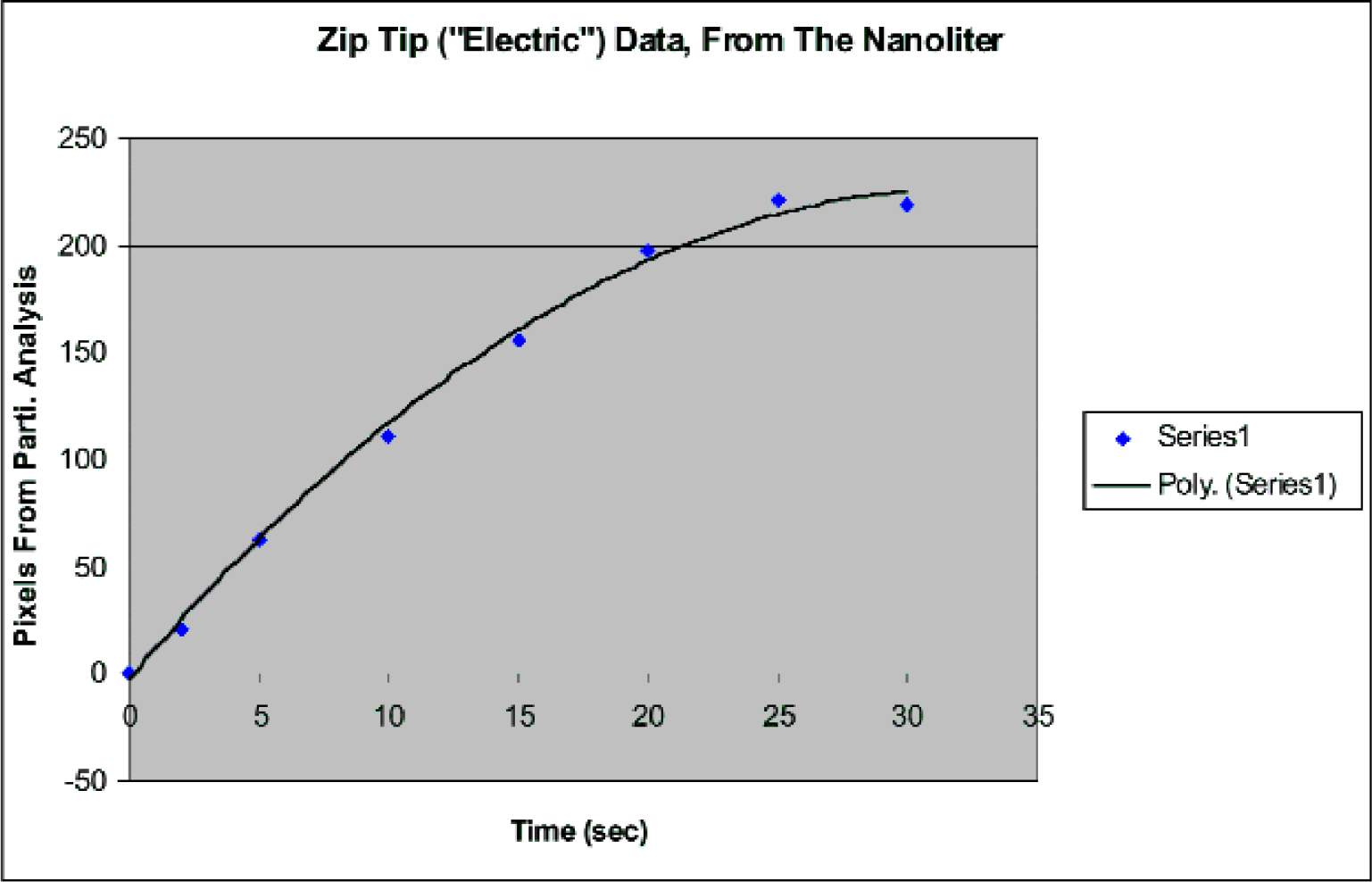
An example of data produced from the Nanoliter, using a Millipore Zip Tip™ is given in Figure 5. Seven blots were produced by the Nanoliter from a standard Zip Tip™. These represent our absolute first attempt at such work. The seven blots were made from a 50 percent mixture of ethanol and water containing blue food dye such that the resin was saturated to visualize output. These data, the pixels, are plotted below as before to quantitate the number of pixels which become related to time and then volume per reference 1. The dispense times are 30, 25, 20, 15, 10, 5 and 2 seconds respectively, using a Nanoliter constant energy setting of 4.5 (see Figures 5 and 6).

Single Channel Dispensation from an “Electric” Zip Tip™ at Constant E, Varied time
Note that the largest two values appear to show saturation (see the curve). As before, with the functional dependence of pixels determined, we estimated the last four blots on that media as 791, 563, 315 and 107 nL's.
An apparent calibration curve was obtained from the Nanoliter with a Zip Tip™ “plugged into” the inductor of the Nanoliter and the solution was energized at different times. We were interested in examining the ability to execute parallel dispensing with a Zip Tip™, as well.
PARALLEL EIGHT CHANNEL ZIP TIP™ DATA FROM THE NANOLITER
Data (buttonized representations) from an eight channel version of the Nanoliter using eight different Zip Tips™, for dispensings onto paper media gave a mean pixel value of 152 +/− 53 pixels yielding a large RSD of 34 percent for a 50 percent solution of ethanol and water containing food dye similar to the previous liquid. These data and other experience with these devices, indicate that the back pressure inherent due to the resin may not have been uniform enough between the eight different Zip Tips™, to facilitate such inter-dispenser comparisons. Clearly, one must recognize that the devices were not designed for the purpose of nanoliter dispensing, and as such, these results are not totally discouraging.
On the positive side, certain within “dispenser” (i.e. Zip Tip™) variation of the data was much narrower than the group as a whole. For example, the lower most row in Figure 7, yielded an RSD of 14.6 percent indicating a very reasonable precision for a non optimized device. It is also likely that some of the variation was inherent in the quantitation approach as well, but the percentages of each has not been studied enough to be assigned given the preliminary nature of this data.
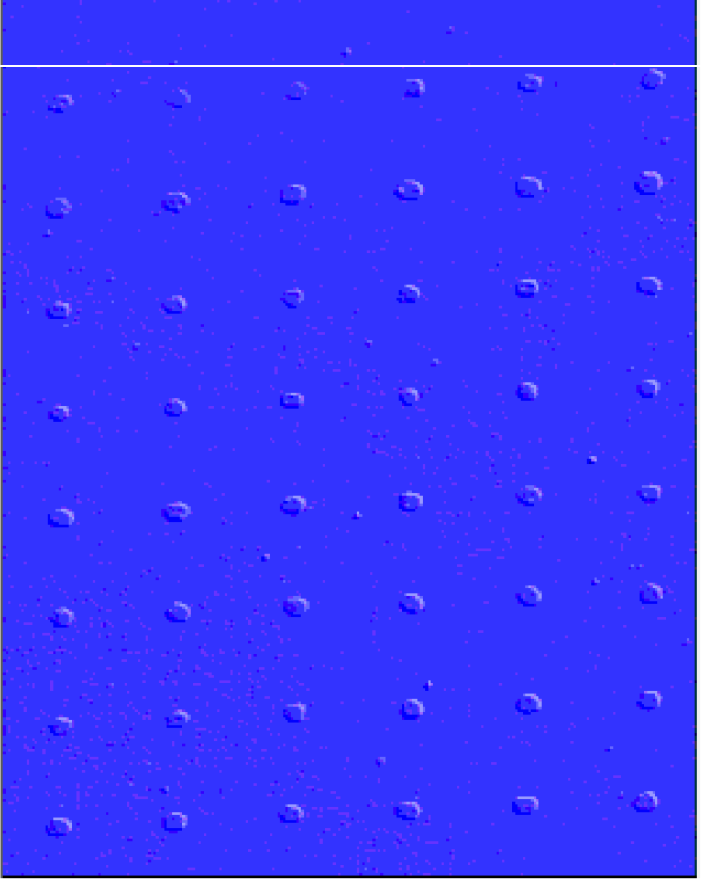
Eight channel “electric” Zip Tip™ data showing 48 dispenses “buttonized” by Paint Pro Shop and exported to Vision Builder for “particle” analysis, i.e., “quantitation” as above, for six parallel eight channel dispensations, at 3 seconds per row.
While additional work and improvement are required, we anticipate that much better inter-device precision and lower nanoliter levels will be attained from Zip Tips™, and other non-IBF optimized devices with just a bit more effort and design and calibration optimization. It is anticipated that with such improvements nanoliter transfers will routinely approach a CV of five percent or better, potentially improving MALDI work. However, at very low nL levels, as shown in Figure 8, where an optimized glass capillary dispenser was energized at constant energy for eight replicates at constant energy, excellent inexpensive, low level nanoliter dispensing precision can be realized using IBF.
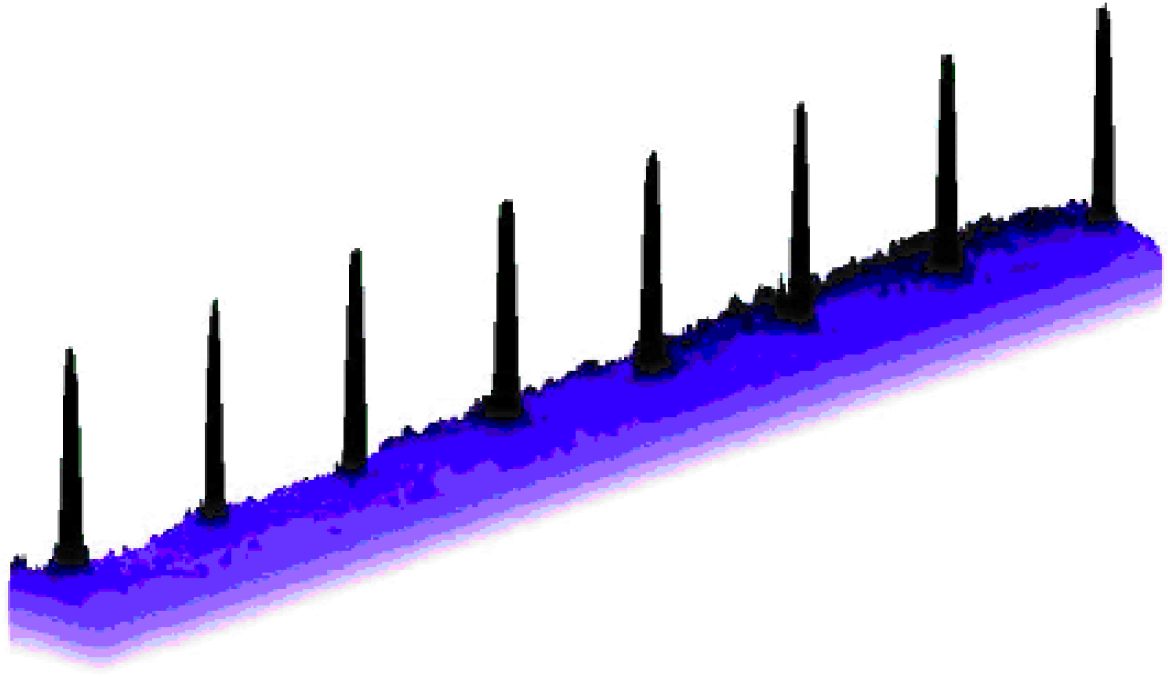
An Example of 23 nL +/− 3.4 percent nanoliter dispensations, n=8 on to paper that has been made 3D (x, y are positions on paper and the Z axis is the number of pixels).
SUMMARY
Uniquely, IBF and the Nanoliter (see Figure 9) allow current off-the-shelf devices to be employed for transporting liquid with reasonable accuracy and precision in many important areas, even when such containers are not designed for such electric induction driven tasks. Clearly, more work is required to examine the utility of applying IBF to the preparation of MALDI TOF targets and related applications. Nevertheless these preliminary results are encouraging. However, in certain major applications, e.g., the production of microelectronics, tasks with micro arrays for DNA analyses and where high precision at low level nL and pL is required, these data and other work indicate that IBF can execute and attain low level nL dispensating with excellent precision and accuracy from devices which should be optimized for such purposes.
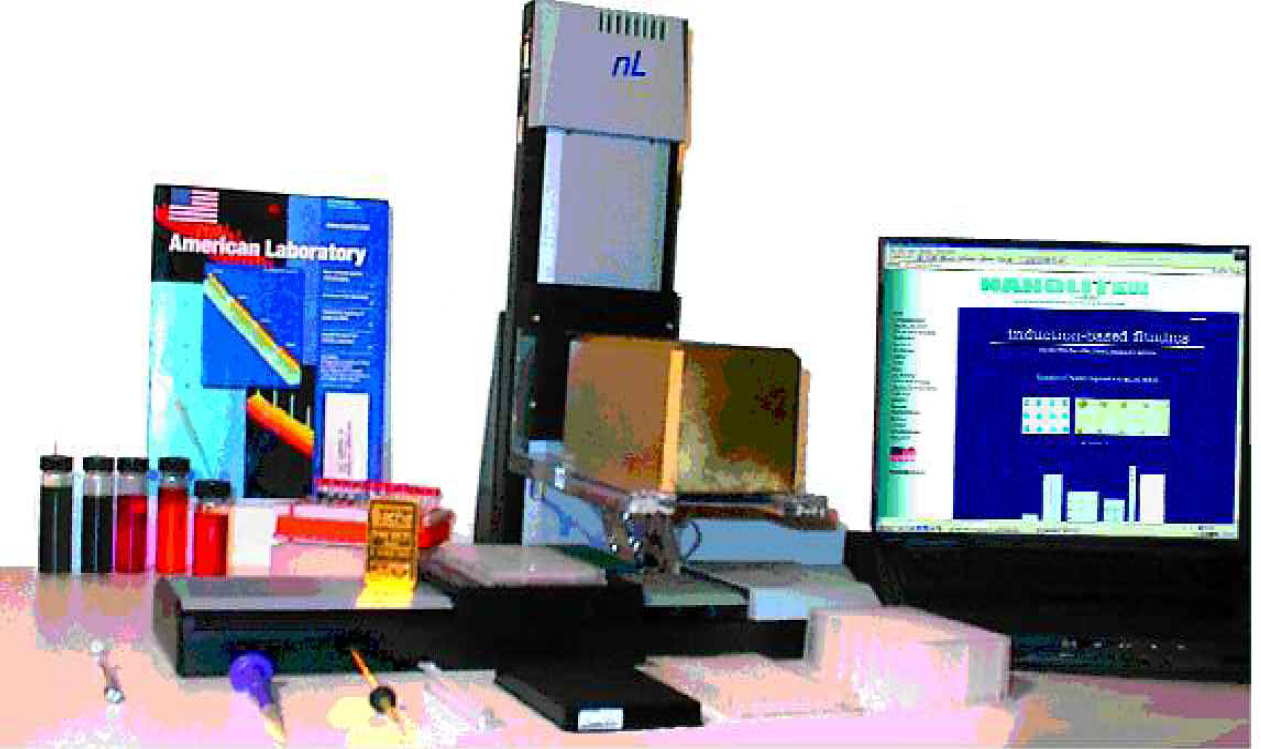
The Nanoliter 2002, The Beta Prototype.
ABOUT NANOLITER
Nanoliter is a startup company with technology for parallel nL,μL and pl dispensation, filtration, desalting, SPE, LC and serially parallel derivatives thereof. It offers free limited time evaluation licenses to selected firms for selected, untargetted Nanoliter markets (e.g., LC/MS).
Zip Tips™ is a product of Millipore