



Abstract
The development of drugs in the generic pharmaceutical industry is a highly competitive arena of companies vying for the few drug products that are coming off patent. Companies that have been successful in this arena are those that have met or surpassed the critical timeline associated with trial formulation development, analytical method development and submission batch manufacturing and testing.
Barr Laboratories has been successful in the Generic Pharmaceutical Industry for several reasons, one of which includes automation. The analytical research and development at Barr has employed the use of automated dissolution early in the lifecycle of a potential product. This approach has dramatically reduced the “Time To Market” on average for a number of products. The key to this approach is the network infrastructure of the formulation and analytical research and development departments. At Barr Laboratories Inc., our cooperative ability to work and communicate together has driven the departments to streamline and matrix their work efforts and optimize resources and time.
The discussion will reference how Barr Laboratories Inc., has been successful with automation and give a case study of products that have moved with rapid pace through the development cycle.
This presentation was given at the 2000 International Symposium for Laboratory Automation and Robotics (ISLAR) held in Boston, MA, October 15-18, 2000. The full manuscript is available on CD-Rom and can be acquired by contacting Christine O'Neil, 508-497-2224; email
INTRODUCTION
Barr Laboratories Inc., has been a competitive player in the manufacture of generic pharmaceuticals as well as proprietary products. One of the pillars of success has been the cooperative effort of the product development and analytical development teams. In the generic realm, companies who have been successful in the marketplace are those who have seized an opportunity for a viable product candidate, and been able to quickly expedite the development of that product and submit it for approval. In the race for generic pharmaceuticals, there is no second place. Companies who come in second risk low market share for their product and therefore very little profit margin.
The critical success factor becomes the speed in which a Biobatch formulation can be manufactured, the analytical method developed and validated, and the Biobatch or Clinical batch tested and submitted to the agency.
PRODUCT LIFECYCLE
To gain a better understanding of where gains in the development and validation process can be made, one must first understand the product lifecycle time line.
First, new drug candidates are selected based on market volume, need for specialty manufacturing facilities and / or techniques (i.e., narrow therapeutic range drug and others), and complementing existing product lines. Next, the candidates are selected and the products are kicked off with a launch meeting which provides information about the therapy for the new product, establishing development time frames, identifying issues with development and validation, resolving issues with raw material and excipient availability, and confirming a clinical research organization for the Biostudy or clinical study.
At this point the evaluation / development work on the Brand product begins, as well as the initial formulations from the product development side.
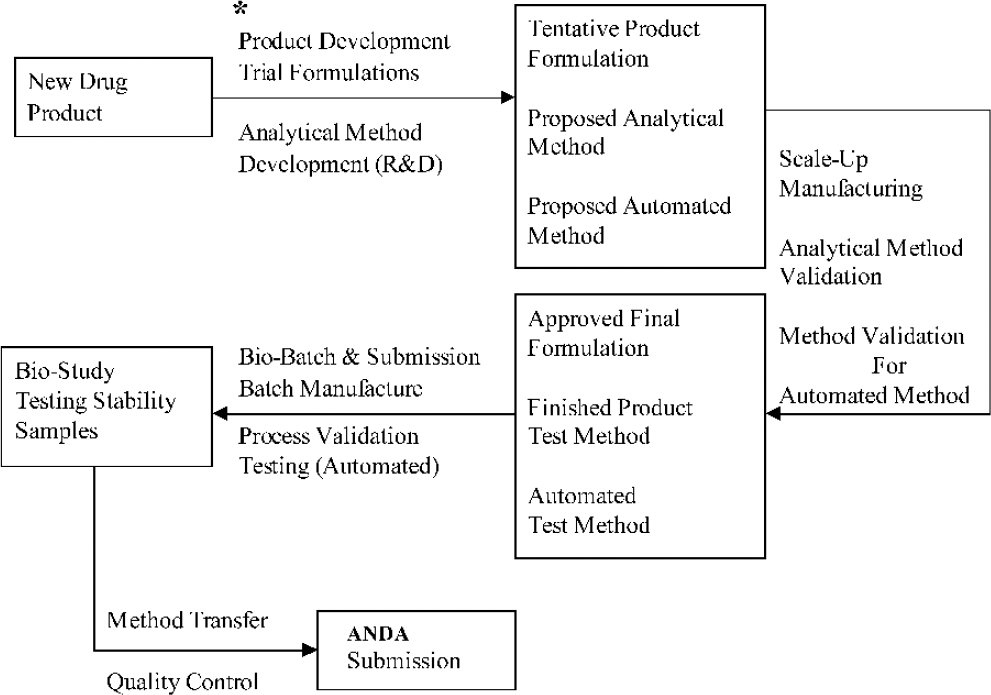
Once trials have been tested, preliminary decisions are made as to the direction for the analytical methodology. Automation usually enters the picture at some point close to the final formulation. Once the final formulation is reached, it is scaled up and the analytical validation proceeds along with the validation of the automated methodology. At just about the same time, both the manual and automated methods are completed and updated as the established methods for testing and releasing the product. The Biobatch is made and the process validation is tested by the established methods. The stability study follows at the predetermined time points, the product is submitted to the FDA, and the methods are transferred to the quality control department.
STATISTICAL DESIGN
The product development team utilizes several tools to enhance its ability to provide a formulation for testing. One of those tools is the use of mathematical models for formulation design. The basic goal in utilizing statistical design is to optimize a formulation. The most readily used design schemes are the Factorial Design and the Simplex Design. These design schemes allow the formulation scientist to vary certain independent parameters while monitoring other dependent parameters.
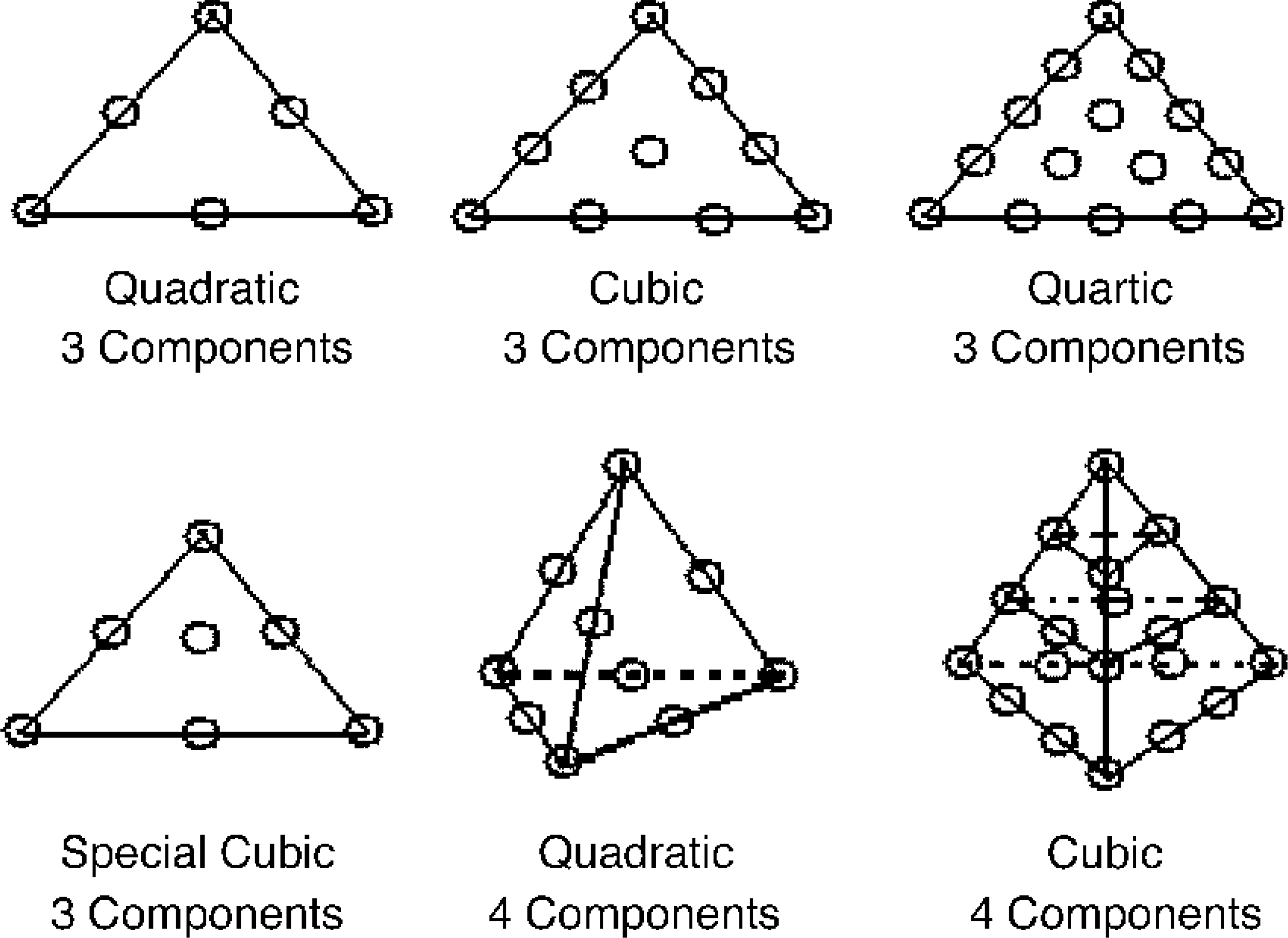
The simplex lattice design is a relatively new design in pharmaceutical research but is quite effective. The basis of this design scheme is that there is a constraint on the mixtures of components. The total amount of the varying ingredients under evaluation must also sum to unity. The components of the design are then arranged in one of several lattice configurations based on the model for that product. Mathematically the model is represented by polynomials. Using the polynomial equations, predictive information about the model can be achieved in a short period of time with a limited number of test cases.
LATTICE STRUCTURE
The lattice design can easily be represented by simple graphical constructs. For mixtures containing three components, a triangle can be used, and for 4 components a tetrahedron. With more than four components it becomes increasingly difficult to represent a 4th dimension and higher visually, but it can be represented as an n-sided figure in an (n-1) dimensional space. However, the ability to uncover information about the blend of components comes by investigating the entire ranges of the composition which is represented by the ordered arrangements of the Lattice structure. The responses or features are measured at the lattice points and equations representing those responses are derived. Calculations are performed and resultant statistics give predictive information as to the suitability of the model for that product.
Overall, these design schemes make it possible to choose a small number of informative test cases that will allow the formulation scientist to quickly resolve a formulation with the desired properties. With these abilities, the formulation scientist can make several lots of product initially and submit them to the analytical laboratory for testing. The information gained from these trials allows them to make an informed decision as to the direction of their formulation work. At this point, the samples are submitted to the analytical laboratory for analysis.
AUTOMATION APPROACH
The Analytical Research and Development (AR&D), laboratory at Barr Laboratories Inc., handles all method development and testing of trial batches produced by the Product Development (PD) formulation scientists. Up until a restructuring of AR&D, all method development and validation of automated methods did not start until the beginning of the Scale-Up Manufacturing Phase (see first chart).
This approach had significant gains in the management of work flow for the individual teams whose project was being automated. In many cases, the scale-up testing and Biobatch were tested completely using automation. This allowed other members of the team to concentrate on more difficult and time consuming tasks. As a productivity tool, automation had scored A's. However, in the category of increasing the number of submissions to the agency, automation was scoring very low.
It was not until the management of the AR&D looked at how and where automation was being implemented, that there would be changes in the way in which automation would be utilized to increase the number of submissions. The change in perspective caused a shift in the way in which projects would be evaluated and distributed amongst the different AR&D Teams. The new view was to hand pick projects at launch meeting time that would be good candidates for automation. Then from the start of the Product Development Trial formulation Phase (see first chart) all work submitted to the AR&D laboratory for dissolution or Assay & CU testing would be tested using automated means.
The first product to use this approach was launched in record time for Barr Laboratories Inc. The length of time from launch meeting to submission was six months, (including the three month stability time point). Each additional product that has utilized this approach has been expedited more quickly as a result of the quick sample turn around. Why were we so successful in this approach? The answer lay in the infrastructure of the company and the successful experience of veteran automation users provided with the right tools.
INFRASTRUCTURE
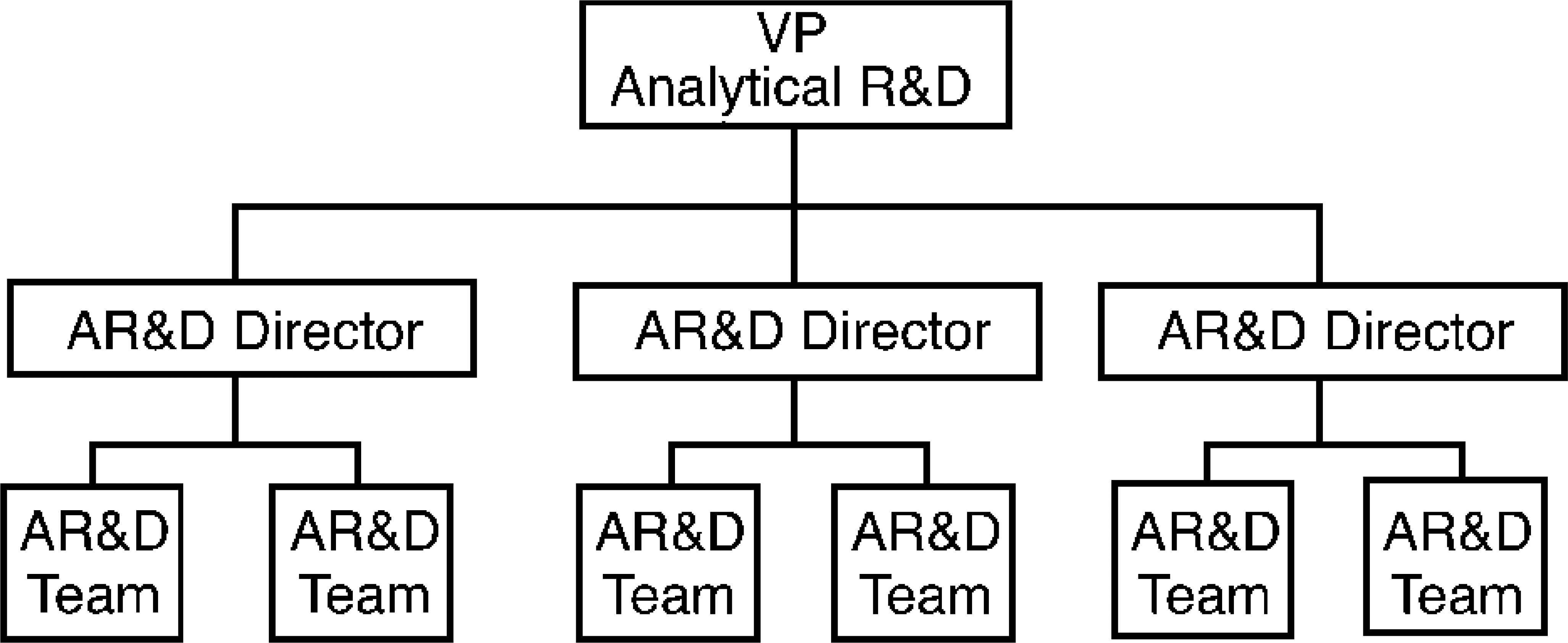
The infrastructure of Barr Laboratories Inc., is such that a large number of projects can be handled by the individual development teams. In turn, these development teams correspondingly work with the AR&D teams for developmental testing of their formulations. Not only does this approach lend itself well to highly parallel development of products, but the skill sets of each of the respective groups get developed and most optimally utilized within their respective environment.
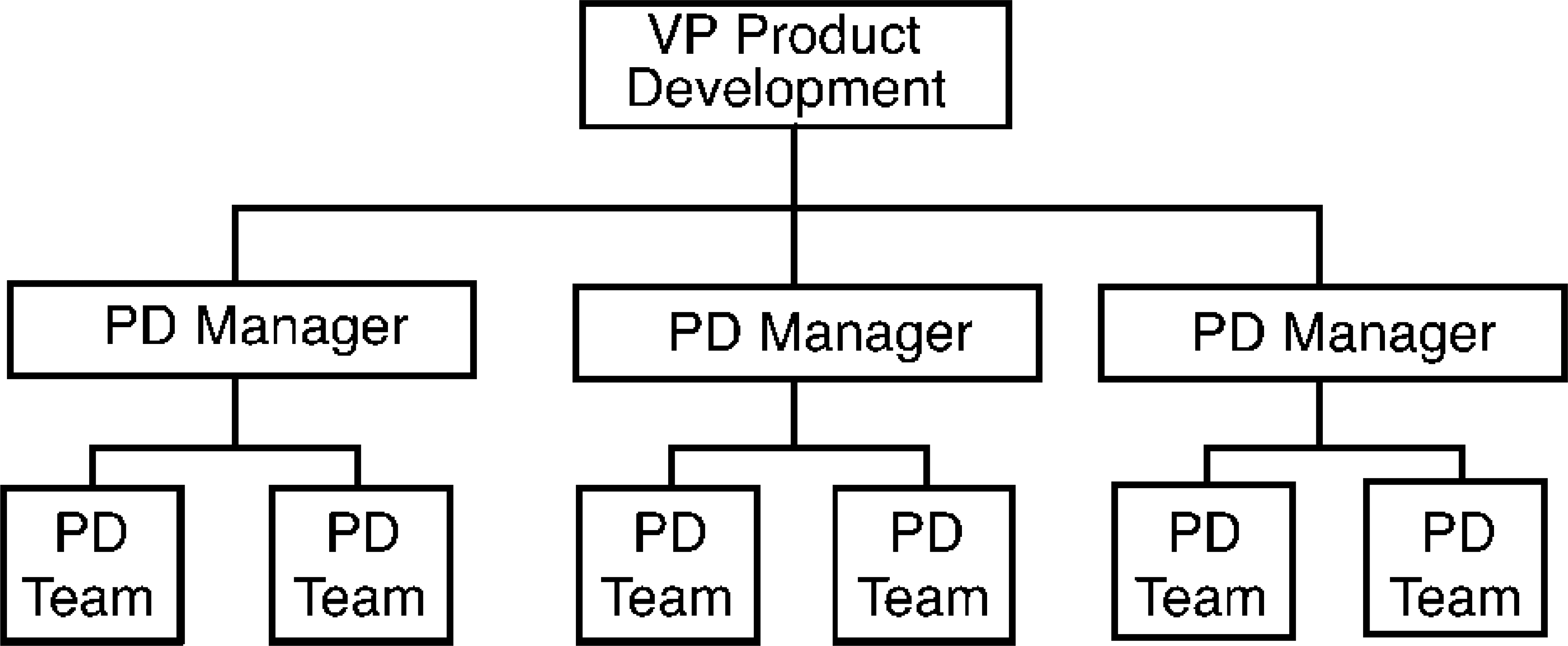
The workflow comes as a function of the PD's submission of samples to the AR&D laboratory for analysis. By changing the entrance of automation to the beginning of the project, trials could be evaluated utilizing automated systems. PD's approach to submitting samples has changed as well. The open lines of communication, matrix design schemes, and the high volume capacity of automation has caused an acceleration in the development timeline for products. Utilization of automation has increased the volume of information while decreasing the overall time for the development of the product
AUTOMATION TOOLS
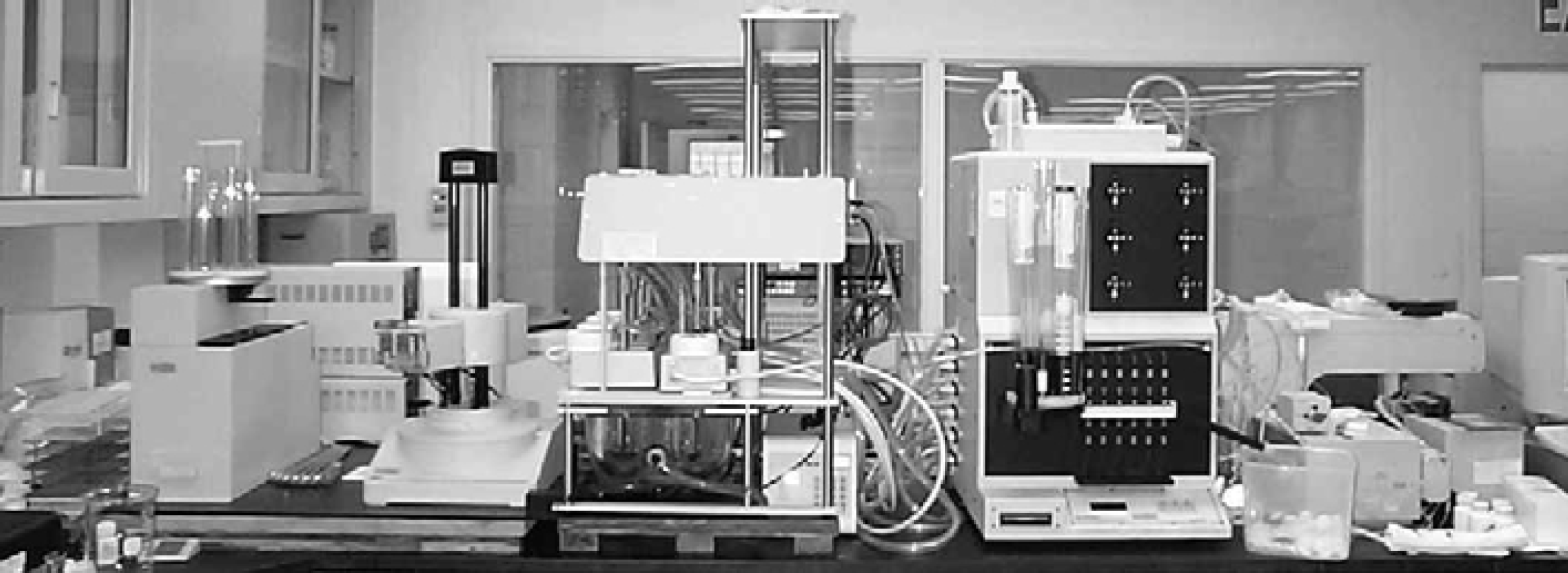
Analytical R&D has made use of several automation resources in its effort at pushing the envelope of the critical timeline associated with launching new generic and proprietary products. One of the most useful tools has been the automated dissolution workstation. We have employed the use of Zymark's Multidose Automated Dissolution Workstation (MADW) as the center point of Barr Laboratories Inc., streamlining approach at launching products.
Some of the key features of the multidose that make it suited for high throughput analysis are its ability to run up to eight batches without reloading, to utilize four different media and DI H2O, to run either Apparatus I or Apparatus II, to collect samples in vials or test tubes, or to run utilizing on-line UV analysis.
The coordination of the inter-departmental communication is the most important factor that has allowed all of the pieces to work together to optimize turnaround time. Our approach in this area has been to set up the development project with the PD department in such a way that high volume testing is part of the resource for testing samples. With this in mind, the formulation scientists have utilized the different statistical design models to submit groups of samples to be analyzed with several different media. The batch analysis approach has shown the effectiveness of the automation tools by providing large volumes of development information in a relatively short period of time.
EFFICIENCIES
The old approach in development was to submit a sample or two to the lab for analysis. The next day results would be generated and submitted for review by the formulation scientists. Upon their review, decisions as to the results would be made and another one or two samples would be submitted to the lab for analysis on the following day. After one week, only about six trials would have been made and tested.
In the new approach, a set of samples of between four and eight would be submitted for analysis in media ranging from 0.1 N HCl through the pH range to pH 8.0 buffer. The results for these analyses would generally be submitted by 10:00AM the next morning and we could expect to receive more trial samples to analyze by late that day. In effect, we were able as a company to formulate, analyze, calculate and review, and reformulate within a 24 hour time period.
As a result, the projects have begun to move with rapid pace through the development and validation stage. These changes have also affected the other areas of the company causing them to streamline their efforts to keep pace with the fast moving projects. Use of data analysis tools has also increased steadily as the Information Technology (IT) department has implemented systems to improve data analysis and report generation.
CASE STUDIES
Currently there are several projects that have benefited from the use of automated dissolution. The products themselves range over several categories of therapy. In each of these cases, the approach was the same: to implement the use of automated dissolution from the project inception through to the completion of the submission.
Three of the products were developed using on-line UV analysis and the other product used off-line LC collection into vials. For the products that used on-line UV analysis, there was an added benefit of additional time point analysis that compromised no efficiency in the throughput. It was no more difficult to analyze the dissolution at five minute intervals, than at 30 minute intervals. This allowed for a greater number of sampling points to provide the formulation scientists with more data about the dissolution analysis. The initial dissolution work for all of these products was conducted by running a series of dissolution analyses of the brand product by both basket and paddle in several media representing the gastrointestinal tract pH. This information coupled with differing RPM and peak vessel combinations provided a wide spectrum of detailed information about the nature of the brand product. For the example mentioned earlier, the development time for Barr Laboratories Inc., formulation was just under six weeks. This compressed timeline was achieved because of the volume of data that was generated early in the life of the project. A final formulation was achieved and confirmed, and a series of additional dissolution tests in different media were conducted to confirm the desired profile. Shortly thereafter, a scale-up formulation was manufactured and tested. All of the analytical methods (both manual and automated), were validated and all samples for the Biobatch were analyzed using the automated methodology. The project from start to submission including the three month stability time point interval was six months. Compare that to the usual 9–18 month time line for product development and submission.
To be realistic, not all products can follow such an aggressive pace. There are raw material and excipient availability problems that need to be contended with as well as issues that arise from manufacturing and analytical areas as well. Two of the products that are currently in the pipeline for automation have experienced these problems and have slowed the pace somewhat, but in the grand scheme of projects, that has allowed an opportunity to evaluate and develop other products in the interim.
The remaining product has been placed on a fast track and has been developed to date in record time, three weeks. This project is far from complete, but final formulation will be soon to come and this project should be submitted early 2001. That would be a five month development and submission time frame.
CONCLUSION
The use of automation in the analytical research and development department has been a major factor in expediting the formulation development process: however, it is not the sole factor for the success. Barr Laboratories, Inc., success at expediting product development is attributed to its corporate commitment to bringing health care products to the market quickly. The cooperation of the differing departments in working toward the goal of accelerated development has been key to making the process successful.
Barr Laboratories, Inc., continues to look at new technology and new approaches to improving and accelerating product development and will continue to invest in those areas that will allow us to do so.
ACKNOWLEDGMENTS
I would like to thank the following people for their contribution to this paper.
Dr. Emad Alkhawam — For his commitment to supporting and developing automation in Analytical Research and Development.
Product Development — For the contribution of product development information.
AR&D Robotics Team — Their dedicated efforts in support of product development trial batch, scale-up, and Biobatch testing.