Abstract
Recently Organon installed automated screening and plate preparation systems for its research facilities in Oss (The Netherlands) and Newhouse (UK). These robotic systems have been developed in close collaboration between Organon and Scitec Laboratory Automation (Lausanne, Switzerland), now part of the Zymark corporation.
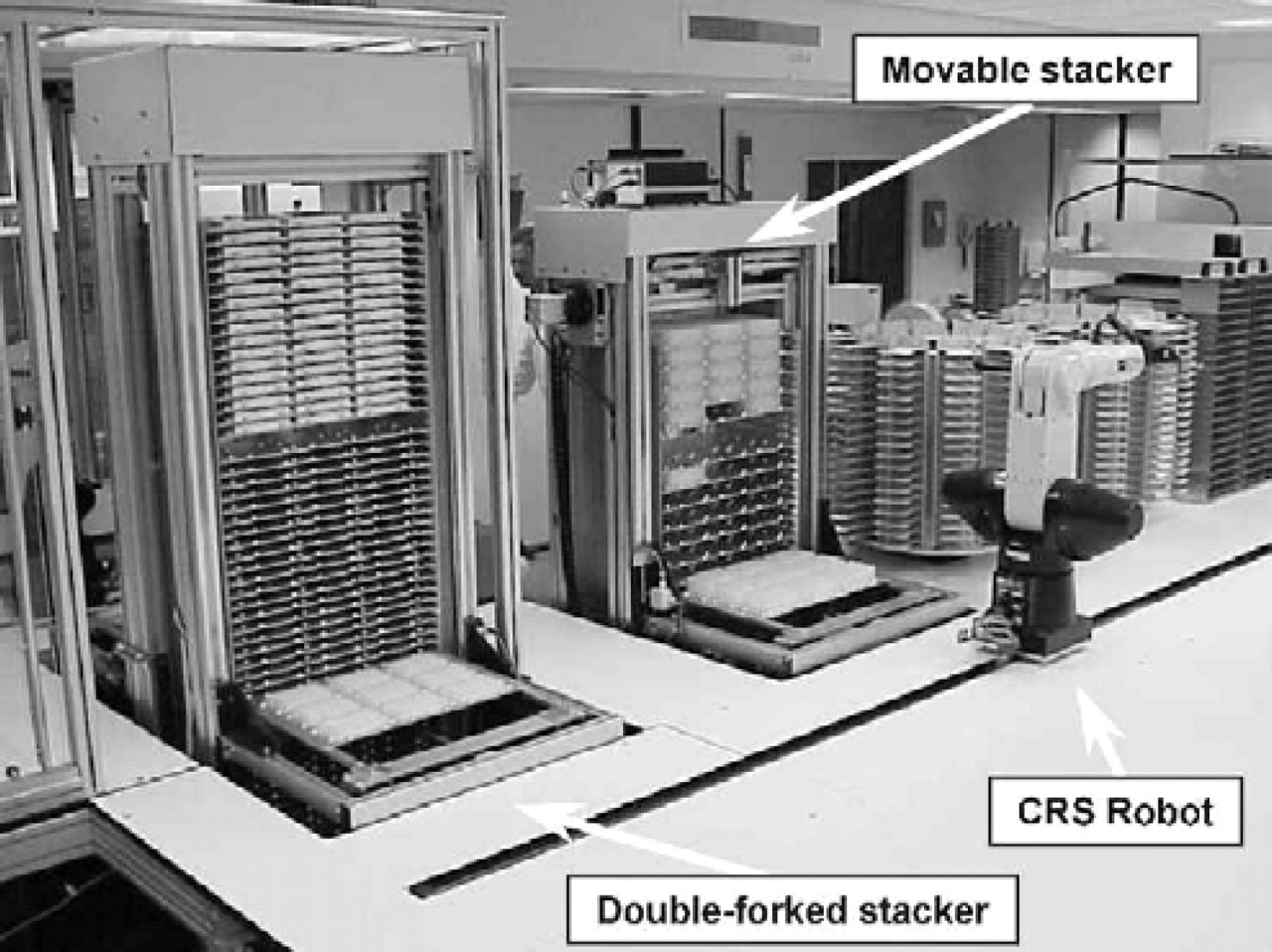
Each of the systems consists of three linear track robots, one of which performs the screening process using standard peripherals. The other two robots take care of the plate preparation and ‘cherry-picking’ procedures. To this end, copies of our total mother plate collection are stored under controlled conditions in Scitec plate stackers (AutoStack) that can be addressed by one of the two robots. The system is designed in such a way that the loading and refreshment of the on-line storage, screening-plate preparation, and ‘cherry-picking’ can be executed automatically in 24 hours operation.
This presentation was given at the 2000 International Symposium for Laboratory Automation and Robotics (ISLAR) held in Boston, MA, October 15-18, 2000. The full manuscript is available on CD-Rom and can be acquired by contacting Christine O'Neil, 508-497-2224; email
INTRODUCTION
From 1996 onwards screening operations at Organon were performed with the aid of an HTS system, consisting of a circular Zymark XP robot controlled by Scitec Clara software. In the course of the following years a clear need arose to integrate more diverse dispensing equipment and new read out instrumentation. The available space around the circular robot, however, did not allow for any further modification or extension of the system. Moreover, it turned out that the off-line preparation of assay plates out of the mother plates became the bottleneck for realising an acceptable throughput of the screening process. Finally, the time between primary screening and the confirmation of the actives was unacceptably long because ‘cherry picking’ had to be performed on workstations that required manual feeding of mother plates.
With the limitations of our previous HTS robot in mind, in 1998 new robotic systems were designed with the aim to create a modular environment with the possibility to extend and upgrade the individual modules. The new systems should be capable of automatically performing the assay plate preparation, the actual screening and the composition of plates for active confirmation via ‘cherry picking’ in parallel.
OVERALL DESIGN
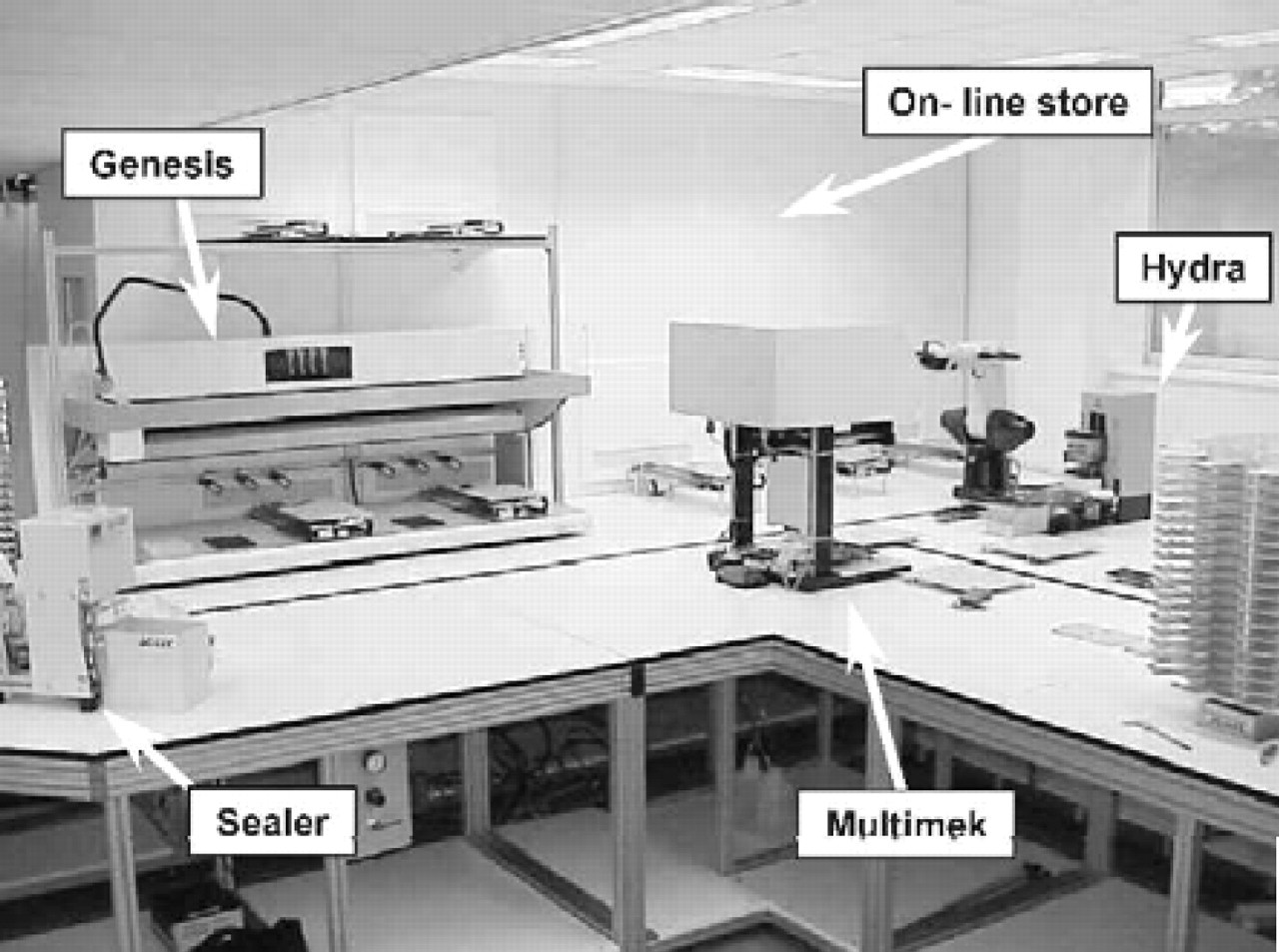
In its final design the total system basically consists of three CRS 465 robots on 5-meter tracks, one of which is taking care of the HTS process. The other two robots together form the so-called SDS, the Storage and Distribution System.
Storage and Distribution System
The Storage and Distribution System (SDS) includes an online plate store and dedicated peripherals allowing:
automatic plate retrieval and subsequent assay plate preparation for HTS campaigns.
‘cherry-picking’ for actives found in previously executed HTS runs.
periodic refreshment of (part of) the on-line store from archived mother plates.
High Throughput Screening System
The high-throughput screening system (HTS) is a conventional robotic system capable of performing cellular and non-cellular assays based on absorbance, ‘time-resolved’ fluorescence, luminescence, or radioactivity-based read-out techniques. A maximum throughput of 300 96–well or 150 384-well microtitre plates in 24 hours can be achieved.
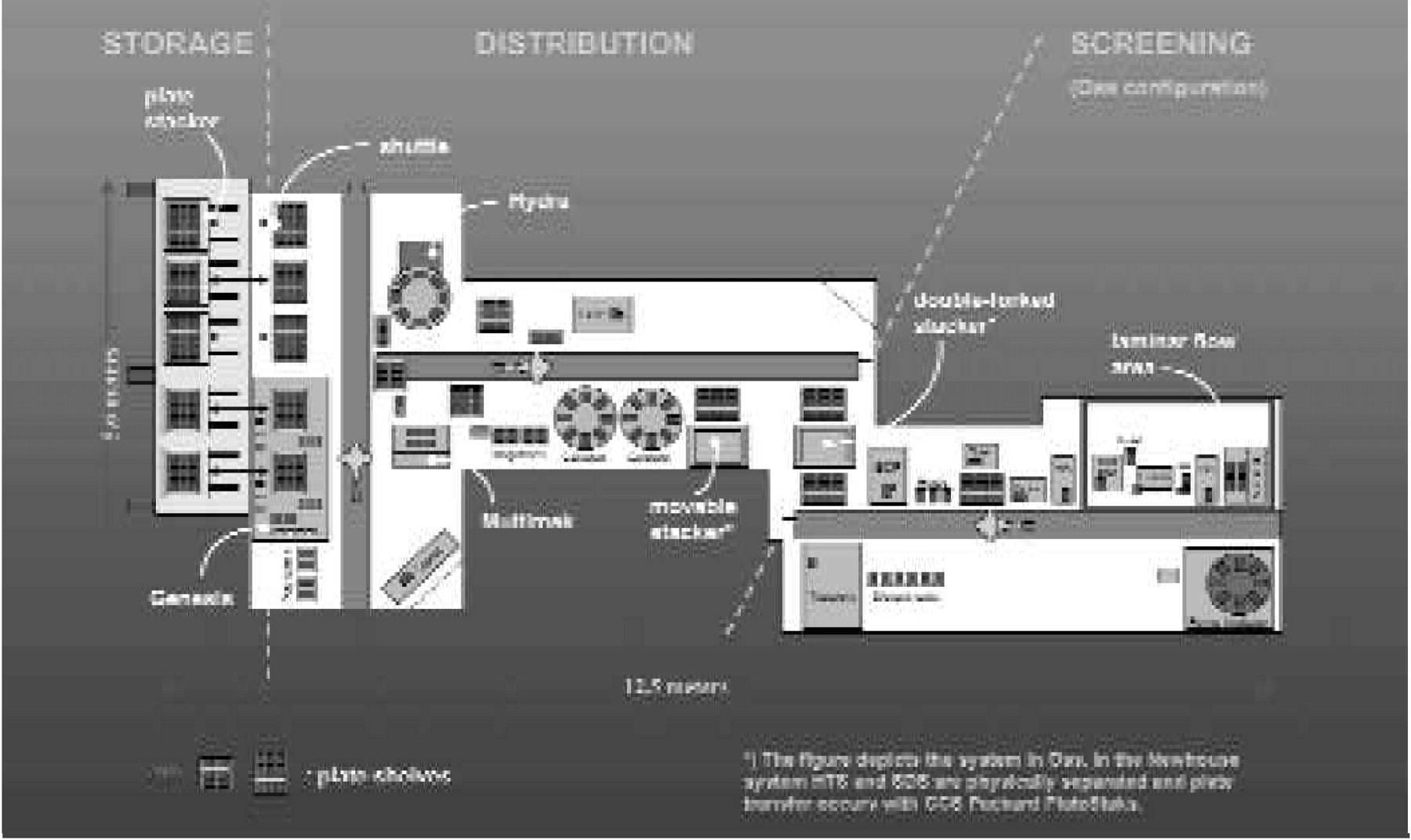
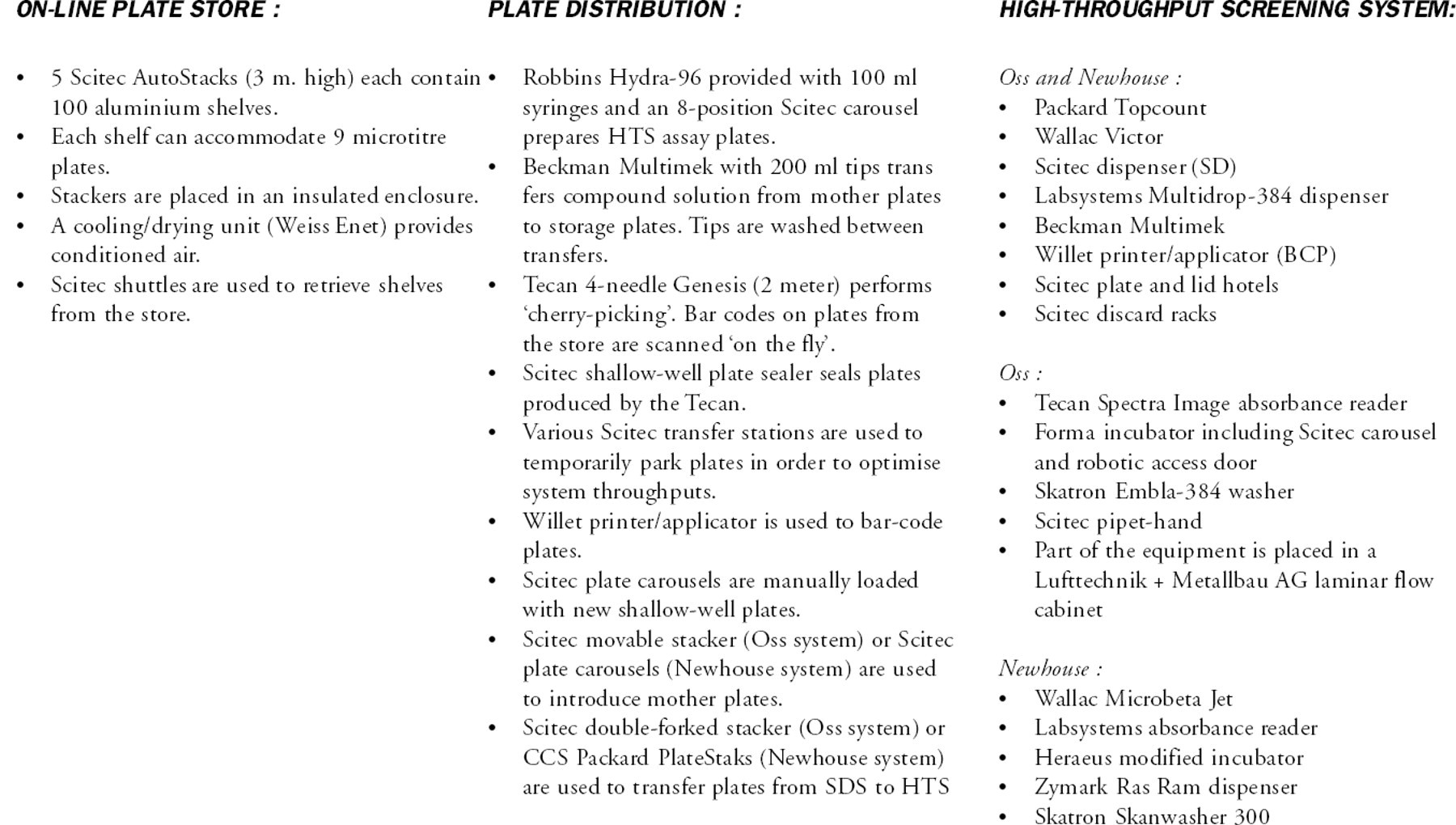
A detailed description of the hardware components of both the SDS and HTS robot systems is given in appendix 1.
ON-LINE PLATE STORE
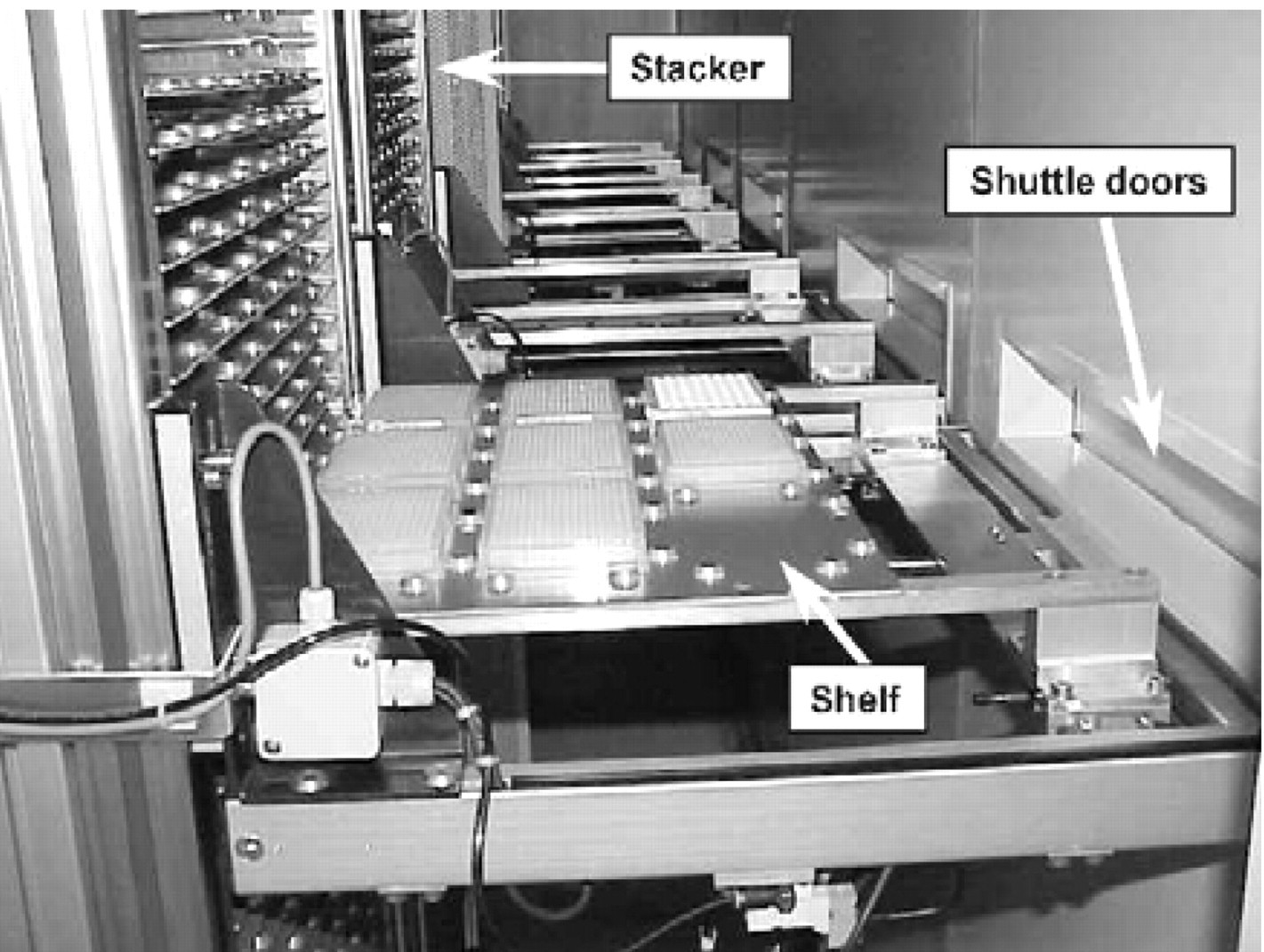
The heart of the storage and distribution system (SDS) is an on-line store that contains copies of our total compound library as DMSO solution in polypropylene 384-well storage plates (optionally in 96–well plates). Plates are stored in one of five Scitec AutoStack systems that are located in an insulated enclosure. The store is divided into two compartments, housing the plates for assay plate preparation and ‘cherry picking’ respectively. The store is kept under controlled temperature (4–10° C) and humidity (10–15%RH).
SDS Procedures
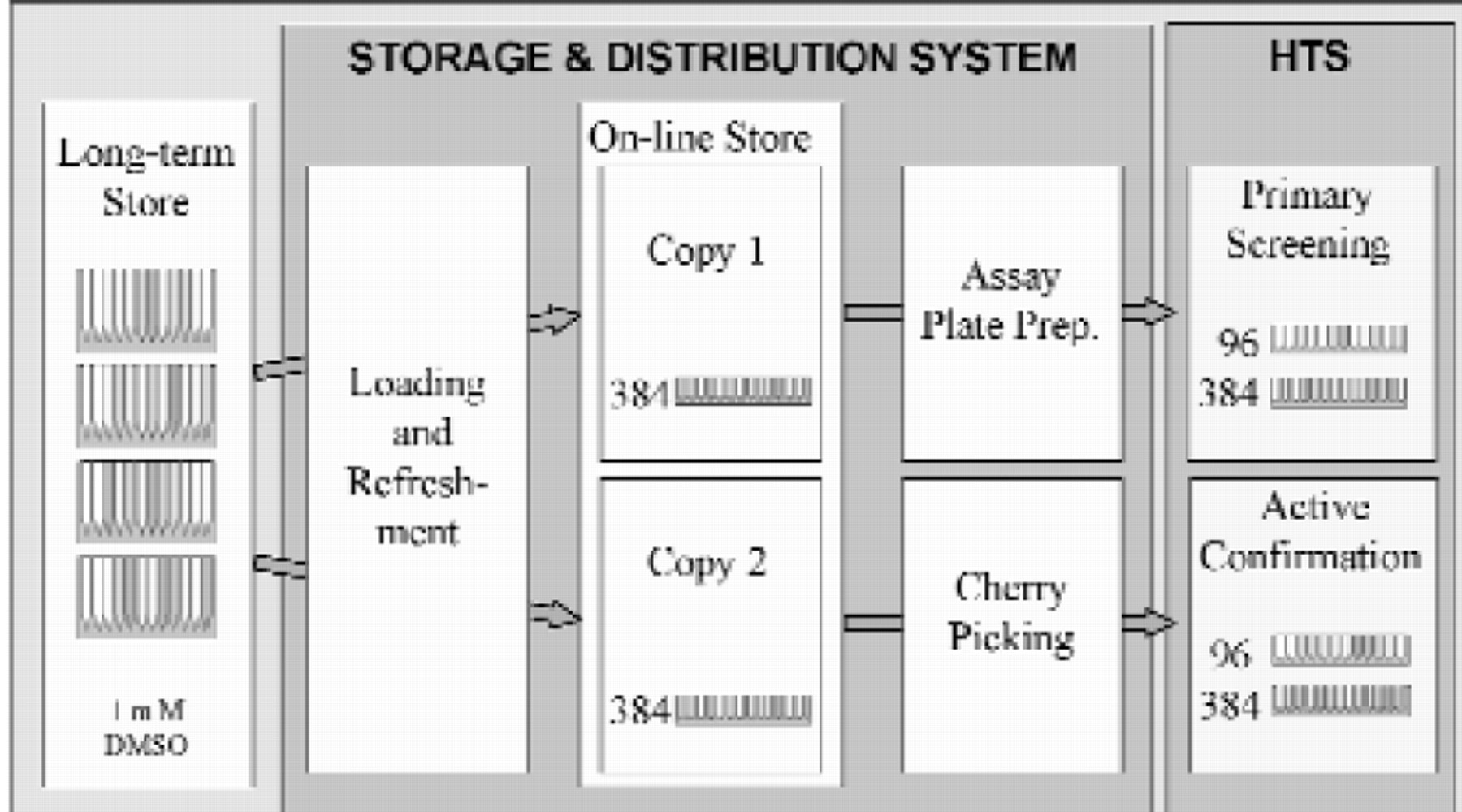
Schematic overview of the SDS workflow
Assay Plate Preparation
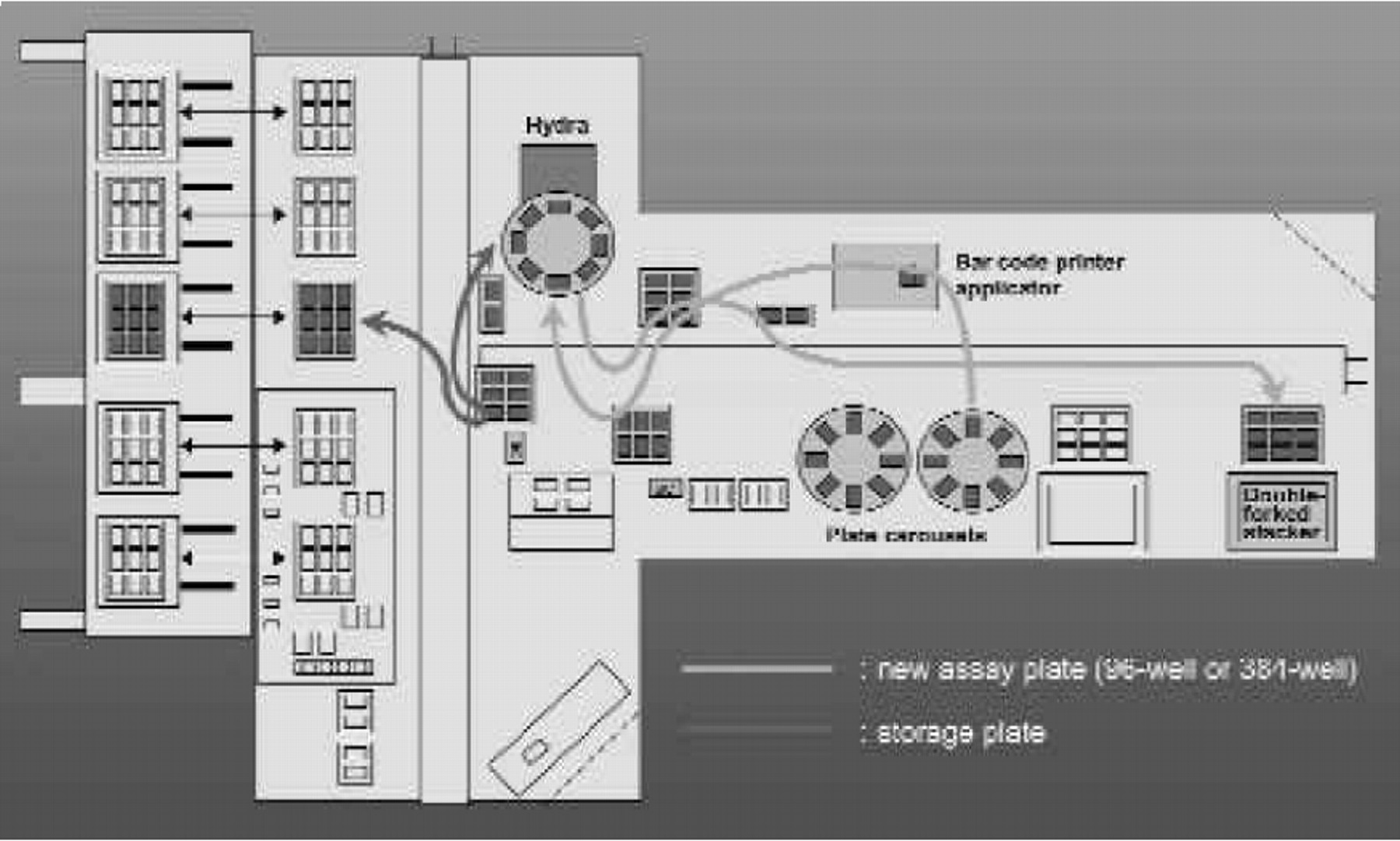
Plate flow for the Assay Plate Preparation Procedure
Retrieval of compound plates from the on-line store occurs by means of shuttles allowing access to the individual plates by the robot. New assay plates are prepared on a Robbins Hydra-96 modified with a Scitec 8-position carousel. The Hydra transfers and dilutes compound solution to prepare assay plates in 96–well or 384-well format.
‘Cherry Picking’
Actives found in primary screening runs are reformatted into new plates for active confirmation. The ‘cherry-picking’ process is performed by a Tecan Genesis which can be directly loaded with plates from the on-line store without robotic interference. Compounds can be reformatted either as single point or five point serial dilution, in 96-well or 384-well plates.
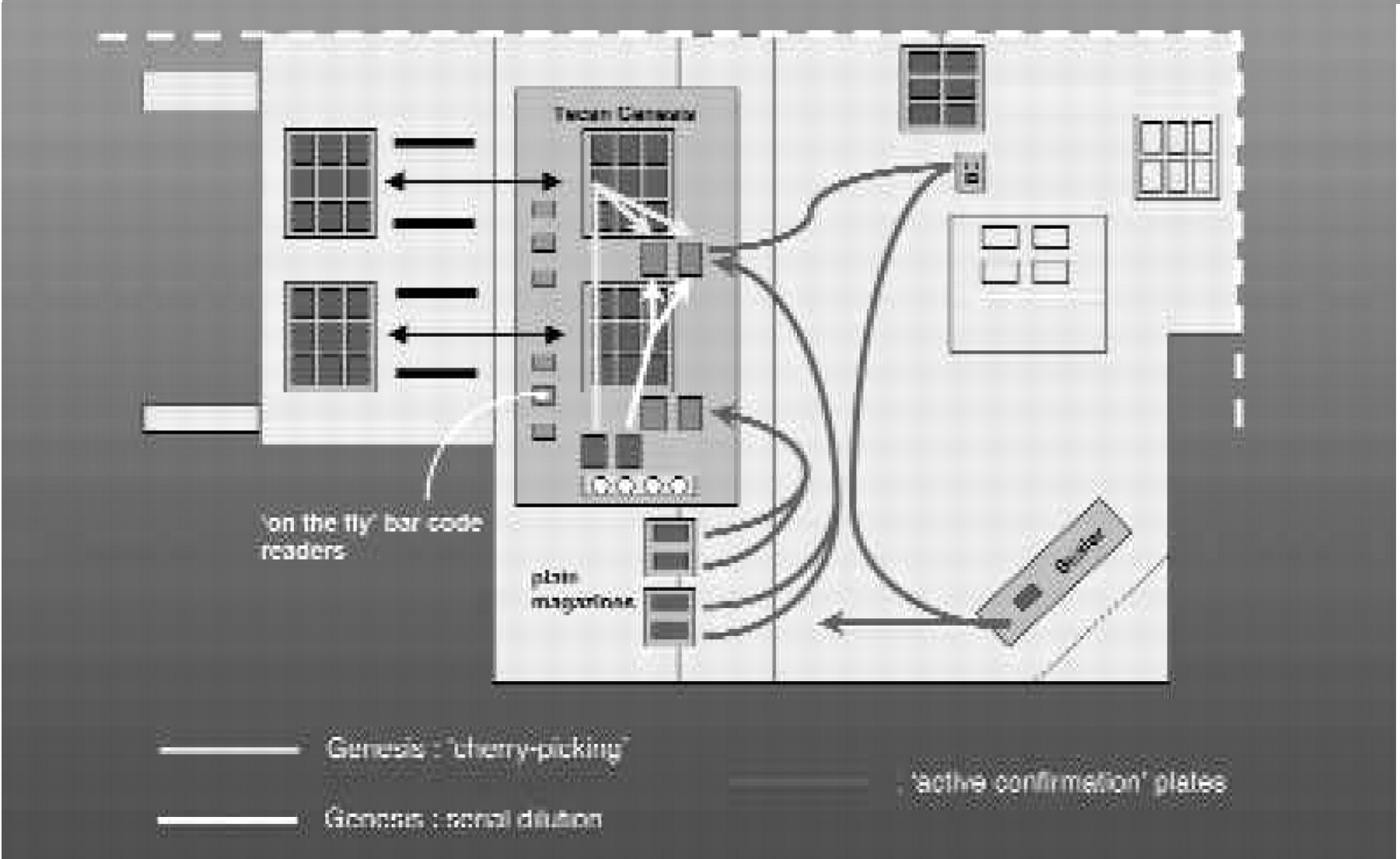
Plate flow for the ‘Cherry Picking’ Procedure
Loading Refreshment
In the refreshment procedure part of the storage plates is replaced by plates that are newly prepared out of deep-well mother plates. A Beckman Multimek is used for the transfer of the compound solutions. Refreshment of the store is performed as a batch-wise weekly process such that the entire store is replaced on a three-month basis. This procedure is also used to load new plate collections that have become available for screening.
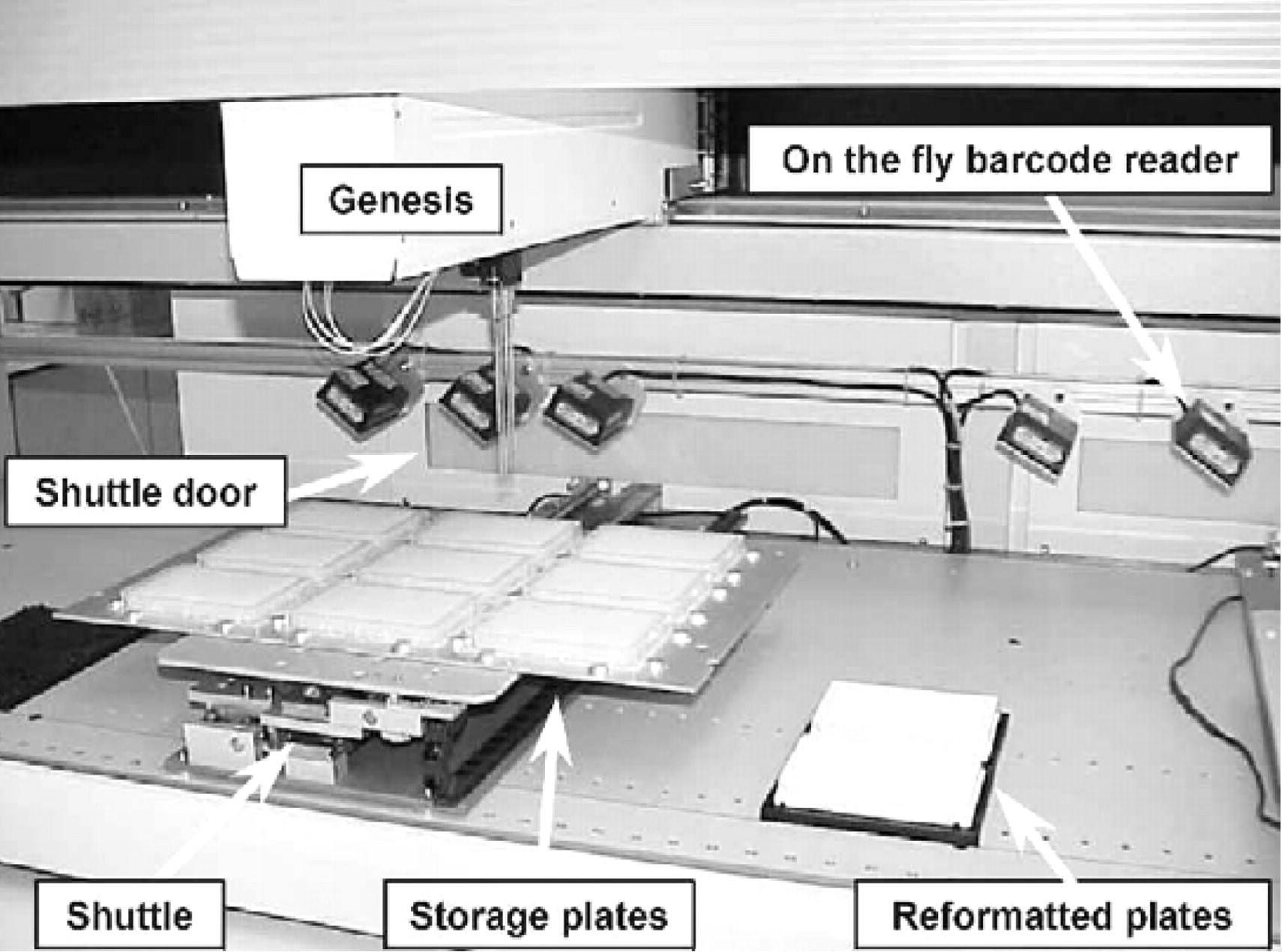
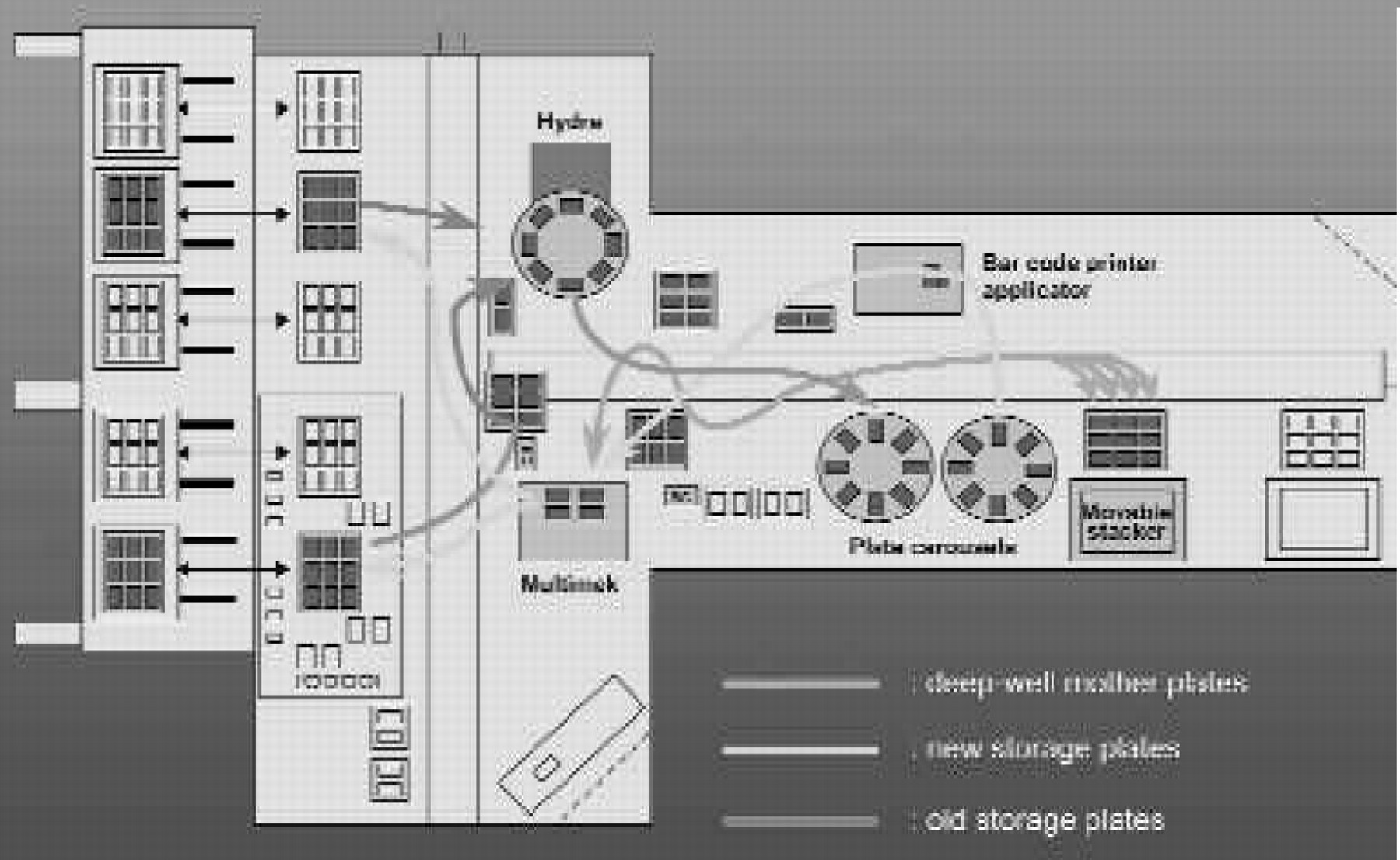
Plate flow for the ‘Refreshment Procedure
IT-ENVIRONMENT
Process control and plate management are organised in the following way:
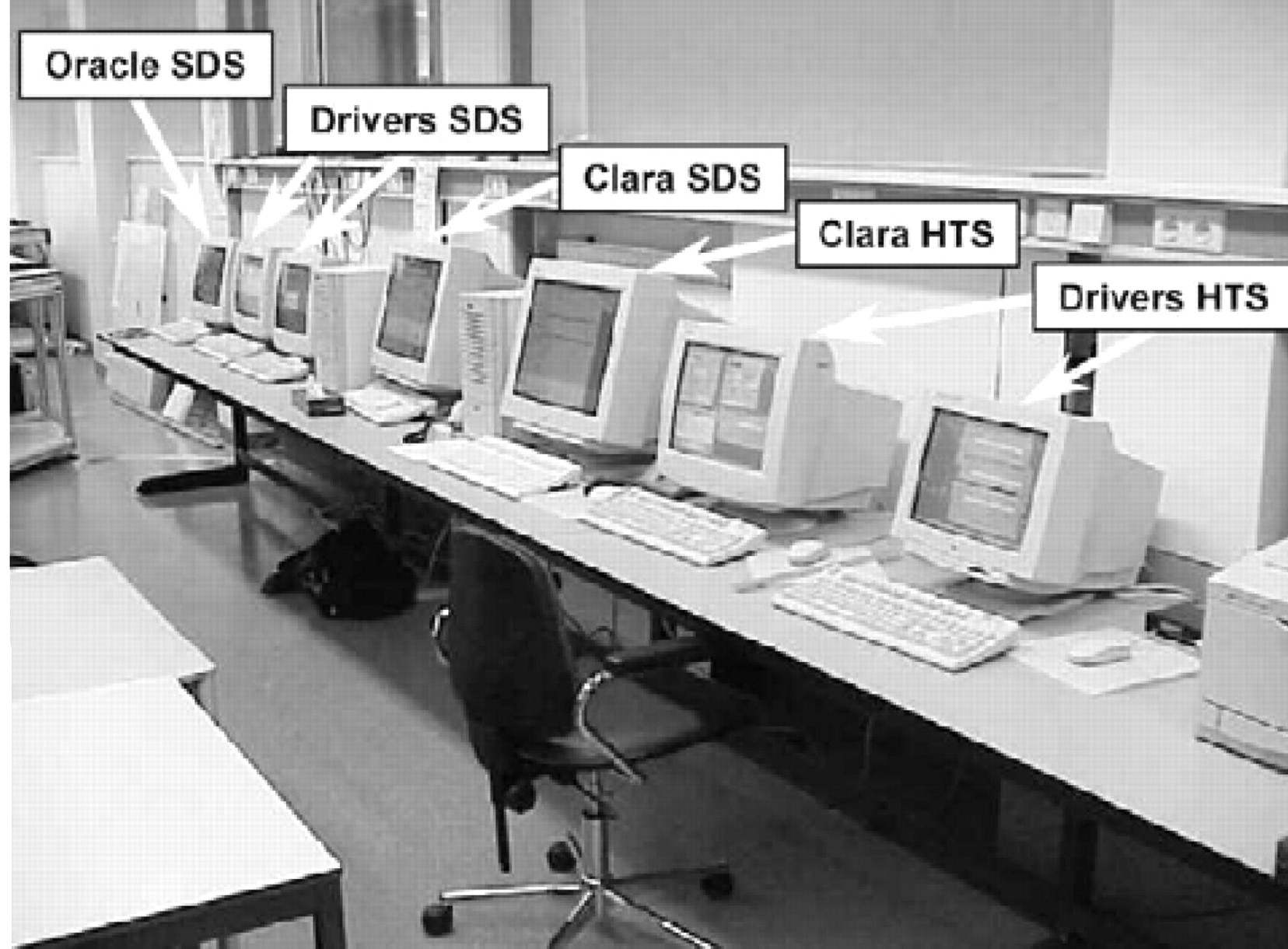
SDS and HTS are independently controlled by separate Scitec Clara scheduling software.
A dedicated Oracle database keeps track of information for the plates in the SDS store. This includes data on plate locations, volumes and creation dates.
Plates elaborated in the systems are identified by meaning ful bar codes, in our case inherited from the parent mother plate(s). This way of working reduces plate management to the minimum but requires the use of bar code printers in the process.
During the SDS procedures only plate and well identifications are used. Compound related information is only retrieved after performance of the assays. The key to this information, stored in a corporate database, is the code of the parent mother plate.
CONCLUSIONS
New fully integrated plate preparation and screening systems were installed in 1999 in the Organon research laboratories in Oss (the Netherlands) and Newhouse (United Kingdom).
With the introduction of these systems an on-line access to the entire screening compound library has been established. The major advantages of the new workflow are:
the quality of the mother plates is ensured now these need to be addressed less frequently
short delays are realised between the production of assay plates, screening and confirmation of the actives
high flexibility is obtained with respect to plate formats, dispensing methods and planning of the process.
ACKNOWLEDGMENT
The authors wish to thank Nicolas Zbinden, Nader Donzel, Jean-Louis Rufener and other Scitec collaborators for their essential contributions to the design, integration and installation of the robotic systems and the corresponding software.
APPENDIX 1: OVERVIEW OF ORGANON PLATE DISTRIBUTION AND SCREENING SYSTEMS