



Abstract

TAP recently moved into a new design and development workshop facility space which allows them to integrate all aspects of product development including initial development, testing, and final stages of production. TAP reduces the development time and cost by integrating pre-existing technologies and only developing new technologies when necessary. Software control systems are produced that provide robust system control and user friendly interfaces. Only fully tested and certified products are delivered to customer laboratories. TAP also provides after sales service and telephone support to all of their customers. TAP has been successful in developing their first systems for lead customers, or a consortium of customers with similar needs. Naturally, once they have developed and sold their lead system, they retain the right to distribute their second generation products more widely.
The notion of developing products for a consortium of competing companies in the same industry is one of the most fascinating aspects of how TAP does business. The prime example of this is the topic of our cover feature, SelecT. Small batch tissue culture has remained one of the most labor intensive and error prone aspects in pharmaceutical discovery. The SelecT system fully automates multiple smaller batch cell culture and improves the speed, accuracy and consistency of manual methods. Designed by TAP and a consortium of 6 of the top 10 pharmaceutical companies, SelecT meets the challenge of producing smaller batches (1 to 50+ vessels) of different cells in parallel, dealing with different culture conditions, batch sizes and processing needs, regularly week after week. This approach is typically used to supply cells and reagents for use in High Throughput Screening.
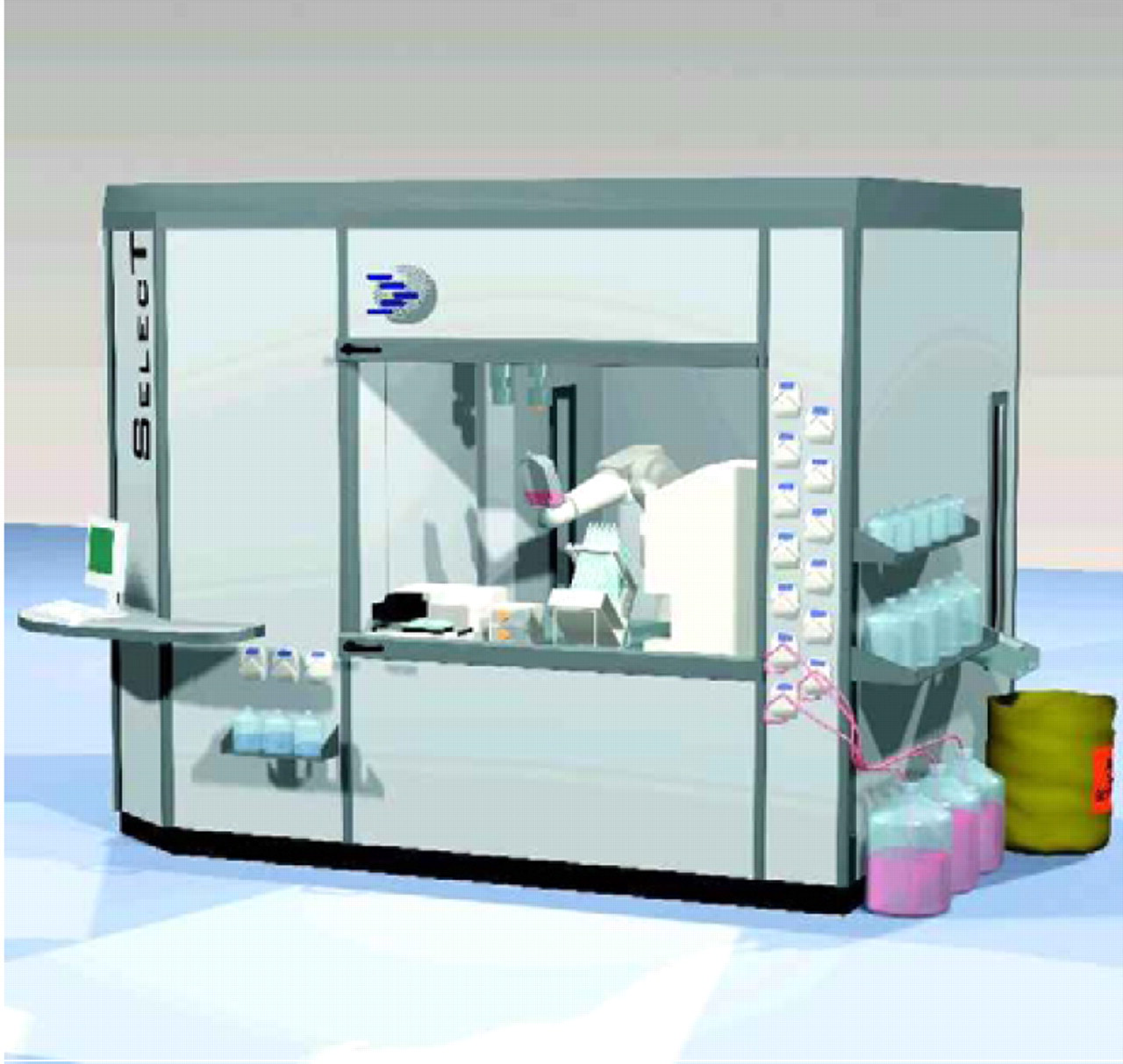
SelecT is capable of the following functions: expansion and maintenance; sub-culturing; cell seeding; harvesting; incubation and plating into microtitre plates. Among the other capabilities that SelecT offers using robust and reliable industrial automation are: parallel culture of multiple cell lines in T-flasks; flexibility in batch size and numbers of cell lines; integrated growth; incubation and processing; bar code tracking of flasks and plates.
TAP completed the SelecT project by bringing together most of the companies who were already using their large scale tissue culture automation, Cellmate™. The Cellmate system fully automates all the processes needed to culture cells in roller bottles and T-flasks, taking cell culture processing from the lab bench to high volume. Using a PC controlled industrial robot arm housed within a Class 100-laminar airflow cabinet, the Cellmate manipulates roller bottles and T-flasks and feeds them into the system on a conveyor belt, where they are processed following user-defined programs. Drug discovery companies using Cellmate had come to find that there were also smaller scale projects which could benefit from the efficiencies of automation. In particular, the inconvenience of manually maintaining cultures late at night and over weekends and holidays provided incentive to seek a small-scale system. Having been in the business of automated cell culture since 1988 (initially as part of The Technology Partnership), TAP had the necessary expertise and historical perspective to devise a new solution to the needs of pharmaceutical companies in the drug discovery process.

Philip Offin, a Cell Biologist with TAP, found from his research and market surveys that the industry was ready for the SelecT technology. The benefits of Cellmate in producing high quantities of limited cell lines was a limitation for certain research oriented laboratories. Therefore, the capability of maintaining a larger number of cell lines became a priority for the Select T project. Although initially targeted to different lines of lead optimization, TAP was surprised to find that it fulfilled ultra-high throughput screening laboratory needs as well. For example, most current cell based screening systems only operate three days a week due to the preceding cycle of cell feeding and growth which is currently oriented around human schedules earlier in the week. Thus, most current systems are only able to run at around 60–70% optimal capacity. Select T improves HTS productivity by providing cells at optimal growth densities and optimal times.
In order to satisfy the largest cross section of customer demand, TAP approached some of its existing customers with the overall idea of a new system. Fortunately, these were companies already well disposed to the philosophy of automating cell culture procedures. By using a consortium approach, TAP was able to being in the functions of specific values to the companies concerned. This required a level of cooperation and problem sharing which is highly unusual in this, or indeed any, industry. TAP began the process by sending out questionnaires and collating the response information. As the initiator of the process, TAP was keenly aware that some functionalities were not necessarily going to be cost effective, so they were obliged to attempt to build the consensus on the key performance features of the new system.
At the first meeting of the consortium, TAP outlined the middle ground of the needs of the companies. Initial requirement differences among the companies were significant in terms of functionality. Sometimes the issue was as fundamental as the size of flask to be used. Many wanted a system that was fully automated. However, TAP had to keep in mind that each function that it automated added to the cost. For this reason it was necessary to obtain agreement between the companies on the price performance ratio. This consultation process continued over a period of five months. Dr. Rosemary Drake, Manager of New Business Development at TAP, explained that among the many lessons learned was the simple need to have meetings scheduled well in advance.
Perhaps the most positive aspect of the experience for the companies involved was learning to share know how. This involved sharing detailed information concerning how cells are handled. For those involved, once they got over the initial skepticism of sharing such information, it was a relief for them to find that in fact they all faced similar obstacles. Equally, by working together on this project they could improve their efficiency and competitiveness. Furthermore, they felt that competitive advantages did not necessarily reside in the tissue culture laboratory. This was the huge benefit of being willing to accept that the advances that would come from the development of SelecT would not necessarily give them a competitive advantage over one another, at least not in the automation phase. For TAP it was a complete change from their normal experience. Traditionally they would have a lead customer for whom they developed a product, and then, if applicable, they would seek other buyers. In the consortium they had to learn to weigh the needs of a variety of companies in a manner which was fair to all. The five companies who formed the consortium were: GlaxoSmithKline, Merck, Pfizer, Bristol Myers Squibb and Astra Zeneca.
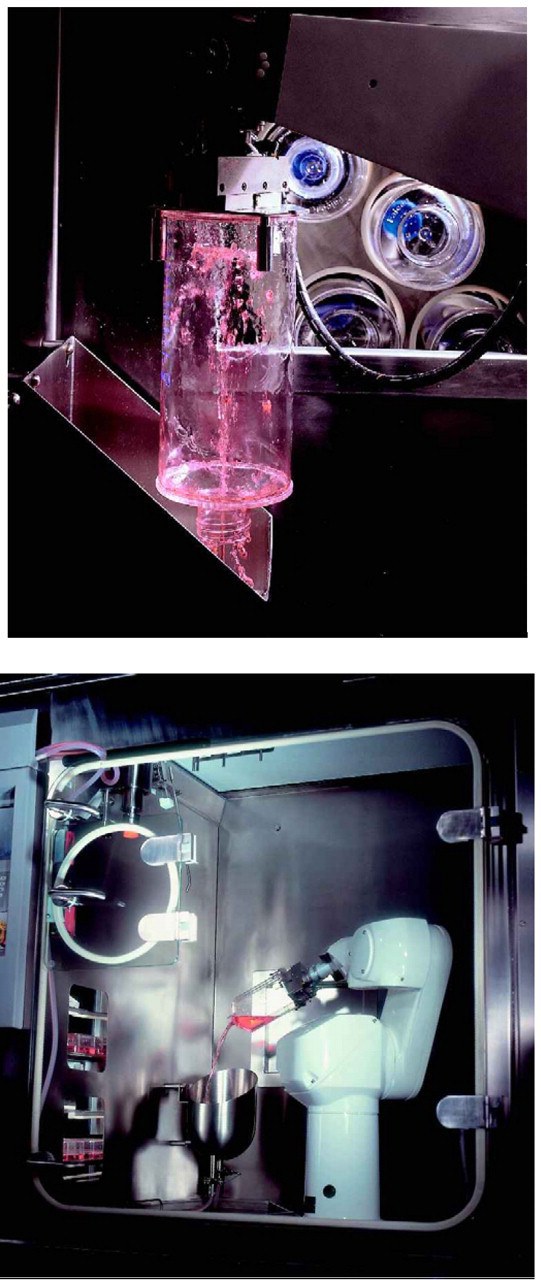
At the heart of SelecT is an automated tissue culture incubator housed within a laminar flow enclosure that is maintained at negative pressure relative to the room. An industrial robot moves flasks through the system and is capable of performing a variety of processing steps, including adding media, decanting waste liquids, pipetting cell suspensions from one flask to another, pooling contents of flasks for harvesting, and dispensing cells into microtiter plates. The robot can access any flask and move it to any defined position in the system. The tissue culture incubator — available in two sizes, to accommodate 75 or 150 T-175 flasks — maintains the cells at the proper temperature for growth and also cell detachment using trypsin.
The six-axis, anthropomorphic robot operates within the clean environment at all times, reducing the chance for contamination. An array of bottles connected via pumps to the system supplies the various media ingredients and other reagents needed to maintain multiple cell lines. Employing a “cocktail bar” approach, the robot draws solution from the supply bottles to prepare specific volumes of the various media “recipes” needed to feed as many as 50 different cell lines, with on-demand mixing of up to 10 components. Non-contact dispensing further reduces the risk of contamination. A carousel within the enclosure stores clean flasks for cell splits and expansion. The robot disposes of solid waste down a trash chute and stores liquid waste in a holding tank.
The SelecT system software is menu-driven and controls all processes, including tracking flask and plate bar codes, logging all operations and process parameters for each flask and batch, and calculating the number of flasks and the approximate amount of media and incubator space required for each operation. The combination of robust engineering specifications, advanced automation technology, and sophisticated process control software used to design the SelecT system has created a flexible, robust solution to multi-batch, medium throughput, cell processing for drug discovery.
As we go to print, five systems have already been ordered. Part of the agreement with consortium members was that they would have the rights to purchase for a period of time prior to TAP being able to place others. That time has now elapsed and TAP expects to make considerably more placements in the months ahead. The first system is due for delivery in January, 2002.
With its roots as a consultancy firm, TAP has evolved over the years into the area of product development. In 1995 they became a subsidiary of The Technology Partnership (TTP). This was needed to ensure clearer market definition. In 1998 they de-merged from TTP. Since becoming independent, TAP has been free to reinvest its profits in future development. Their complete line of products has been updated by using reinvested capital, including the SelecT system. TAP's growth has expanded the staff from 80 employees in 1998 to over 150 at present. Over the next four years they conservatively estimate that this should grow to 250 worldwide. The area where they foresee the greatest growth is software development. To this end they are rapidly expanding their base of software engineers. They also envisage raising more investment capital in order to stay ahead of market trends. Having established the effectiveness of the consortium approach, and learned from this experience, TAP is already engaging in another similar consortium initiative. However, they are keenly aware that others may follow their lead, and are therefore constantly striving to adapt themselves to stay ahead. It is likely that we shall here a great deal more about The Automation Partnership in JALA in the months and years ahead.