



Abstract

INTRODUCTION
Telemedicine has been defined in broad terms as “the delivery of healthcare and sharing of medical knowledge over a distance using telecommunications systems” (1). Most of the early attempts to transmit data were based on land telephone lines, and were limited in the speed and quality of transmission and by the limited techniques available to digitalize analog signals. Later, in the 1960s, remote interviews and consultations with television were tried, but the issues of image quality and speed of transmission were similarly poor. In the 1970s, physiological monitoring of astronauts led to sensor miniaturization and digital processing, but it was only in the 1990's that technological progress and widespread use of digital telecommunication triggered the explosive growth in telemedicine that we see today (

The growth in telemedicine applications and use
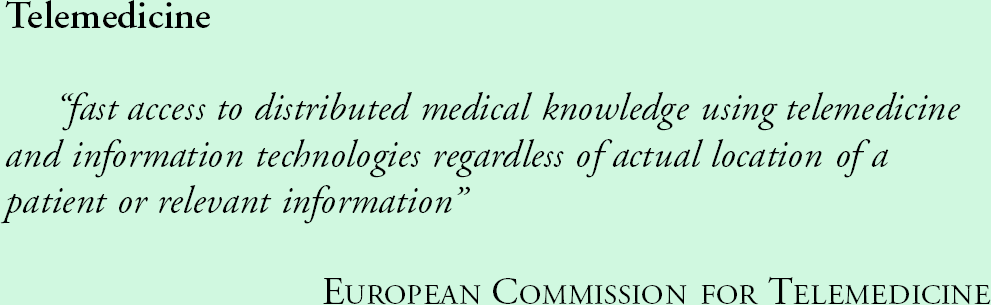
This growth in telecommunications is worldwide. Telemedicine projects are supported by many national governments and by the European Union. The European Union definition of telemedicine (Figure 2), adds three new concepts to the old definition — fast access, essentially aimed at real-time interactions; specific telemedicine technologies, and separation at a distance from the health professional or telemedicine system operator of both patient and the relevant information. These separations can be at national, multi-state, or even international levels. The emphasis on real-time interaction is important. The definition of a “consultation” may require real time exchange between patient and health professional for reimbursement (as in the USA), and this imposes a number of technical challenges that are greater than for an approach with storage and transmission of data for subsequent interpretation. The international or multi-state sources of information must all use a similar structure for coding and classification of diagnostic categories and treatment information, so as to facilitate the processing.
The specific technologies driving the use of telemedicine include high speed digital modems and digital telephony — able to transmit 128 kbit/second, and the increasing use of fiber-optic cables for local and wide-area networks. These can handle enormous numbers of simultaneous connections, yet cost less to use than dedicated telephone lines (such as the Transpac system that were popular in the 1980s). Image sharing is facilitated by high density television and television formats that are compatible between Japan, Europe, and the USA. Several telemedicine applications use the world-wide web. In remote areas that have no telephone lines, radio-satellite communication can be achieved with easily transported equipment, widely used by journalists today.
Much of telemedicine is based on the analysis of images — CT Scans, X-rays, etc., and these involve large data files with fine image resolution for display at 2000×2000 pixels that require large amounts of computer memory to store. Data compression algorithms can reduce this, but there are many questions still to be answered on the loss of fine resolution that can lead to misinterpretation of the image when it is decompressed, or in pathology images if the number of colors is limited to 256 from 16 million. Answers to some of these questions are found in non-medical multimedia applications, and there are a number of reports of pathology images being stored in PC compatible formats such as JPEG. This allows the use of the world-wide web — advantageous because of familiarity and ease of access — but still with some limitations on the speed of transmission of large files and in the size and resolution of video images transmitted in real-time. Nevertheless, regular multimedia internet mail can be used for the sharing of images and dictated commentaries between pathologists (2). Another potential obstacle to use of the world-wide web concerns the confidentiality of the data that is transmitted, with the concern for protecting medical secrets and preventing unauthorized modifications. This too is evolving, with data encryption and security software whose development is driven by non-medical applications, e.g., in business and banking.
The demand for telemedicine applications
Technology is not the only driving force. In fact telemedicine has major potential demand in developing countries. Local helpers can be guided through a diagnostic or therapeutic problem by a trained person at a home base or district hospital. In developed countries, telemedicine is one approach to harmonizing the access to care between rural and urban areas, and can improve quality of care by standardizing the medical decisions in patient management among the users of the system.
The reasons why telemedicine has become such an issue for national and European governments are probably related to the macroeconomics: There are tax revenue and employment benefits from the commercial activities in development and supply of the equipment. There are potential savings in healthcare expenditure, both direct and indirect, from not having to transport patients to specialist services, and by not having to provide (and pay), underutilized specialist manpower in communities with low caseloads.
In the US, The Federal Telemedicine Gateway (3), offers a list of Federal telemedicine projects, jointly funded by the Department of Defense, the Rural Utilities Service, the National Telecommunications and Information Administration, the Agency for Healthcare Policy and Research, the FDA, the Office of International and Refugee Help, the Indian Health Service, and others. The range of sponsors reflects the diversity of ways in which telemedicine can be used. Several projects are centered on the remote interpretation of radiological and nuclear medicine images. Many of the devices use direct digitalization from phosphors and not from subsequently scanned film, so that transmission of data is rapid. TV cameras and microscopes with TV cameras can transmit images captured from skin, the cornea, the retina, fiberoptic endoscopes, and so on. Telemedicine applications are found in radiology, nuclear medicine, dermatology, psychiatry, emergency medicine, home healthcare, cardiology, pulmonary function, obstetric ultrasound, ophthalmology, oncology, and endoscopy.
Applications of telemedicine in the clinical laboratory
These include histopathology, static image transmission, remote microscope operation, intraoperative frozen section interpretation, routine histopathology, immunohistopathology, PAP smears, and in microbiology — Gram stain, wet mounts. These have similar characteristics to the clinical applications (
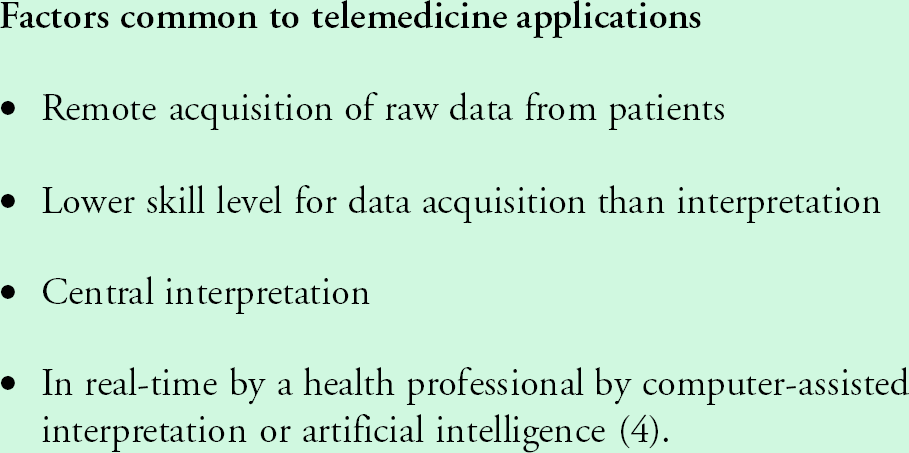
Telepathology has been in development, especially in Europe since the 1980s, initially with an emphasis on diagnostic coding and standardization of the signal processing. The two principle approaches are: 1) the transmission of a selection of static images at random from a slide, and: 2) having a robotic workstation where the reviewer at a distance manipulates the slides under the stage. There are several examples of telepathology systems which have been evaluated for diagnostic efficiency versus glass slide review. These include the Resintel network in Dijon, the commercial Roche RIAS, the TELE.INFO.MED.LAB project in Greece, to mention only a few. The Lab Eye Innovativ system is used in Sweden for remote pathology conferences, and there is a 10 year experience of remote interpretation of frozen section slides in real time (3–45 minutes), for breast and thyroid surgery. Both Norway and Sweden have developed telepathology services, particularly appropriate to the geographic distribution of the population in those countries. Many other examples can be found in the literature of locally developed telepathology devices and their application to routine work, including cervical cytology, which has some special requirements for clear, relatively high magnification images. Microbiological microscopy can also be performed with remote interpretation of gram stains and simple preparations for flagellates which can be done by a nurse or technician. In principle, the same could be done for blood films, and indeed, when automated differential counting was performed by pattern recognition systems in the 1980s, there were several specialized laboratories offering centralized slide review. Some attempts have been made for transmission of microscope images of thick films for malaria. Although cells isolated and prepared by flow cytometry can also be subjected to remote review, the experience with this is mostly for research applications.
There is some use for humans of telehematology systems, but the most highly developed applications in the USA are for veterinarians. Telemedicine applications in biochemistry are not common. The most developed approaches involve remote interrogation of QC and calibration parameters on blood gas instruments. It is possible to link the instruments to artificial intelligence systems such as VALAB (Erems, France), (5), in order to get a clinical plausibility of the result, and there is some experience of this in France for release of the results of tests performed at night in the absence of a qualified pathologist. A special case, more common in the UK, is the transmission of serum hCG and estriol results, together with patient information, for the determination of trisomy 21 risk in pregnant women by algorithms which are not in the public domain. Both of these applications demonstrate the feasibility of transmission of data, either test requests or results, in order to have an optimized pattern of investigation or interpretation of these results.
Telemedicine and professional practice
The use of telemedicine in biology is expanding, but there are still problems to be overcome. These problems have been identified by a task force on diagnostic cytology (6), but the findings apply to all telebiological tests. The Task Force felt that economic factors will impose the use of commercial equipment and software. As professionals, we have to define how we will use these to better serve and protect our patients by being involved in the development of procedures and checks that ensure the accurate transmission and interpretation of the results and information. We have to develop the technical standards for this ourselves, in collaboration with manufacturers and national authorities. We need to be able to validate and maintain the systems for teletransmission and interpretation. When this interpretation is made at a distance, by someone who is not a charge of the patient, or by a diagnostic algorithm, we need to have clear definitions of responsibility and of professional liability. With the political will to enter the era of telebiology, it is sure that we will find the political will to find solutions to these new challenges in our professional practice.