



Abstract

INTRODUCTION
Technological advances have affected all aspects of modern day life and continue to offer exceptional benefits that were once considered unrealistic. Clinical chemistry is the latest sphere of this technological revolution with the introduction of an automated Biochip Array System. Fully-automated, this system is currently at the final stage of trials and is due for launch in the year 2000. Simultaneous multianalyte testing will enable patient profiling and help clinicians build more accurate diagnostic knowledge which will in the long term, be conducive to a better healthcare system for all.
What are biochips?
Biochips, or microchips, are small, wafer-like components manufactured from substrates such as silicon, fused quartz, soda glass and plastic. Substrates are selected on the basis of chemical structure and physical attributes, such as conductivity, pliability and surface topography. Techniques have been developed for microchip manipulation, including techniques to produce physical structures (chambers and channels). For example microfabricators have used photolithographic or reactive ion-etching methods, embossing, microinjection moulding, micromilling, and x-ray or e-beam etching and scanning tunnelling microscope. Techniques to produce microarrays of test areas have also been described including physical deposition or synthetic techniques, such as ink-jet printing and light directed combinatorial chemistry.
Microarray techniques are used for the production of biosensors to enable simultaneous multianalyte analysis of specific markers. A biosensor is an analytical device that uses a biodetector (enzymes, antibodies, nucleic acids, micro-organisms or tissues) to perceive a target analyte directly, without the need for complex specimen processing. Attachment of the target analyte to the biosensor creates a biochemical reaction, which is converted to an electrical signal by a transducer, quantified and displayed on a conventional screen. Biosensors may be classified according to their target molecules.
New Technology meets clinical needs!
Biochip applications cross all scientific disciplines and have been developed with the specific user needs in mind. Clinical laboratories set strict criteria for the acceptance of new analytical systems.
Clinical Requirements for New Analytical Systems.
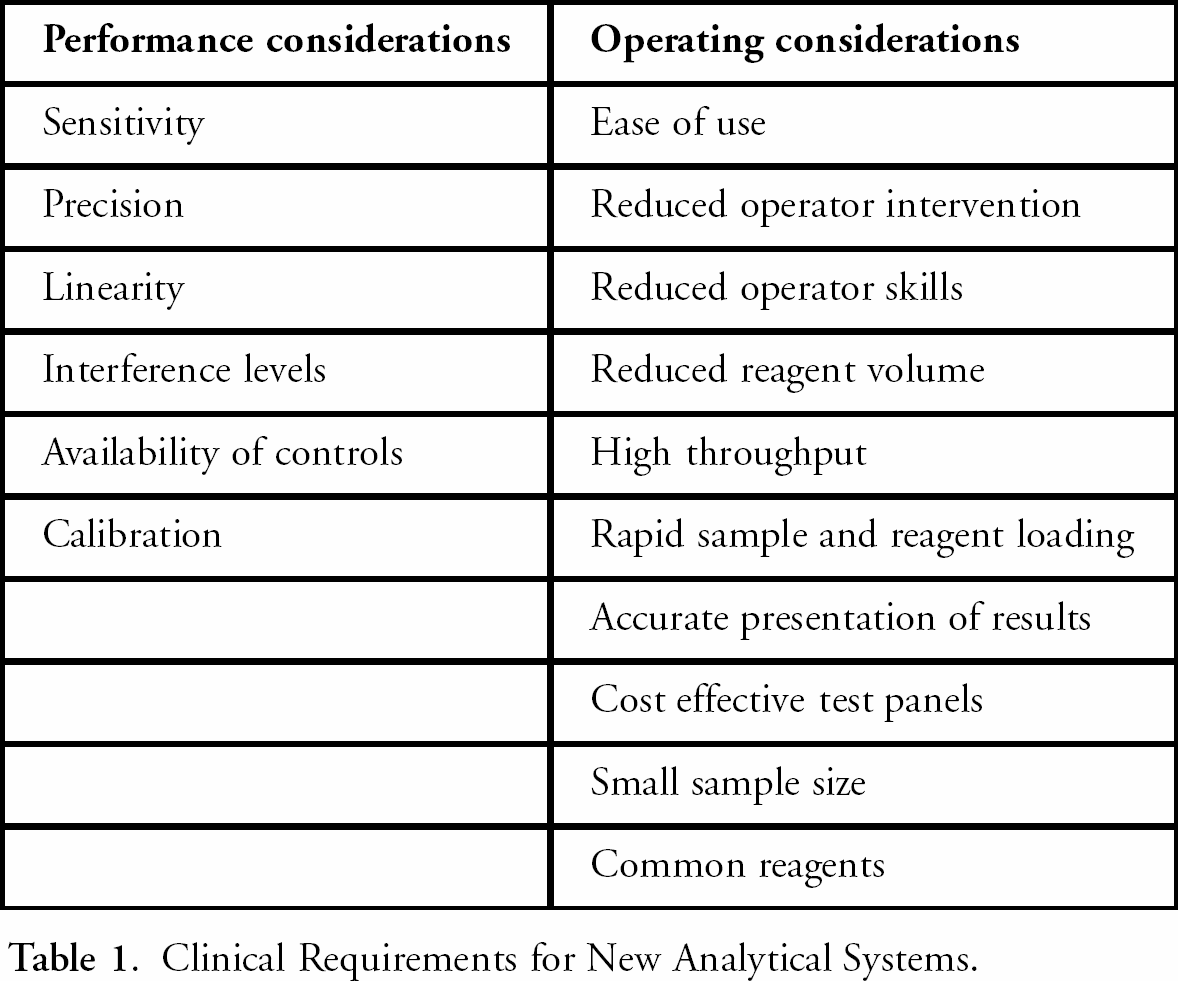
Technological innovations have embraced clinical criteria for analytical systems with the introduction of the recent complete laboratory automation systems. These systems perform most routine preparations and operations but most are based on wet chemistry techniques. Some instrument manufacturers have introduced extendable systems with independent units that simply ‘add on’ to the existing instrument. This approach offers significant user benefits but may require substantial laboratory space. Biochip array technology is set to supersede all existing instrumentation and change the current ideals of a perfect system.
Adapting microchips for clinical applications
Specific and simultaneous profiling of biological markers is probably the biggest advantage of this technology for clinical applications. Current clinical tests rely on the sensitive detection of small changes of analyte levels for accurate diagnosis and treatment. Manipulation of the biochip surface is required to reduce complex biochemical interference and enable ligand attachment at specific and discrete test sites.
The biochip is the single, most important component as it houses chemical recognition sites for selective and sensitive analysis of multiple parameters simultaneously. Development of this integral component has involved exhaustive chemical and physical analysis to ensure optimal selection, activation and stabilisation of the biochip. Microarrays are the platform of choice for the new clinical system due for launch in the year 2000. Stages of biochip development are discussed below.

Overview of Biochip Technology
Selection of biochip substrate
Substrate selection for the biochip is probably the most important decision of the system. Commercially, many substrates are used for microchip manufacture including silicon, fused quartz, soda glass, and plastic (polymethylacrylate, polypropylene). However substrates used for biochip manufacture must meet strict criteria to minimise non-specific biological interactions. Substrates selected for biochip manufacture must be relatively inert, possess a surface consistency ideal for ligand attachment, and be amenable for electronic circuit design.
Analytical physical and chemical techniques have been employed to assess and select optimal activation and stabilisation techniques for the biochip substrate. Surface activation is required to enable attachment of a biological ligand that can be displayed in a functional manner. Techniques employed include chemical derivatisation and synthesis, such as Chemical Vapour Deposition and Wet Chemistry Modification.
Biological Ligand Attachment
After substrate activation, immobilisation of a biological ligand requires very accurate and specific placement at discrete test sites on the biochip surface. The number of test sites per biochip depends on the panel of tests. A variety of biological ligands can be utilised for attachment, however antibodies are generally the ligand of interest. Antibody attachment requires antibody orientation that holds the Fc regions open for capture of the analyte of interest.

Antibody Orientation
After attachment, the biological ligand is stabilised on the biochip surface to ensure extended storage capabilities. At this stage a biologically functional biochip is prepared and ready for use.

Structure of biochip with functional ligands attached.
Analyte attachment to ligands bound to the biochip result in the generation of a chemiluminescent signal after reagent addition that can be easily detected and quantified. Signal uniformity across the surface of the biochip is monitored at each stage to ensure process optimisation and ligand attachment at discrete test sites.

demonstrates the signal output across the surface of the biochip, with peaks of signal evident only at discrete test sites. The figure also demonstrates the reproducibility of the signal at discrete test sites.
Development of a detection system
Selection of a detection system had rigorous criteria for acceptance, that included versatility, rapidity and accuracy coupled with the ability to cope with multiparameter analysis. A unique imaging system has been developed which enables accurate and rapid quantification of signal at discrete test sites.

5 × 5 Spot Array
System Automation
Biochip applications for clinical chemistry laboratories are only worth considering if the analytical method can be fully automated, offering high throughout and excellent assay performance. Integrated system requirements for extensive sample throughput, minimal operator intervention and exceptional performance have been presented in the unique Biochip Array System that enables patient profiling in minutes. Expertise from scientific and engineering disciplines have been brought together to enable complete process automation from test panel selection through to the production of calibration curves for analyte panels. Simply load primary sample tubes and the instrument does the rest. Unique features of the automated system offer the operator significant advantages that surpass existing instruments. For example bar-coded primary sample tubes select biochip test panels to match the clinician's request and uniquely identify the patient. Following test selection patient samples are added directly to each biochip within the carrier which is then transported to the reagent dispense station. After reagent addition, carriers are transported to a micro-temperature controlled incubation tower that affords great versatility and high sample throughput. A multi-wash automation station enables extensive washing and aspiration under vacuum to remove unreacted material. The process is repeated to ensure each biochip is free from non-specifically bound interfering material. Biochips are then measured in the rapid imaging station. The imaging station has a capacity for up to nine biochips. The chemiluminescent light signal is captured through an imaging camera and digital recordings are converted into meaningful units of measurement. Calibration curves, controls and multianalyte signals are recorded and stored as original images for future reference. After imaging the carrier is ejected into a sealed biohazard disposal unit.

Quantification of Image Signal
BIOCHIP APPLICATIONS
Biochip technology can be adapted and utilised for almost any laboratory application and covers all scientific disciplines including immunology, clinical chemistry and even DNA profiling.
Early biochip test panels at the final trial stage include those for fertility markers, drugs of abuse and antibiotic residues. Biochip results have shown excellent agreement with existing analytical methods and standard curves have been generated for selected test panels.
The new biochip array system will be launched with a drugs of abuse test panel which detects a range of analytes on a single chip. Drug classes detected on the biochip are listed in Table 2.
Drug Classes Measured by the New BIOCHIP ARRAY SYSTEM

Comparative studies have shown that biochip technology can dramatically reduce analysis time for a drugs of abuse panel. Savings on operator time and overall cost with such an improvement in throughput are tremendous and enable the laboratory throughput to increase substantially. Reductions in sample and reagent volumes per test are additional features offering exceptional benefits of the new biochip array system coupled with the ability to perform clinical tests in simultaneously.
A variety of test panels are in early development for biochip application that include, tumour markers, specific proteins, infectious diseases, autoimmune markers, and allergy tests. A dedicated team of molecular biologists has developed DNA technology for biochip applications.
In conclusion
At present, ‘evidence based diagnostics’ appears to be the buzzword in the medical community, promoting the practice of more widespread diagnostic testing, more often and earlier in the clinical assessment process. Many studies have revealed substantial cost savings for a number of clinical conditions when an ‘evidence based’ approach has been adopted. Testing patient samples for a panel of disease markers simultaneously leads to more accurate diagnosis and treatment. Current restrictions on healthcare costs has limited the use of test panels and opted for a policy of fewer selective and specific tests.
‘EVIDENCE’ — the new automated biochip array system from Randox is set to reverse the current trend of test number reductions and offer clinical laboratories a rapid and cost effective alternative to existing instrumentation.