



Abstract
Every year the European Society of Feline Medicine (ESFM), with the support of Hill's Pet Nutrition, organises a feline day during the European College of Veterinary Internal Medicine (ECVIM) Congress to update on feline issues and to present the annual ESFM/Hill's award for outstanding contributions to feline medicine. With its usual high standard of lectures, the ESFM day in Ghent covered may topical subjects including infectious diseases, nutrition, dermatology, liver disease and critical care.
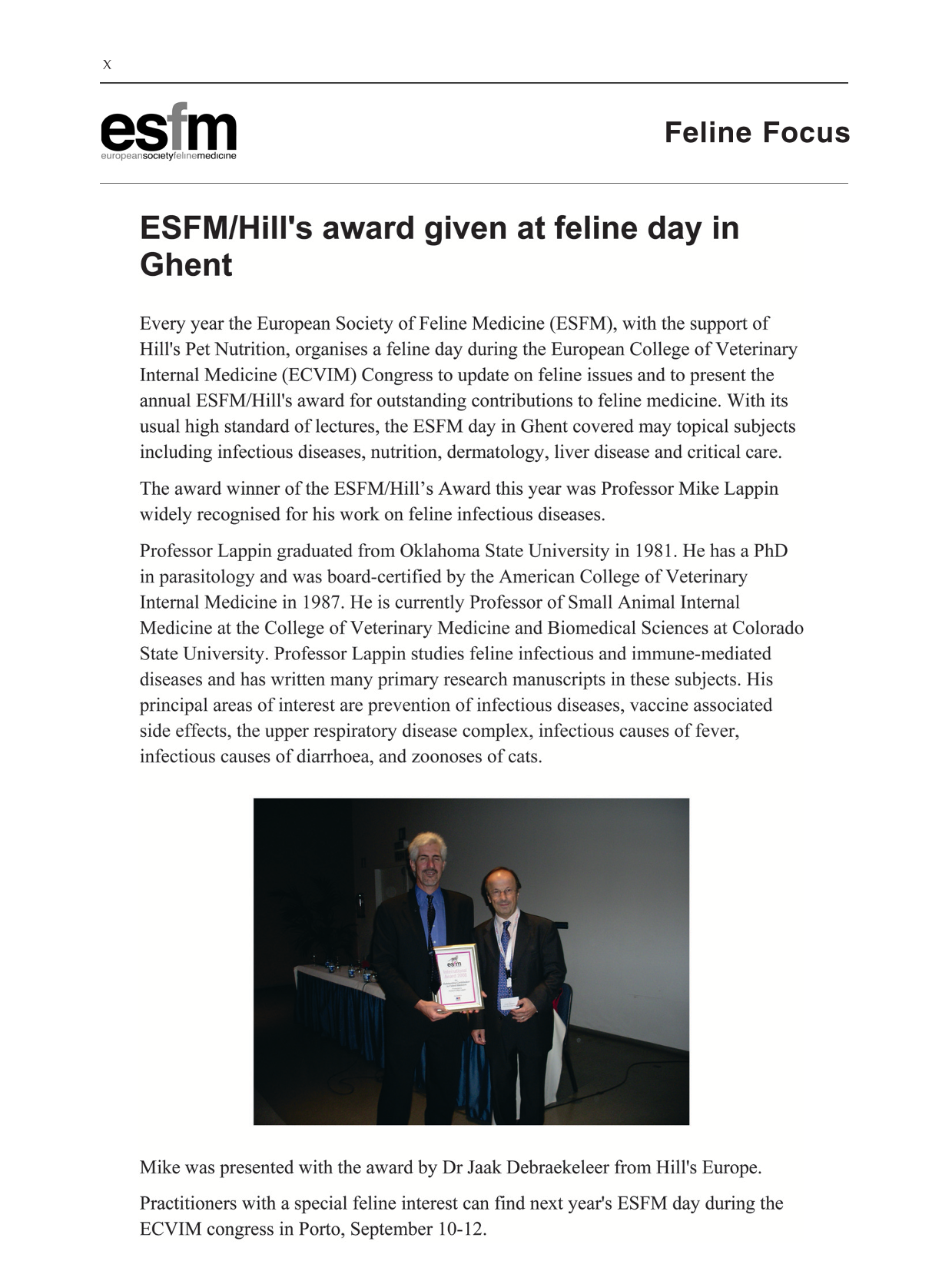
The award winner of the ESFM/Hill's Award this year was Professor Mike Lappin widely recognised for his work on feline infectious diseases.
Professor Lappin graduated from Oklahoma State University in 1981. He has a PhD in parasitology and was board-certified by the American College of Veterinary Internal Medicine in 1987. He is currently Professor of Small Animal Internal Medicine at the College of Veterinary Medicine and Biomedical Sciences at Colorado State University. Professor Lappin studies feline infectious and immune-mediated diseases and has written many primary research manuscripts in these subjects. His principal areas of interest are prevention of infectious diseases, vaccine associated side effects, the upper respiratory disease complex, infectious causes of fever, infectious causes of diarrhoea, and zoonoses of cats.

Mike was presented with the award by Dr Jaak Debraekeleer from Hill's Europe.
Practitioners with a special feline interest can find next year's ESFM day during the ECVIM congress in Porto, September 10-12.
The first ABCD and Merial Young Scientist Award 2008 was presented to Dr Hannah Dewerchin, from the State University of Ghent (Belgium), on 25 September in Edinburgh, at the ESFM Congress.
Dr Dewerchin (29) received the award for her work on Feline infectious peritonitis (FIP), and in particular its interaction between the infecting coronavirus and the host cell, and its ability to evade the humoral immune response. ‘The immune mechanisms involved might explain why a cat cannot overcome the infection and why vaccination attempts usually fair,’ she said. Her research contributes important insights for a better understanding of FIP pathogenesis.
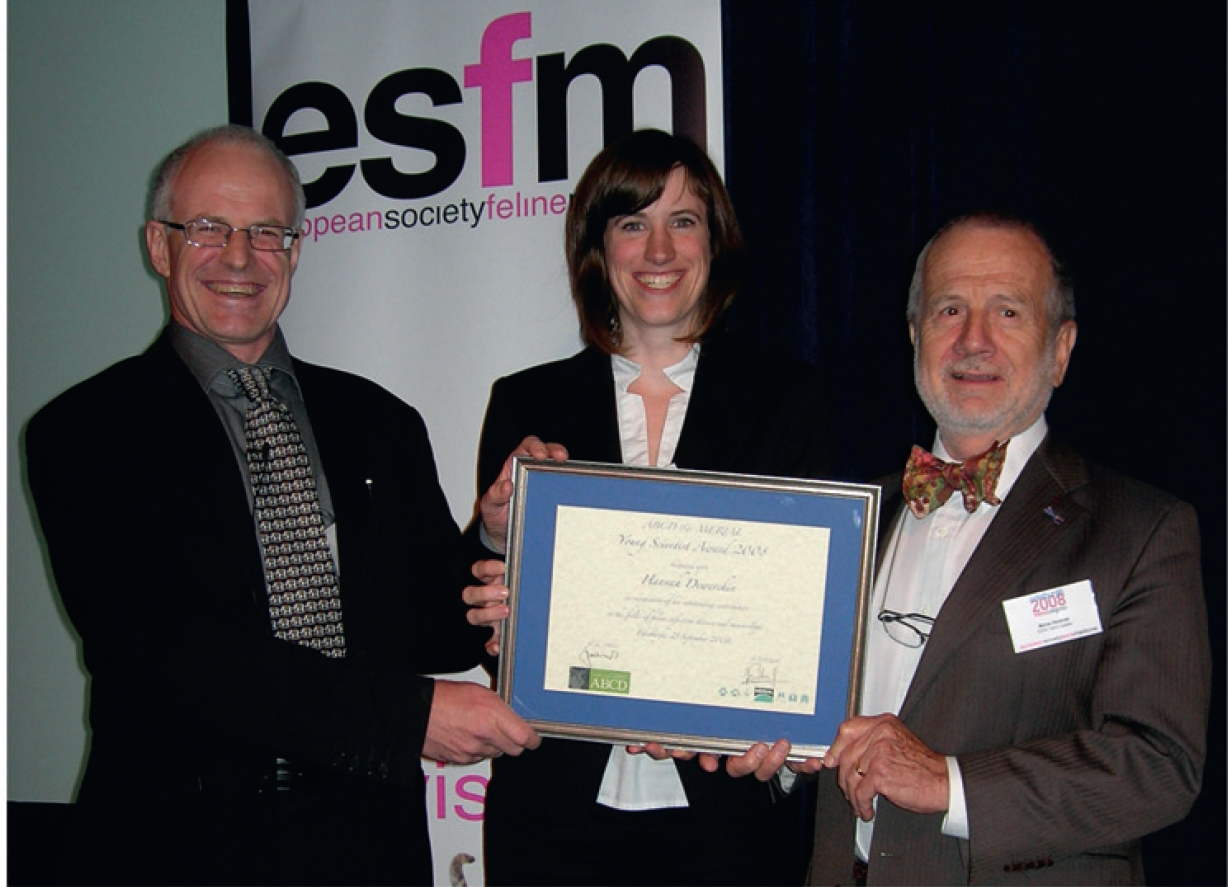
The award was presented by Professor Marian C. Horzinek, Chair of the Advisory Board on Cat Diseases (ABCD) and of the award jury, who congratulated the laureate. ‘The standard of the applications we received was very high, but the entire jury agreed on the quality of the work of Dr Dewerchin. She is a very promising young scientist’
Dr Jean-Christophe Thibault, Merial's Technical director for biologicals added,‘True to Merial's mission statement of being an innovation-driven leader in animal health, we are very proud to have made this European award possible. Initiatives such as these, in association with renowned scientific bodies like the ABCD, highlight promising young researchers and the teams to which they belong.’
The ABCD and Merial Young Scientist Award, created in 2008 and worth 1000 ε, is funded by Merial and is presented to a young scientist in veterinary or biomedical science, who has made an original contribution in the field of feline infectious diseases and/or immunology. Applicants should have published their findings in a journal listed in PubMed or Web of Science or had them accepted by another recognised assessing body.
Candidates should be based in Europe (EU or EFTA country), have completed a veterinary or biomedical curriculum, but should not yet have achieved a PhD or Diplomate status at the time of application. Applications for the 2009 award are now being invited.
Application forms and detailed rules can be downloaded from the ABCD web site (www.abcd-vets.org)