



Abstract
This is a moment every scientist dreams of—to write an editorial in a newly-launched journal. The dream of publishing a Journal of Feline Medicine and Surgery (JFMS) matured into a plan, thanks especially to the energy and dedication of Andrew H Sparkes and Claire Bessant—and you are now looking at its first issue. It is an international veterinary publication platform dedicated exclusively to feline health. Following its objectives proclaimed in the inauguration statement on April 10, 1996, as being ‘…the dissemination of information and knowledge of current developments in the field of feline medicine with all its facets’, the European Society of Feline Medicine (ESFM) took this initiative. A modest predecessor of the JFMS was the Society's quarterly Newsletter Feline Focus, which will now be discontinued (although the name will be kept for the ESFM News Section of the Journal). In addition, the ESFM has organized specialist meetings (mainly in association with existing veterinary conferences in Europe), and it will certainly continue to do so.
Since its establishment, the membership of the ESFM has risen steadily; having arrived at about 670 in less than 3 years, it is now already one of the largest veterinary societies. Its members are not from Europe alone, but also from the Arab emirates, Australia, Canada, Israel, New Zealand, Russia, South Africa, and the USA. These figures show the great interest in feline medicine, the need for information exchange amongst practitioners, amongst researchers, and particularly between these two constituencies.
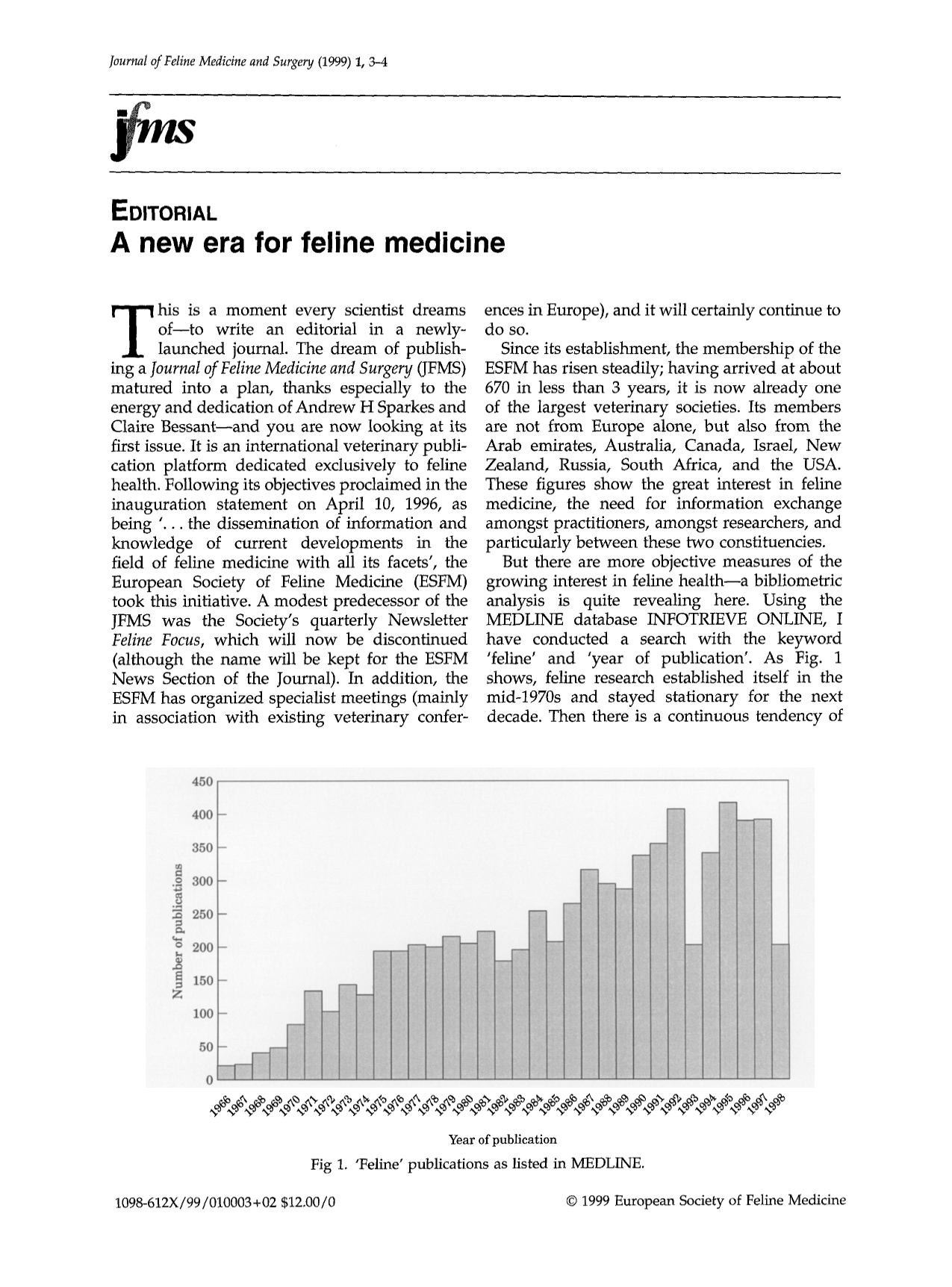
But there are more objective measures of the growing interest in feline health—a bibliometric analysis is quite revealing here. Using the MEDLINE database INFOTRIEVE ONLINE, I have conducted a search with the keyword ‘feline’ and ‘year of publication’. As Fig 1 shows, feline research established itself in the mid-1970s and stayed stationary for the next decade. Then there is a continuous tendency of growth, leading in some years to almost twice as many papers. During the whole period, infectious conditions had a large share in the publication volume especially viral (3017) infections, with bacterial (192), helminthic (13) and protozoan (1) infections lagging behind. I should emphasize that this was just a ‘quick and dirty’ assessment to get an impression—a detailed analysis will probably reveal the effects eg of discoveries important for biomedicine (eg FIV), of funding from the pharmaceutical and vaccine industries and the like.

‘Feline’ publications as listed in MEDLINE.
Demographics show that the popularity of the cat as a companion animal has risen steadily since the 1960s, with a consequent rise in cat population density and associated health problems. Companion animal medicine has discovered a new niche, a rewarding and economically viable one, as any small animal veterinary congress can prove. The first cat clinics have emerged, in several European countries, and chairs of feline medicine are being considered at less conservative vet schools and faculties. The JFMS launched with this issue meets a demand from the profession, and being its official journal, the ESFM will keep a watchful eye on developments in the feline field. The publisher's intention to accommodate original articles, editorials, reviews, short communications and case reports on the Journal's pages is broad enough to cater to everybody's taste. I am convinced this kitten will develop into a healthy adult.