



Abstract

Himalayan rations usually consist of a combination of bulk stores taken out from England or obtained in India and of foodstuffs purchased locally in the Himalayas. Rice, potatoes, tsampa (coarse flour made from roasted barley), dhal (a kind of lentil), eggs, chickens and meat are the chief foods available locally; fresh fruit and vegetables are seldom, if ever, obtainable.
The earlier Everest expeditions took with them a great variety of bulk stores. Later expeditions have come to depend increasingly on local food supplies, limiting their bulk stores to essential items not procurable locally, such as tea, powdered milk, sugar, jam, biscuits and butter.
Experience gained on expedition to Cho Oyu, 1952
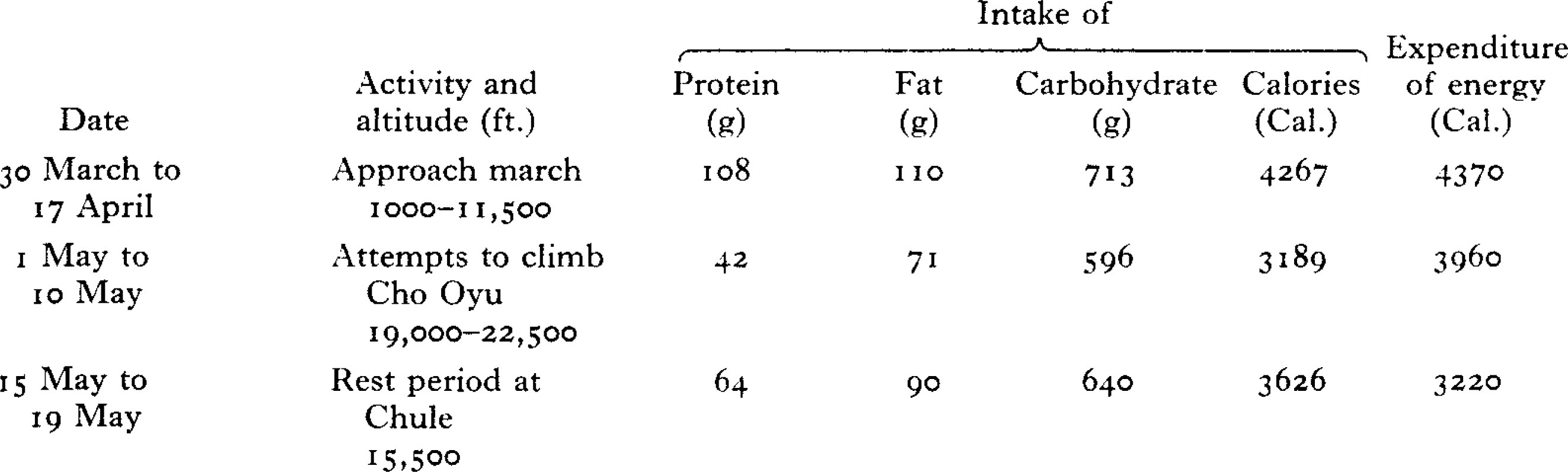
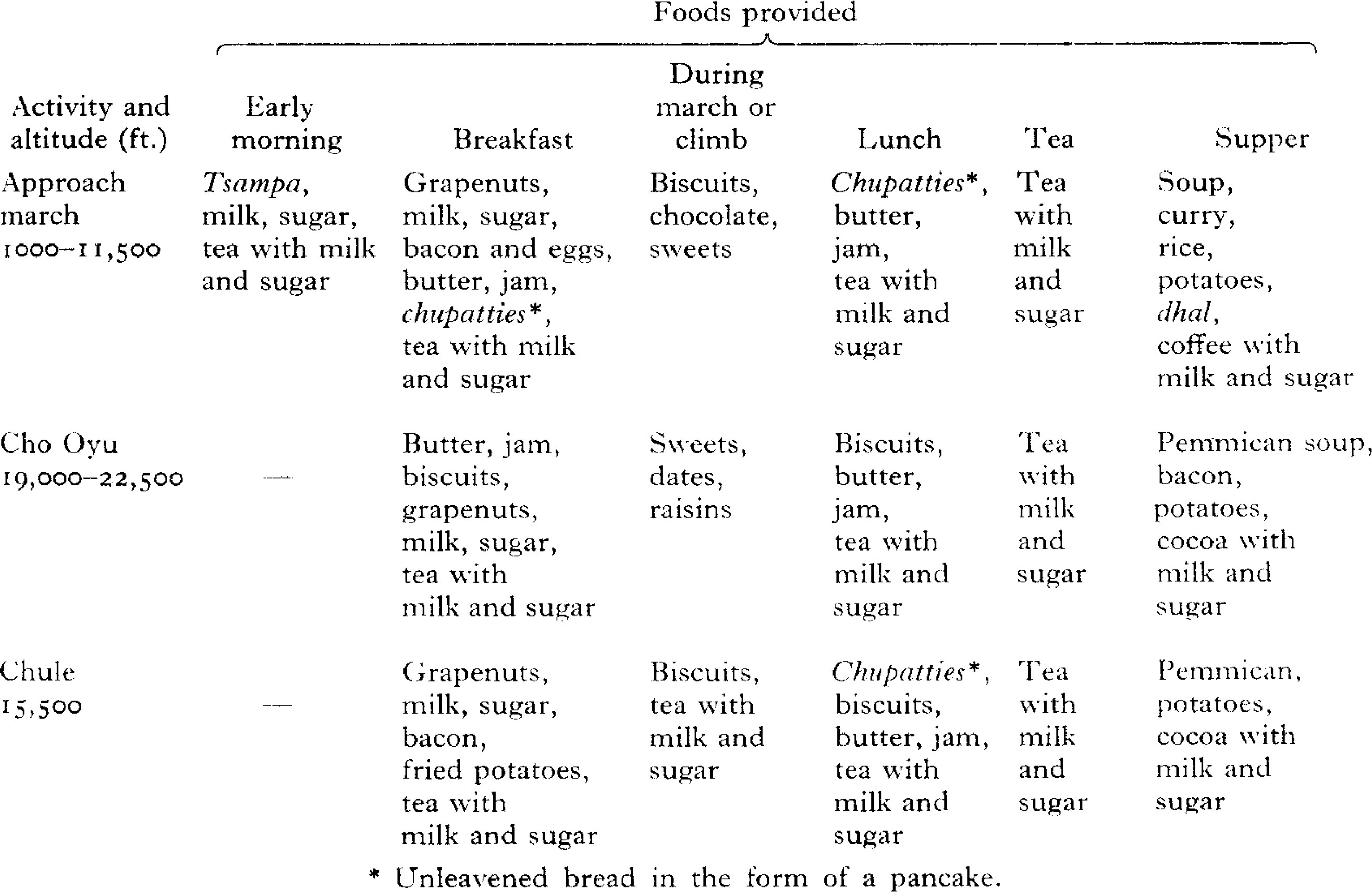
On the expedition to Cho Oyu in 1952, which may be taken as typical of British postwar expeditions, a survey was made of nutritional and dietary problems. Measurements of the oxygen consumption of members of the party climbing at their normal pace at various altitudes made it possible to construct an approximate energy balance sheet for the period of the approach and for the time spent at high altitude (Table 1). The demand for calories during the approach march was fairly well met, but the bulky and strange diet gave rise to rather severe disturbances of the digestive system in some individuals. Menus are shown in Table 2. During the period at high altitude, there was marked reduction in appetite, and a large proportion of the daily food intake was consumed in the form of sugar in beverages. Some members of the party developed cravings for specific items of food such as pineapple cubes and tinned salmon which were not available.
Analysts of diets, and intake and output of energy during the British expedition to Cho Oyu in 1952
Menus of the British expedition to Cho Oyu in 1952
The deficient calorie intake during the period at high altitude was associated with considerable loss of body-weight; the average weight lost over the initial 24-day period spent mostly at altitudes over 12,000 ft. was 11 lb. and ranged from 6 to 14 lb.
The findings were typical of the experience of previous expeditions. Deterioration in appetite, however, seems to have occurred at lower altitudes on Cho Oyu than was reported on previous expeditions to Everest. The low food intake on Cho Oyu was regarded as evidence of insufficient acclimatization to altitude. At a later stage in the expedition, when the climbers were better acclimatized and after they had been to lower altitudes for a short rest, both their general condition and their appetites improved. Another factor contributing to the low food intake on Cho Oyu was thought to be the monotonous and unappetizing nature of the diet. The conclusion was drawn that considerable improvement in the fitness of the party on the forthcoming Everest expedition could be achieved by spending more time on acclimatization, and providing a more satisfactory diet.
The Everest expedition, 1953
In planning the expedition to Mount Everest in 1953 the decision was taken to break with tradition, and make use of composite rations of the type used in the armed forces for supplying troops operating in isolated groups or small units. The advantage of such ‘compo’ rations would be as follows: Provision of a European type of diet; Increase in palatability and variety; Simplification in sorting and making up loads; Avoidance of shortages of essential items due to pilfering or over-consumption; Reduced contamination of food by flies and in handling, all the cooking on Himalayan expeditions being done by Sherpas.
Against advantages had to be set an increase in weight and expense. Weight was not a serious disadvantage, apart from increasing the cost of transport, since there was no difficulty in hiring porters to carry loads up to at least 18,000 ft. Porterage in the Himalayas may, however, become a problem at certain seasons of the year and at altitudes requiring special protective equipment.
The total cost of the rations for 2300 man-days was about £450, but this figure does not include certain items to the value of from £50 to £100 which were supplied by the manufacturers free of charge. The cost of transporting the rations from England to Kathmandu was about £100 and from Kathmandu to Mount Everest by coolies was about £500.
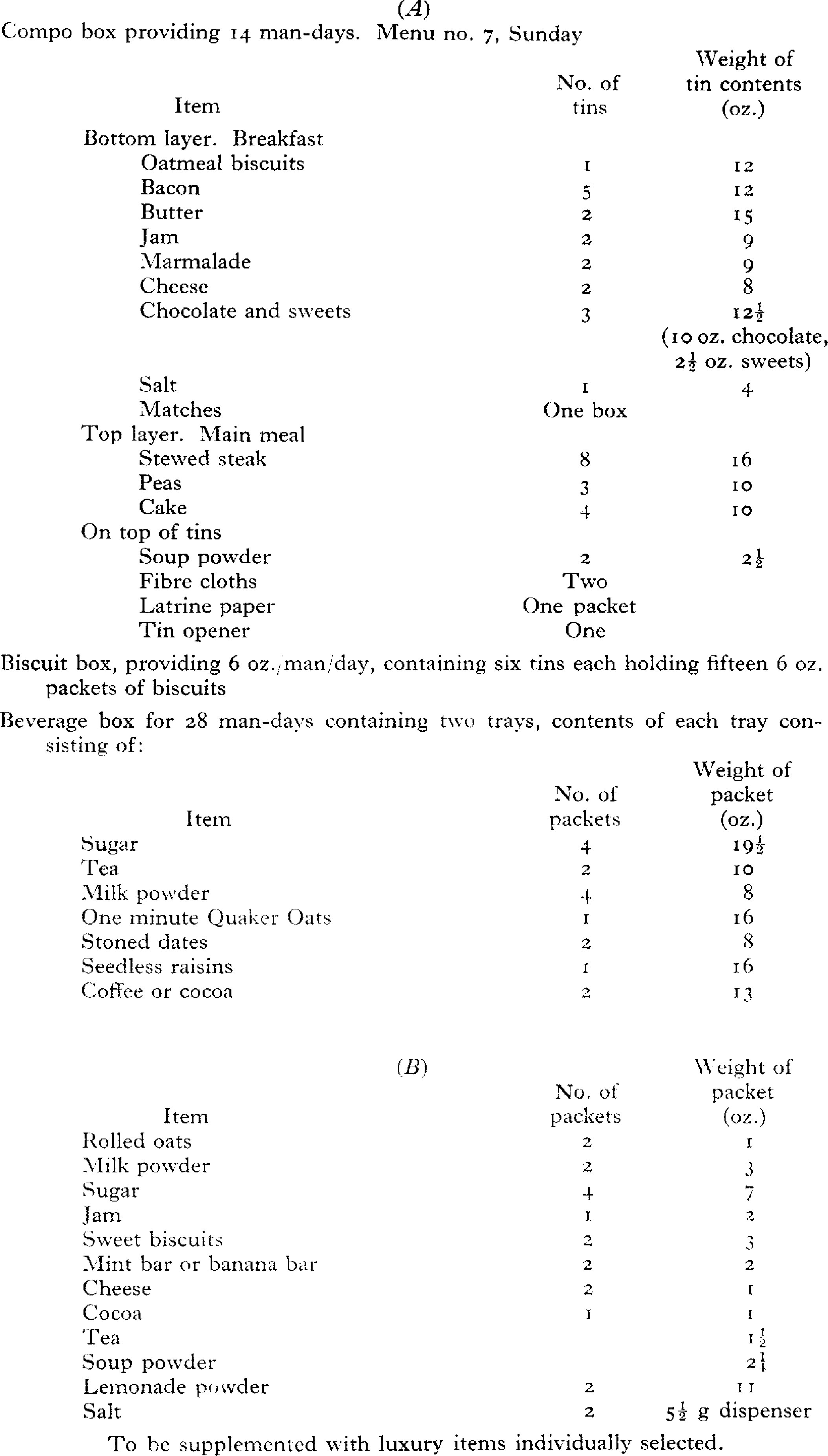
Full details of the composite rations have been published in the official account of the expedition by Sir John Hunt (1953). There were two types of ration: a ‘composite’ ration for general use (Table 3a) and an ‘assault’ ration for use above 21,000 ft. (Table 3b).
Rations for Everest expedition, 1953 : (A) composite ration for general use and (B) modified assault ration for 2 man-days
General purpose composite ration
The general purpose composite ration was packed as follows:
The compo boxes were weatherproof fibre-board cases of gross weight 45 lb., containing an evening meal, breakfast, and food for the day's climbing for fourteen men for 1 day. All the items were packed in tins. There were five varieties of meat, as well as salmon, four varieties of vegetables, tinned fruit, cake, oatmeal biscuits, butter, jam, marmalade, chocolate and other items. By combining the meat, vegetables, fruit and cake in different ways, different menus were provided for each day of the week, and the boxes were labelled accordingly. The precise quantities of each item depended to some extent on the size of the tins available in army stocks. A specimen menu for 1 day is given in Table 3.
The biscuit boxes were crates of gross weight 

The beverage boxes were fibre-board cases of gross weight 35 lb., containing 2 days’ rations of sugar, porridge oatmeal, tea and coffee or cocoa for fourteen men, as well as other items not requiring variation and suitable for vacuum packing. There were no tins in the beverage boxes (Table 3).
It was intended to supplement the above rations with potatoes, rice, dhal and occasionally fresh meat purchased locally. The calorie value of the composite ration, apart from locally purchased items, was approximately 4800 Cal./man daily. The intake based on the Cho Oyu study was not expected to be more than 4500 Cal. The surplus food was intended for the high-altitude Sherpas, who joined the expedition from Darjeeling, to supplement their diet of atta (stone-ground whole wheat flour), rice, tsampa and potatoes. Since the Sherpas were responsible for the cooking, a certain amount of leakage to them was in any event to be expected.
‘Assault’ ration
For use at high altitude where the ‘compo’ rations would no longer be acceptable on the score of weight, and where the sugar requirements would be very large, a special 24 h ‘assault’ ration was provided. This consisted of basic foods only, all of which were vacuum packed.
It was arranged to supplement the assault ration with so-called luxuries chosen by climbers according to their individual tastes and taken out from England in bulk. The calorie value of the assault ration was higher than would be required, and it was planned that individuals should modify their rations on the spot and reject items they felt they would be unable to eat. Actually, seventy assault rations were modified according to an agreed plan at base camp (18,000 ft.). Each modified unit consisted of two men's rations for 1 day packed in a single pouch (Table 3). The original assault ration contained, in addition to the items given in Table 3, 
The views and opinions of the climbers with regard to the feeding of the 1953 expedition were collected by means of a questionnaire after the return of the expedition. All except one of the party agreed with the principle of taking composite rations as opposed to bulk rations. Most of the men wanted more local food, especially more fresh and less tinned meat. Adequate supplies of fresh meat, however, are not always procurable in the Himalayas, as was found on the return march, by which time the compo rations were finished.
It was agreed that packed rations for the assault should include only basic items acceptable to all (a difficult requirement !), and should be supplemented by individually selected items as was done on the present expedition.
Compo rations were still in demand at a greater altitude than had been anticipated, in fact up to Camp 4 at 21,200 ft., for which the probable explanation was partly that the party was better acclimatized than in 1952 and partly that the variety and palatability of the food were greater. The provision of enough pressure cookers and well-designed Primus stoves greatly assisted the preparation of meals and ensured an adequate supply of fluid for drinking.
At the higher camps, the modified assault rations proved satisfactory and were supplemented by such items as sardines, salmon, honey, Vitawheat, saucisson, and tinned fruit, part of which was derived from Swiss supplies left behind on the South Col (26,000 ft.) the previous year. Climbers subsisted on the modified assault rations for periods of from 2 to 5 days in the month of May at the time when the high camps were being established and during the assault phase.
The party was much fitter physically at all stages of the expedition than on the Cho Oyu expedition the previous year, for which objective evidence is provided by the records of body-weight. The average loss of weight during the first 26 days after arrival at Tyangboche (13,000 ft.) was only 2 lb. (range from −8 to +3 lb.) compared with n lb. (range from −6 to −14 lb.) during the corresponding period on Cho Oyu. This was the so-called acclimatization phase during which the climbers were living at altitudes ranging from 13,000 to 18,000 ft. and making ascents to 20,000 ft. During the 2nd month, spent mainly in the Western Cwm (20,500 to 21,000 ft.), with short periods at altitudes up to 24,000 ft. and in some instances ascents to 26,000 ft., the average loss of weight was 4 lb. (range from −11 to +3 lb.).
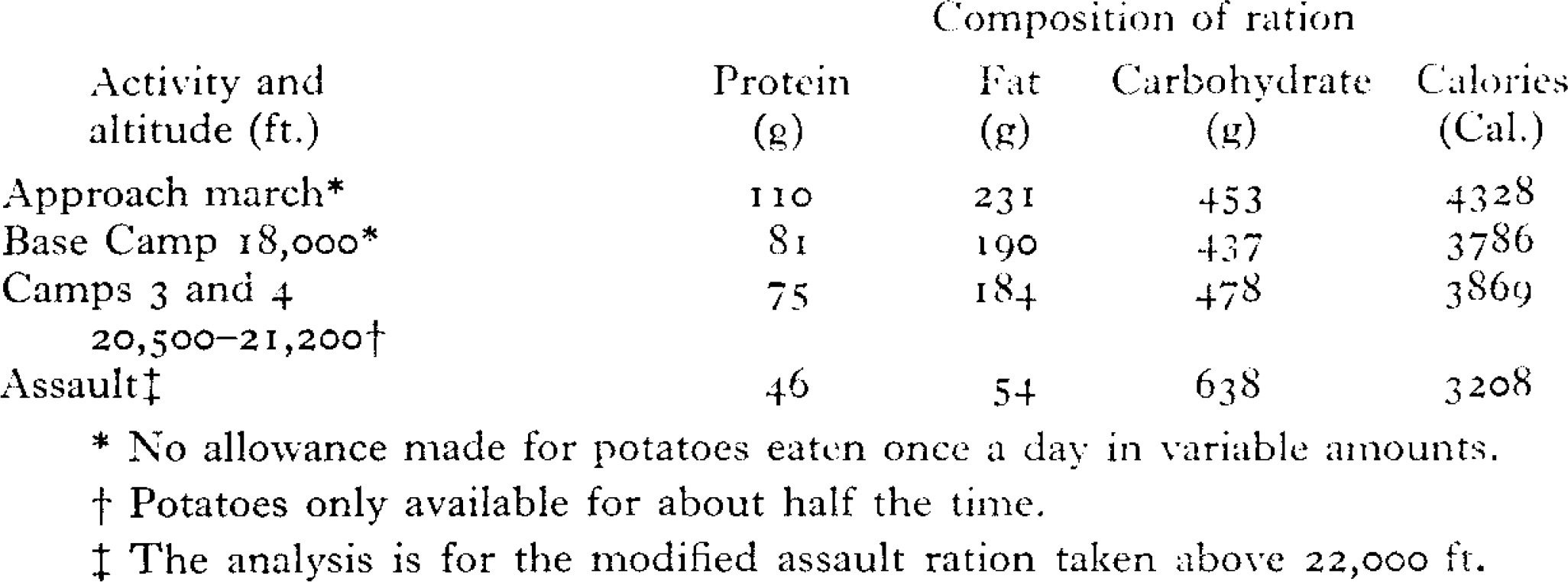
Evaluation of the calorie value and composition of the food eaten at various stages of the expedition (Table 4) shows that the calorie intake during the approach march was comparable with that in 1952, but the intake of fats was twice as high in 1953 as in 1952, indicating a less bulky diet. The calorie intake at Base Camp and in the Western Cwm was higher than the calorie intake during the high altitude phase of the Cho Oyu expedition. There was, however, a good deal of variation between individuals, which the available records do not reveal. For example, at any given camp the same amount of food would be served to each climber at supper, but not every one would eat all of it, and no record was made of the waste. Few quantitative records are available of the food eaten on the Lhotse Face and above it, that is to say at altitudes above 22,000 ft. In Table 4 values are given for the composition of the modified assault ration, of which some climbers stated that most was eaten. There was general agreement that all or nearly all the sugar was consumed, and it alone would yield up to 1500 Cal. Ward kept a record of the food eaten by him and Noyce over 48 h in going from Camp 4 (21,200 ft.) to Camp 7 (24,000 ft.) Evaluation of his record shows an intake of 2600 Cal./man/day. Hillary described how he and Tensing spent much of the night in camp at 27,900 ft. in brewing tea. They added three or four heaped dessertspoons of sugar to each mug of tea in addition to milk. For food they ate sardines and Vitawheat biscuits. On getting back to Camp 4 the day after the ascent to the summit, Hillary ate two omelettes and 6 oz. of salmon at a sitting, and drank 2 pt. of lemonade.
Analysts of the food eaten at the various stages of the Everest expedition, 1953
At all stages of the 1953 expedition the food intake was much greater than that recorded by Shipton (1938) on the 1935 expedition to Mount Everest. Shipton stated that food intake did not exceed 2000 Cal. between 17,000 and 21,000 ft., and 1500 Cal. at higher altitudes.
The question of fluid intake at high altitudes where all water has to be obtained by melting snow was given special consideration in planning the 1953 expedition, since there was evidence on certain previous expeditions that the climbers had become seriously dehydrated. The Swiss, for example, in their spring expedition to Everest in 1952, had less than 1 pt./man/day during 3 days spent on the South Col (25,850 ft.), and it was considered that fluid deficiency contributed to the extreme state of exhaustion which they suffered. Measurement of water intake on Cho Oyu showed a daily intake of from 5 to 7 pt. in beverages and soup, and the observation was confirmed on Everest in 1953. Probably at no time during the 1953 expedition did fluid intake fall below requirements for more than a day at a time. The climbers passed urine two or three times a day up to 22,000 ft. The recorded urine output in one subject up to that altitude was from 1·2 to 1·5 1. a day. During the assault phase most climbers could remember having passed water twice a day, which should be compared with a statement of Finch (personal communication) that he was the only member of a party of five to pass water over a period of 17 h spent above 25,000 feet.
A further question which requires to be raised is that of vitamin requirements, which might be inadequate in a party subsisting for 3 months on packed rations. In the 1953 expedition, as on Cho Oyu the previous year, each climber was issued with a supply of compound vitamin tablets containing ascorbic acid 75 mg, vitamin A 5000 i.u., vitamin D 500 i.u., thiamine 3·0 mg, riboflavin 2·0 mg, nicotinamide 20·0 mg, folic acid 1·0 mg, vitamin B12 1 μg. Apart from ascorbic acid, however, the intake of which was about 14 mg a day, the diet at all phases of the 1953 expedition except the assault was adequate in vitamin content without further supplements.
Discussion
The evidence which has just been presented suggests that the general efficiency of Himalayan expeditions can be improved by providing a diet of greater variety and palatability and more consistent with European food habits than has been customary on many previous expeditions, in particular small expeditions with limited funds. Members of an expedition starting out on an unaccustomed and excessively bulky diet nearly resembling the local native diet are likely to suffer considerable loss of weight and digestive disturbance during the first 2 months, but experience has shown that in most instances adaptation will eventually occur. * The ability of experienced Himalayan travellers to adapt themselves to native diet appears to be greater than that of newcomers on their first expedition. On expeditions to a high and difficult mountain the extra expense of taking composite rations is fully justified if it increases the general efficiency of the party and prevents even a single casualty.
It has been the writer's experience that men in a state of great fatigue prefer to eat nothing rather than put up with food for which they have no taste, nor are they able to eat if their water requirements are unmet. Insufficient intake of food, especially in combination with fluid deficiency, leads to deterioration in performance if continued for more than 1 or 2 days.
At altitudes above 22,000 ft., where deterioration from the effect of anoxia is inevitable, it is obviously important to avoid accelerating the process by allowing food and fluid deficiencies to arise. Indeed, apart from mountaineering considerations, it is not surprising to find that expeditions that have failed to provide themselves with adequate arrangements to meet their food and water requirements at high altitude have failed in their objective.
The demand for sugar by climbers at high altitude has long been recognized, but the requirement is so large that the supply has seldom been sufficient. Even men who at sea level are not fond of sugar and sweets find that their sugar intake increases as they go higher. Sugar seems to taste less sweet at high altitudes, and large quantities are needed to sweeten beverages. The increased appetite for sugar at high altitude has a physiological justification in terms of respiration. The oxygen intake corresponding to a given work output is less on a high than on a low R.Q. Houston (1947) has pointed out that at 20,000 ft. the effect on the mean capillary oxygen pressure of a rise in R.Q. from o-8 on a mixed diet to i-o on pure carbohydrate would be equivalent to a reduction in altitude of 2000 ft.
Loss of weight is a characteristic effect of high altitude and has been observed on physiological as well as mountaineering expeditions to high altitude (Barcroft, 1925; Dill, 1938; Hingston, 1925; Warren, 1937; Bauer, 1931). Loss of weight is associated with anorexia, which is one of the most characteristic symptoms of altitude intolerance. It has often been observed, however, that the general health and performance of a party may be good in spite of loss of weight, and it has been inferred that some reduction in body-weight may be an advantage since it reduces the work of climbing. After the Cho Oyu expedition in 1952, we were inclined to interpret some degree of weight loss as part of the acclimatization process. It was of great interest, therefore, to find that on Everest body-weight was so much better maintained by more careful acclimatization and improvement of the diet.
Summary
The dietaries of a typical postwar Himalayan expedition and of the 1953 Everest expedition are described. Himalayan expeditions usually live off the country, supplementing local food from bulk stores. The 1953 party had composite rations, thus providing a more variable and palatable diet than is possible for a party living mainly off the country. The sudden change to a strange and bulky diet at the beginning of the expedition was avoided by using composite rations. Climbers living at altitudes above 19,000 ft. usually consume about 12 oz. sugar a day and a large proportion of their food takes the form of sugar dissolved in beverages. They develop strange food cravings and prefer to do without rather than eat food that is unpalatable to them. The Everest party in 1953 ate normal food up to 21,000 ft. This was explained by better acclimatization, the greater palatability of the composite ration and the use of pressure cookers. The general physical condition of the members of the 1953 expedition was considered to be better than on the 1952 expedition, and the loss of body-weight which is characteristic of sojourn at high altitude was less than on previous expeditions.
Grateful thanks are due to Miss M. W. Grant, of the Human Nutrition Research Unit, London School of Hygiene, for her help with the dietary analyses.
Footnotes
*
Reproduced with permission from the Nutrition Society (The Proceedings of the Nutritional Society, Vol 13, 1954, pp 60—69. Original style, spelling, and punctuation have been retained.
*
Chronic diarrhoea, probably of infective origin but kept going by unsuitable food, is not uncommon, and, on Cho Oyu in 1952, a case of sprue occurred.