




Abstract
This article argues that maintaining the status quo is not an option for the euro area. The euro has functional and existential weaknesses that force us to take drastic action if we want to become resilient enough to withstand the next banking crisis. The article argues that the existential weaknesses of the euro stem from the D/Y ratio (debt-to-GDP). Euro-area members have only limited scope for using traditional mechanisms to deal with D/Y problems. What makes this especially worrying for the overall stability of the euro area is the ownership of the debt issued by the euro-area member states. It is absolutely vital to separate banks and sovereigns and to slash debt-to-GDP levels. The question is whether the political decision-making processes in the member states can deliver these structural changes.
Introduction
The future of the Economic and Monetary Union (EMU) is currently a hot topic. The success of the EMU will to a considerable extent determine whether the EU succeeds in fulfilling two of its core promises: prosperity and stability. This article argues that without considerable changes to the EMU, its functional and existential weaknesses will impair the EU's ability to deliver prosperity and stability. This would ultimately jeopardise the very existence of the EMU. I will start by singling out the most notable functional weakness, which results in the suboptimal functioning of the EMU. The argument is made that while this weakness does not per se endanger the existence of the EMU, it creates severe challenges for certain member states and political friction between its members. Next, I will explain the EMU's existential weakness, which stems from the D/Y ratio. I will also explain why—unless changes are made to the EMU and to the economies of the member states—the next banking crisis could be fatal. The article concludes by arguing that the euro-area member states must adopt and implement a policy programme (a) to reduce their public debt, so as to cushion the impact of the next crisis, and (b) to separate banks from their sovereigns.
Functional weakness
According to the optimal currency area theory, the euro area suffers from many weaknesses which impair its proper functioning (Mundell
The real-interest-rate–real-inflation dynamic was highly evident before the crisis in the euro area erupted. The countries of Southern Europe, also known as the periphery, which had traditionally had higher inflation and interest rates than the core countries, suddenly saw a remarkable drop in both. The low interest rates led to rapid private-sector credit accumulation in countries such as Spain and Ireland. In contrast, the only country with serious public-sector indebtedness prior to the crisis in the euro area was Greece. Low or negative interest rates in the peripheral countries boosted the cycle by discouraging saving and incentivising investments and expenditure, much of which went into real estate and created a bubble in Ireland and Spain. At the same time, however, the exact opposite was happening in the core countries. In Germany, very low inflation encouraged saving, with these savings being channelled by the financial markets to the Southern peripheral countries, which offered higher financial returns (but with low real interest rates for households and companies in those countries) (Storm and Naastepad
‘Countries with high productivity growth also experience high wage growth, which leads to higher real exchange rates. The Balassa–Samuelson effect suggests that an increase in wages in the tradable goods sector of an emerging economy will also lead to higher wages in the non-tradable (service) sector of the economy. The accompanying increase in inflation makes inflation rates higher in faster-growing economies than it is in slow growing, developed economies.’ (Investopedia n.d.)
It is important to understand that the euro area is not the only monetary union suffering from this dynamic. However, the rigidity of the labour markets in the euro area caused the adjustments to price and wage levels to take longer and be more painful in the aftermath of the euro crisis. In both policy and political terms, the dynamic is difficult to mitigate, especially because it builds up primarily through the private sector. Politically it is challenging, to say the least, to try to slow down credit accumulation in the private sector when the economy is growing and new jobs are being created. This is the very same problem that has always weakened the effectiveness of, and the scope for, Keynesian demand management. At a technical level, countering the problem requires high-quality real-time data and a highly capable administration able to use regulatory and fiscal policy to rein in the real-interest-rate dynamics (Odendahl
As requested by the Eurogroup in April 2016, some work on this is being carried out by the European Commission. However, it remains doubtful whether, using the current methodology, potential output can be calculated in real-time accurately enough to base controversial and politically costly fiscal-policy decisions on it. Time lags make it difficult to rein in real interest rates, since slow data collection and analysis mean that policy decisions will always be taken many quarters later. With the further development of economic models and data collection, there is hope that it will become technically easier to counteract the real-interest-rate dynamic. Unfortunately, this does not lessen the political challenge of trying to cool down an economy which is growing too quickly. Moreover, the EMU still has to rely on political decisions instead of letting the economy automatically restabilise itself. Political decisions on highly complex, uncertain and politically costly issues are a major source of political friction among the member states.
Another related problem is that overall labour mobility in the euro area remains low, although new research indicates that it has increased (Ehmer
In a monetary union, adjustment of competiveness vis-à-vis other parts of the union requires price adjustment, in which wage adjustment plays an important role (Ehmer
The real-interest-rate dynamic is a tangible problem for the EMU because it deepens busts and boosts booms, as well as causing friction among members. Yet it is not an existential weakness. The most potent ways to address and mitigate its effects are through measures to increase labour-market flexibility, encourage equity investments rather than credit investments and remove structural obstacles to labour mobility. Although all three are worthwhile goals, they are difficult to achieve and not without their political drawbacks.
Existential weaknesses of the euro
The most severe threat to the long-term success of the EMU and the euro stems from the interconnectedness in Europe of banks and their sovereigns,
2
combined with very high D/Y ratios. As argued above, the euro crisis was not caused by public debt. Nevertheless, the high level of public debt arising from the recession and the crisis puts in doubt our ability to handle the next banking crisis. Carmen Reinhart and Kenneth Rogoff have argued that national public-debt crises and banking crises have been a common problem throughout history, and that well-established policy options exist for dealing with them (Reinhart and Rogoff
‘The sovereign–bank nexus was one of the main amplifying factors of financial distress during the euro area crisis. Banks’ difficulties affected sovereigns directly, through the bailout of troubled intermediaries, and indirectly, through the impact of the disruption of lending on the economy. Sovereigns’ difficulties affected banks’ ratings, funding costs, and balance sheets, while the recession worsened their lending portfolios.’ (Visco
The interconnectedness of banks and states allows a crisis to spread from the former to the latter, and the other way around. If states had low debt levels, however, this interconnectedness, while still perilous, would not be potentially fatal. That may sound overly dramatic, but if we look at some figures, the alarmism becomes understandable. According to research by Reinhart and Rogoff (
A country can try to solve its debt issues by reducing the amount of debt (D), or by increasing GDP (Y). To raise its GDP, a country has two main options: implementing structural reforms to increase the growth rate or increasing inflation. To reduce debt, by contrast, a country can repay or restructure debt, make the central bank absorb the debt or try to limit interest costs (Buttiglione et al.
The ownership of sovereign bonds in the EU is a huge obstacle to using any means other than structural changes to lower the D/Y ratio. Sovereign bonds in Europe are largely owned by each country's own domestic banking sector. There are dramatic differences between countries, but on average the domestic banking sector owns 57% of sovereign bonds. This is considerably higher than the US equivalent of 45%, but what is especially worrying is that in all the big euro-area countries this percentage is above that of the US (European Political Strategy Centre
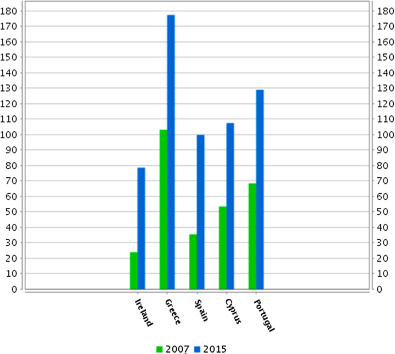
Government-debt-to-GDP ratio, 2007 and 2015, euro crisis countries
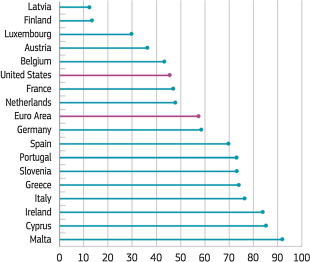
Sovereign debt held by domestic banks at the end of 2013 (as a percentage of total government debt)
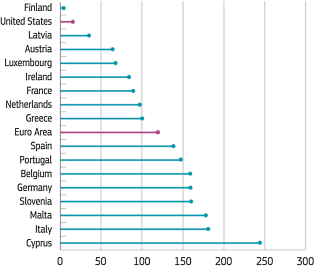
Exposure of banking system to domestic government debt at the end of 2013 (as a percentage of own funds)
What turns this problem into an existential weakness is the already high debt levels shown in Figure 4, together with the limited scope for lowering debt-to-GDP ratios. If we assume that Reinhart and Rogoff's research and the experience we have of the recent crisis in the euro area are indicative of the effect the next crisis will have on public debt levels, we can expect the next crisis to raise countries’ debt-to-GDP ratios by more than 50% compared to the pre-crisis level. It remains questionable whether the markets would be willing to fund such an increase in public debt. For example, compared to the current levels, Italy's debt-to-GDP ratio would be well beyond 200% and France would find its ratio above 150%. Naturally, these are only back-of-the-envelope calculations. However, the dangers associated with the situation should prompt member states to adopt a strategic long-term plan to reduce their debt levels and separate banks from sovereigns, so as to have the room to cushion the next crisis, which is inevitable. The question is whether our democracies are capable of adopting and implementing strategic policy initiatives, which are politically costly and divisive, to create space to cushion the next banking crisis, since this approach will require years of considerable primary surpluses.
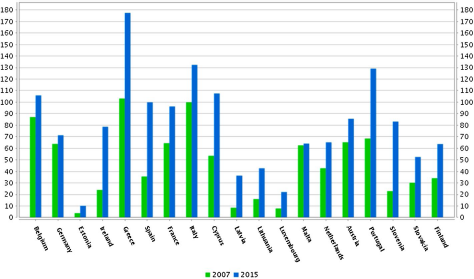
Debt-to-GDP ratios in the euro area, 2007 and 2015
Conclusion
This article argues that maintaining the status quo is not an option for the euro area due to functional weaknesses which lead to the suboptimal functioning of the EMU and in turn to political friction among members. Furthermore, far-reaching reforms are needed due to the high D/Y ratios. These result in there being only limited room to cushion the next banking crisis, which, history tells us, is inevitable. If debt-to-GDP ratios are not lowered and banks are not separated from their sovereigns, the next banking crisis may prove to be an existential threat to the EMU. Nevertheless, it is absolutely clear that, rather than dismantling the euro, action should be taken to correct these weaknesses.
Footnotes