




Abstract
This article looks at the causes and impact of a range of current events related to migration, examining them from the perspective of present-day demographic trends in Africa and the Middle East. The quest for decent prospects in life acts as the incitement and rationale behind the push–pull factors which underlie the movements of people from these parts of the world. The article sheds light on the extraordinary nature of modern migration, which is creating pressure on policymakers to ensure appropriate policy and economic resolutions are formulated, as well as providing answers to how the formation of trenches between nations and nationalities occurs, which stems from collective identity discourses. By applying a structural and socio-economic feature-focused approach to explaining the migration process, the article highlights the impact of socio-psychological mechanisms on shared decision-making processes, and aims to build an improved and broader conceptual understanding of the ongoing demographic shifts.
Introduction
Demographic shifts have existed since ancient times as an integral and collective component of civilisation on the African continent. The leading causes of these shifts were environmental and meteorological conditions, which matched the human and animal requirements of the former tribal and nomadic societies. These shifts were also guided by subjective views that interpreted the underlying ‘realities’ and were inspired to a certain degree by communal group interests in the respective geographic locations, that is, tribal claims over water resources, territory or agricultural areas. In modern history, large movements in populaces continue to occur, transferring a complex combination of economic and political issues from the countries of origin into the countries of destination. The unprecedented developments in terms of recent migration movements have provoked a multitude of challenges. The lack of conceptual clarity among European policymakers to find sustainable solutions, and the lack of political will and cooperation to achieve suitable ‘crisis management’ at hot spots and in countries of entry into Europe, are contributing to the proliferation of unexpected economic and social collisions in modern societies and are hampering the creation of meaningful tailored solutions.
General observations on demographic developments in Africa
Demographic shifts in Africa in the recent past can be linked to fast-paced globalisation, violence, armed conflict and crises. In recent years these factors have had an increased impact on changes in population density and can also be linked to changes in birth and death rates, economic decline and migration. In order to produce reliable demographic projections in Africa, national census figures and health and demographic surveys—which provide fertility, mortality and migration data—are taken into account, along with historical data on births, deaths and migration. Using this data, population estimates are calculated for every country in Africa and the estimates are then aggregated for the continent. It is important to note that census figures for many African countries are not accurate. In some instances, current population estimates are based on old census data and are little more than projections themselves. Migration is the single most difficult component of population change to measure reliably, according to the UN (
The primary reasons for demographic change in Africa are substantive disruptions of the peace and a lack of adaptable economic measures and provisions, both of which create a perpetual inability to cover essential needs and support livelihoods. Consequently people are forced to leave their home countries for both safety reasons and to achieve their aspirations for a decent life. People who are forced out of their original countries create pressure on the social and economic systems in the receiving countries, not only at the time of their arrival through initial high numbers in a certain area, but also in the generations to come, as ultimately their children and grandchildren swell the base population to several times its original size.
Finally clichés, information received through communication and media channels, and unrealistic promises of a better life at the other end of the journey in countries such as Germany, Sweden, Austria and the UK, become ‘pull’ factors for people who have been pushed out of their countries of origin by terror, war and human rights abuses. The worldwide almost instant and unlimited access to the communication technology network and a steady development of cheaper and faster transport facilities, allow for better mobility in remote areas and less developed countries on the globe. Particularly in Africa, the resulting developments were seen in an increasing use of mobile devices during the past decade. The global media dissemination of high-standard life perspectives in countries where peace, social stability and security seem to be a granted criterion in everyday life, provide people with a ray of hope for a better life and an incentive for people to migrate to Europe.
The confusion regarding how to face the additional problems in Europe connected with the influx of migrants is highlighted by the way in which European leaders are grasping for uncoordinated solutions, as well as the lack of consensus about how to share the burdens amongst all EU member states.
According to Eurostat, the highest number of first-time asylum applicants in the second quarter of 2016 was registered in Germany (with more than 186,700 first-time applicants, or 61% of total applicants in the EU member states), followed by Italy (27,000, or 9%), France (17,800, or 6%), Hungary (14,900, or 5%) and Greece (12,000, or 4%). These five member states together account for 85% of all first-time applicants in the EU28 (Eurostat
Impact and consequences of migration flows on Europe
The armed conflicts in the Gulf and the Middle East have added considerably to the migrant flows coming from the African continent as the result of pre-existing conflicts, and hardship (i.e. in Nigeria, Somalia and Sudan) has exacerbated the situation. Thus both these factors have contributed to the demographic changes in Europe. Europe is confronted with a mixed-migration flow, comprising economic migrants as well as asylum seekers (Park
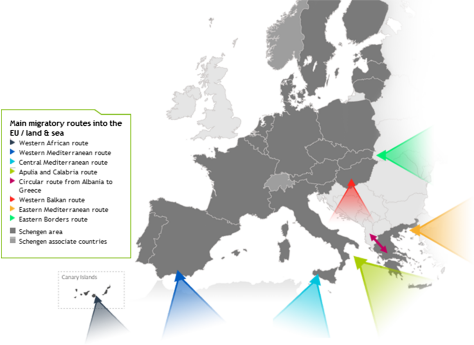
The main migration routes into Europe.
Migrants from Africa as a possible solution for the ageing labour force in Europe
Demographic pressures, such as those caused by the ageing labour force in Europe, increasing critical labour shortages and deficits of skilled workers in developed countries, have resulted in the growth of mixed migration, both regular and irregular. The migration crisis presents a big challenge for Europe and is steering discussions among the member states on the issue of demographic pressure as the result of the ageing European society, concerns over national identity and migrant integration, and questions regarding the economic impact of migration on the member states, as well as the importance of finding a common asylum policy and sufficiently managing the external borders of the EU. Europe is facing the worrying demographic trend of an ageing and shrinking population. The EU's total fertility rate is not much more than 1.5 children per woman. According to The 2015 Ageing Report of the European Commission, the population of the EU member states will reach 523 million in 2060, with the working-age population (15–64 years old) falling to just 202 million (European Commission
Less-educated low-skilled migrant workers may increase pressure on public services such as health care, housing and education systems, and this poses a risk of depression in public wages and increased unemployment (Ellyatt
Migration steers political divisions across Europe
Europe is currently experiencing political divisions on the issue of migration, with the conflicting views of member states, driven by economic, social and cultural divergences, creating a highly fragmented environment, endangering future European integration. The inflow of refugees is likely to continue for years, if not decades, and therefore Europe has to find a common solution and take coordinated policy action. The Schengen system of open borders lacks the ability to cope with a crisis situation of this scale (Aiyar et al.
Anti-immigration sentiments are also a rising concern across Europe, with political parties such as the UK Independence Party, Alternative for Germany and France's National Front enjoying increasing popularity (Ellyatt
The EU is taking several measures to effectively overcome the obstacles and negative effects of the increasing migration crisis. In April 2016 the European Commission adopted a Communication launching the process for a reform of the Common European Asylum System, which would meet the need for options that ensure a fair and sustainable system for allocating asylum applicants among member states (European Commission
Impact of migration flows on Africa
A snapshot of Africa's population in the UN's 2015 population review (UN Department of Economic and Social Affairs, Population Division
A look at the present situation suggests that the European leadership tends to solve the challenges created by African problems by trying to apply tailored European solutions; the same paradigm applies to Arab problems. Europe accepts and adapts to the increased inflow of African skilled labour forces by attempting to rapidly integrate the migrants into European countries, which is intensifying the already critical brain drain in African countries.
The creation of temporary accommodation in hot spots in buffer countries such as Turkey or Morocco for those who have been forced out of African countries could prove to be a better solution in social, cultural and economic terms than long-term integration procedures that do not sufficiently consider the difficulties of integrating people from ethnically distant countries, cultures and traditions. Such integration procedures have a tendency to negatively tint assumptions and perceptions. It should be noted that looking for solutions in Europe for African problems seems to cause other unwanted effects, such as radicalisation and the spread of violence and terrorist movements. It also puts additional pressure on governments and societies to handle emigrants’ everyday needs within a very short time frame and leaves experts struggling as volatile developments call for flexibility from state actors in the receiving countries. The visible discomfort reflected in reports of growing criminal offences and terrorist threats among the various European populations is becoming increasingly obvious. European state actors do not seem to have found the necessary spontaneity and flexibility regarding the introduction of additional security measures or specific expert capacity, or in terms of suitable infrastructure. While there is no question that there is a need to protect life and respect human rights, the equal claim across Europe for the protection and respect of the people's rights in their home countries is getting louder. Unrealistic expectations of the newcomers combined with unwillingness to adopt to European standards can result in increased violence as a means to express frustration. Moreover, such expectations can feed further polarisation and already existing nationalist tendencies, culminating in xenophobic outbursts, radicalisation and hate crimes.
We should learn from past events, such as the case of Zimbabwe, when a downturn in development, which started with the land reforms of 1998 and 2000, led to military and police brutality against the citizens, ordered by the Mugabe administration, and forced people out of the country. Zimbabwean men and women immigrated to the US, the UK, Canada, Australia and New Zealand; many also moved to neighbouring countries such as Botswana (Tevera and Crush
According to a January 2014 World Bank report, the number of African migrants doubled between 1980 and 2010, reaching 30.6 million. This represents around 3% of the continent's total population. Approximately half of these African migrants stay in Africa, with Côte d'Ivoire, South Africa and Burkina Faso as the most popular destinations. However, the number of African migrants who stay in Africa has decreased steadily over time (from 59% in 1980 to 51% in 2010). There is a growing movement of North African migrants to the Middle East as well as to Europe, which is the second most popular destination (Ehrhart et al.
Recommendations for proactive measures and options
Shifting the focus onto who the most dominant international stakeholders in Africa are, it can be seen that there is a prominent Chinese presence, which has increased over the past two decades, fairly undisturbed by and away from European attention. China plays a significant economic role, with substantial control of the mineral resource market (Alessi and Xu
The development and modernisation of infrastructure requires training, education and capacity building. By inviting international academic institutions and economic stakeholders and manufacturers to the continent to develop tailored programmes in specific areas (e.g. health care or high-end technology), the progressive transfer of knowledge and technology will allow for greater compatibility among and better functionality of services in African countries.
The massive numbers of people who have forced entry into Europe through regular and irregular migration clearly show that trying to build solutions here can hardly be of sustainable long-term value for European countries. The unexpectedly large numbers of foreigners are overstretching social welfare due to constraints on the budgetary resources and economic capabilities of individual governments. The basic human needs for acceptable standards of safety and economic prospects, which are the notable push-factors from the African conflict belt, act as pull-factors in the receiving countries of Europe. Destination countries such as Germany, Austria, the UK and Sweden are well known for their sophisticated social welfare systems. These factors attract migrants and encourage even greater flows through the misleading messages being conveyed that the doors are wide open and that the charitable social welfare packages are a ‘free for all’ opportunity.
International economic connectivity to create employment in less conflict-ridden countries and regions
Economic connectivity can serve as a basic method, depending on individual circumstances and needs, to establish temporary accommodation hot spots in buffer countries and regions. The groundwork can be prepared through international cooperation that builds political and economic bridges with more stable countries in the Mediterranean region for migrants originating from Arab countries. Here Turkey could serve a pivotal role and gain economic importance as an EU partner country by providing temporary economic arrangements for migrants. This approach could replace the EU's expensive investment in securing its external borders. Investment incentives aimed at promoting public–private partnerships based on intergovernmental cooperation treaties between European and African countries could build the bridges which bring politics and the economy together. People with African roots from the Horn of Africa and beyond could be settled in more stable countries in the sub-Saharan region.
International economic connectivity as a new aspect of development cooperation would bring actors together in a multi-stakeholder approach with financial support from the international donor community. This would serve to promote a viable economic production industry, and create and modernise basic infrastructure, such as transnational road and rail transport corridors and networks. European–African partnership agreements with an increased emphasis on the development of road and rail transport systems across the continent would serve to create employment and to feed into more efficient resource management, with increased benefits for the African population. Attractive and investment-friendly packages for international trade and industrial investors, combined with security for investments, would have a positive impact on the creation of employment. Furthermore, the provision of skilled workers from industrial countries to assist in ‘train the trainers’ programmes, combined with the transfer of modern technology, would boost the abilities of the skilled labour force in the temporary establishments and equip them for realistic employment conditions in competitive labour markets. This particular model reflects the likelihood of people who are forced out of their native countries temporarily acquiring better positions and opportunities and improving their skills. This would prepare them for a return to their countries once conflict has ended and there is a need to rebuild society and destroyed or dysfunctional infrastructure.
Development of trade and industrial productivity through the transfer of expert knowledge, capacity building and training
Building economic bridges with the aim of temporarily settling migrants, including refugees, means countries are identified for specific roles (e.g. Morocco for migrants stemming from the Middle East, and Israel, which already hosts refugees from Eritrea) and given substantial political and financial support to serve as buffer and/or transition countries of closer proximity to the particular countries in the region. Directing migrants into such transition countries, which have a simpler way of life and where the more familiar eco-social systems better match their original backgrounds, has the implied advantage of shorter assimilation periods and a much quicker integration time for newcomers. This, in return, means a more rapid turnaround in terms of productivity and earlier economic returns in the new transition countries. At the end of this equation there is the potential for another positive outcome: once the countries of origin have established a stable peace and are rebuilding, the chances of encouraging the skilled labour force to move back and rebuild their home countries will be higher as they will be transferring within the region and thereby the risk of an enormous decline in the quality of life will be lower. Their living standards would be boosted by training and employment, and the ultimate goal would be repatriation to their country of origin after the end of the conflict. This measure would prevent further brain drain from the African continent.
Migration in the 2030 Agenda for Sustainable Development
For the first time, the 2030 Agenda for Sustainable Development includes migration in the global development framework and provides countries with comprehensive directions on effective migration governance. UN agencies, such as the International Organization for Migration, elaborate on the specific references made in the Sustainable Development Goals (SDGs) and set them as the basis for their activities. Amongst the various initiatives being developed is the Migration Governance Index, which has been created as a tool to measure the effectiveness of national policies for safe and regular migration as per target 10.7 of the SDGs (see Figure 2). SDG 10.7, in particular, calls on countries to ‘facilitate orderly, safe, and responsible migration and mobility of people, including through implementation of planned and well-managed migration policies’ (International Organization for Migration
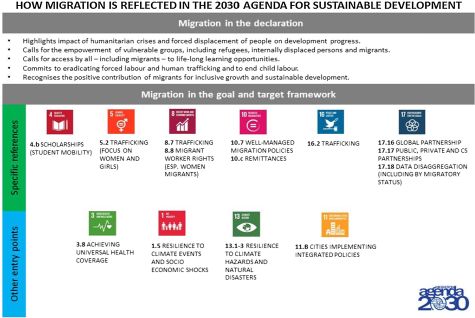
Migration in the 2030 Agenda for Sustainable Development.
Conclusion
At the present time more than 85% of refugees and migrants are being hosted in developing countries. This points to a need for the international community to adopt a new and more creative approach. Concerted action is required to create for migrant populations a better social environment in areas less affected by conflict. For decades European policymakers have tried to persuade African governments to introduce democratisation procedures with the hope of creating more stability and reducing the potential for violence and conflict. However this process will take time. In fact, international political interference has not had the desired result and further migration flows from African countries are evidence of this. Africa's population will double by 2050. Given these dynamic trends and the economic, political and security challenges that African countries have to face, further major migration waves to Europe can be expected, augmented by support for migration from the growing African diasporas. Europe will have to tackle growing migration pressure from Africa, as illustrated in the UN forecasts. All facts considered, the current level of integration in Europe in the areas of freedom of movement, migration and asylum is insufficient, and will hardly allow an effective common response to be made to the further development of the crisis (Lehne
Footnotes