



Abstract
Since 1989 the former socialist countries of Central and Eastern Europe have been undergoing a transition from a more or less totalitarian political regime, planned economy and socialism towards a democratic regime, market economy and capitalism. This article examines the indicators that are used to measure the success or failure of a transition and compares them to the outcomes of democratic processes and economic performance. Five Central and Eastern European countries are studied: Slovenia, Hungary, Slovakia, the Czech Republic and Poland. The article concludes that the countries that opted for a ‘big-bang’ approach to transition are either completing this process (the Czech Republic and Poland) or are well on track to concluding it (Slovakia), while the countries that missed the moment and opted for a gradualist approach (Hungary and Slovenia) lag behind and may even find stability in a form of deficient democracy.
Introduction
Since the democratic revolutions of 1988-90, the former Communist countries of Central and Eastern Europe have been in transition. In dictionaries ‘transition’ is defined as ‘the process or a period of changing from one state or condition to another’. This transition has been occurring in the areas of democracy, economy, well-being and so on. Maldini (2007) defined democratic transition as ‘a change from undemocratic to democratic political system’. He claims that democratic transition has three key stages: ‘liberalisation and the fall of authoritarian system, democratisation and social modernisation, and, finally, consolidation of democracy’.
Economic transition is generally understood as the change from a planned to a market-based economy. Broader societal transition is the process of convergence of former socialist countries with the West in terms of societal openness, media plurality, tolerance, rule of law and so on. The economic consequences of transition should be the convergence of wealth and quality of life standards between countries on both sides of the Iron Curtain. The political consequences of transition should be fair competition for political ideas and the exchange of power between the main political forces in the country.
How to measure transition?
The European Bank for Restructuring and Development publishes annual transition reports. In its 2013 report (EBRD 2013) it evaluates and measures the transition progress of former socialist countries across dozens of criteria including income, market system, democratic and economic institutions, and human capital development. The report finds that countries may be ‘stuck in transition‘–-that is, the convergence process has generally stopped or is even reversing in these countries.
This is possible because transition is a primarily political issue. It is the transition of public infrastructure–-democratic, economic, legal and other social systems. This infrastructure is shaped by policies.
Transition is also fundamentally ideological. It is about shifting from one system of ideas and ideals–-the socialist one–-to another–-the capitalist one. As such, transition itself is an object of political competition and a struggle along left-right fault-lines. It is not something that runs in the direction of convergence with the West on its own, nor is it governed by the rules of physics regardless of human will; it can be faster, slower, or even stall or reverse its course as a result of political decisions.
Most former socialist countries (China being an exception) established a formal democracy first and then introduced reforms of other systems democratically. In an ideal scenario, a successful and decisive beginning to transition results in public opinion that supports the accelerated continuation of the transition. In a realistic scenario a fair competition would take place between those advocating accelerated convergence with capitalism and those in favour of preserving aspects of socialism–-both the general social organisation as well as the inherited personal power and privileges. In the worst-case scenario, transition would be rejected by the electorate and the country would democratically choose a system that would preserve itself by creating a self-reinforcing loop in which opponents of transition monopolise the public and political space, shaping public opinion against transition, and getting democratic support for preserving or even back-tracking into socialism. While democratic in form, such a situation is not democratic and pluralistic in substance.
This paper examines if, and to what extent, transition is complete in the countries of Central and Eastern Europe, and, if it is not complete, which of the three scenarios described above is taking place in each of them. Central European countries sharing similar cultural, religious and political backgrounds are examined. Austria, Slovenia, Hungary, Slovakia, the Czech Republic and parts of Poland were all part of the Austro-Hungarian Empire. Until the First World War they had the same economic, political and judicial systems. Austria is included in the study to illustrate the gap that transition countries need to close. The Baltic States, on the other hand, are culturally inclined not towards Alpine-Rhine capitalism but towards Anglo-Saxon capitalism and have been left out of these comparisons.
After setting the stage in this section, the indicators of economic freedom, press freedom, democracy and the rule of law by which transition is measured, are examined to see how the countries compare with each other and with their neighbours. Then the outcomes of the political process over the last 25 years and economic performance during the recent economic crisis are examined. Finally, the outcomes of the two methods are compared, an explanation is provided, and topics for further study and policy action are recommended.
Indicators of transition
First, the indicators that allow us to compare these countries to each other and to their Western counterparts are examined. The latter is something that is not possible with transition-specific indices. Then we will look at the performance of these countries during the recent economic crisis and the results of the democratic process.
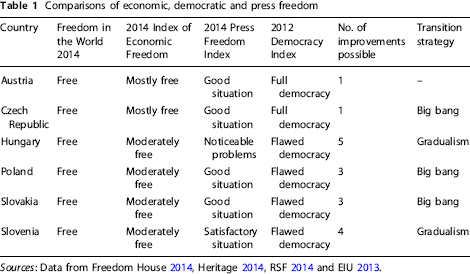
As indicators of the success of transition, the four most widely quoted and transition-non-specific indices were used: Freedom in the World 2014 (Freedom House 2014), the 2014 Index of Economic Freedom (Heritage 2014), the 2014 Press Freedom Index (RSF 2014) and the 2012 Democracy Index (EIU 2013). The comparisons can be seen in Table 1.
Comparisons of economic, democratic and press freedom
Sources: Data from Freedom House 2014, Heritage 2014, RSF 2014 and EIU 2013.
A comparison of the selected indices shows that the Czech Republic is entirely comparable to Austria. These countries’ scores in the four indices are identical. Poland and Slovakia have minor economic freedom and democracy problems. Slovenia and Hungary have similar problems and also have press freedom issues. If one compared them with the entire EU15 (old member states), the average number of improvements possible is 2.2. The ‘number of improvements’ equals the number of times a grade can be improved to reach a perfect score. For example, the Czech Republic can only improve on the Index of Economic Freedom from ‘mostly free’ to ‘free’. Only four old EU member states would score better than Poland or Slovakia and only one worse than Slovenia. For the majority of the examined countries, the transition would seem to be on track.
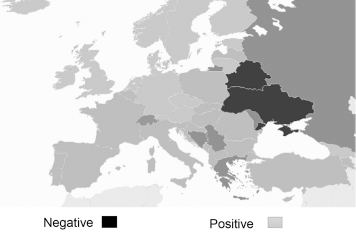
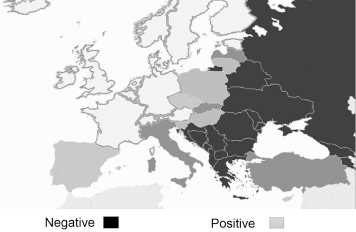
For a fuller picture, and to see if the Iron Curtain remains a factor, we can look at a graphical representation of the detailed indicators for the 2013 Index of Economic Freedom (Heritage 2014). The Gdansk-Trieste line has largely disappeared (Fig. 1). It remains noticeable, however, in the fields of fiscal freedom (countries in the East are taxed less), the security of property rights (Fig. 2, property is less secure in the East, except in Estonia, and is also less secure in Greece and Italy) and freedom from corruption (countries in the East have more corruption). In all other areas (business freedom, trade freedom, government spending freedom, investment freedom, financial freedom and labour freedom) the East-West divide is not significant.
Overall economic freedom in Europe
Security of property rights
Similarly, there is an East-West divide in the World Justice Project's rule of law index (WJP 2014). Austria is ranked fifth in the Western Europe and North America group. Poland is 15th; the Czech Republic, 16th; Slovenia, 20th; and Hungary, 21st.
In summary, there are areas where the divides along the Iron Curtain persist (such as the rule of law), and there are areas in which they have disappeared. Differences among the countries examined still exist and are quite consistent across the categories, with (naturally) Austria in the lead, followed by the Czech Republic, Poland and Slovakia. But the differences among the former socialist countries are not dramatic (Table 1).
Economic and democratic performance
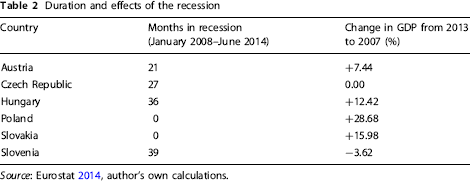
The differences among the examined countries get much bigger if we compare their economic and democratic performance. Having similar grades on the indices for their economic, legal and democratic systems, one would expect a similar outcome when examining actual performance. However, this is not so. Table 2 shows that Poland and Slovakia did not have a recession at all. It also shows that while other countries were growing during the crisis, the output of Slovenia actually shrank.
Duration and effects of the recession
Source: Eurostat 2014, author's own calculations.
In a democracy one expects that there is a regular exchange of power between liberals and conservatives, between left and right, or (as is the case in transition countries) between the heirs of the old systems and the new democratic parties. In all the former socialist countries examined the democratic opposition won the first democratic elections, which were typically held in the spring of 1990. The personalities that brought about democratic change, like Lech Wałtȩsa and Václav Havel, became the presidents of the republics. Democracy was introduced and the heirs of the old regimes organised themselves into political parties to compete in the democratic elections. The success of the heirs varied widely. Figure 3 shows the length of time that each country was led by those who cannot be regarded as the heirs (institutional or ideological) of the former regime or who were not already members of the former ruling elite (retention elites).
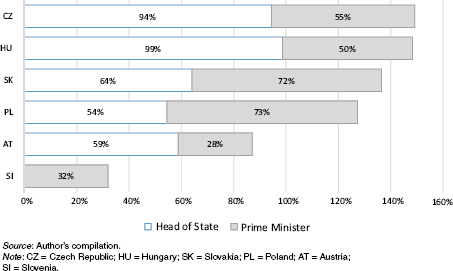
Percentage of time the centre-right was in office from January 1990 until June 2014
The first column in the chart shows the political affiliation of the president of the republic, the second that of the prime minister. In the case of Austria, as well as the later office-holders in Poland and the Czech Republic, we use the traditional left-right divide. The affiliation of the prime minister who was leading the coalition government is charted. The chart shows that while in the Czech Republic and Hungary the left and right governments were in power for almost an equal amount of time, the presidents of the republics were never from the retention elites. Slovakia and Poland had more volatility in terms of their presidents, but the centre-right held government power for almost three-quarters of the time. It should be noted that all socialist-led coalition governments during this time in Austria were grand coalitions with the Austrian People's Party (österreichische Volkspartei, öVP), while the right-wing coalitions were purely right wing. Slovenia is a special case, as all its democratically elected presidents were members of the retention elites, and 70 % of the time these elites led the government.
As shown in Fig. 4, there is a very high correlation (0.73) between the time the new democratic forces (generally the centre-right parties) were holding government office and economic performance during the economic crisis.
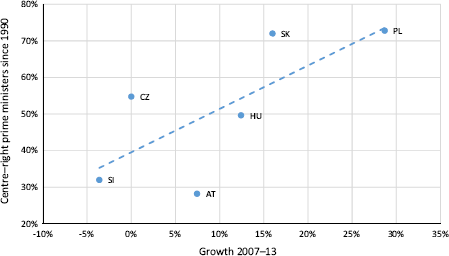
Democratic shifting of power versus response to the crisis
How the speed of transition affects economic performance
Adam et al. (2009) studied differences between the development paths of Estonia and Slovenia. Estonia is moving in the direction of a free market model while Slovenia is moving towards a corporatist social welfare state. The study attributed the difference to the disparity between the political elites. In Estonia most of the elites were new, while in Slovenia the elites were largely heirs of the pre-1989 system.
The same study (Adam et al. 2009) also explains why Slovenia is lagging behind in closing the gap with the West compared to the other countries with which it is compared in Table 1. Slovenia being culturally autonomous, with open borders to the West and some elements of market economy, was not forced into radical reforms in the 1990s but proceeded with transition gradually instead. This gradualism also allowed for the survival of the elites (Adam and Tomšič 2012). Those on top in the 1980s remained on top in the 1990s. Thus, the balance of political and media power that would allow for a working checks-and-balances approach to politics was never established.
Moreover, the static and consensus-driven socioeconomic model that emerged in Slovenia after 1989 proved unable to react to the challenges of the 2009 economic crisis. Not only did the Slovenian transition get stuck after the homework needed to join NATO, the EU and the eurozone was accomplished, but Slovenia froze and failed to respond to the economic crisis. In comparison, Poland did not even fall into recession in the 2009-14 period and in the other countries that we have looked at the crisis was much shorter (Table 2).
Conclusion
The usually cited benchmarks, indices and statistics provide a limited insight into the completeness of the transitions of countries from totalitarian regimes and socialist economies into democracies and free markets. They do a good job of making a quantitative analysis of market freedoms, but are less reliable for the qualitative aspects of transition, particularly the openness of the political, economic and media spaces for new entrants. Without fair political competition, a balanced media space and an independent judiciary, the measured economic freedoms simply benefit a single elite which is able to capture power in an apparently democratic way.
In this paper we have focused on five Central European countries, Slovenia, Hungary, Slovakia, the Czech Republic and Poland. The differences measured by the European Bank for Reconstruction and Development and the various business, press and political freedom indices were rather small. On the other hand, the analysis of how power has been shared since 1990 and the countries’ varying abilities to handle the recent economic crisis has revealed huge differences between Slovenia on the one hand, and Slovakia, Poland and the Czech Republic on the other. The very different outcomes, particularly in Slovenia, cannot be explained by the usual indicators.
The last column in Table 1 summarises the approach to reform (Havrylyshyn 2007). In retrospect, making a quick transition and implementing decisive reforms in the 1990s was better than the gradualist approach of Slovenia and Hungary.
The question is whether this was a unique opportunity. Did the moment, right after the democratic change, offer a unique opportunity to carry out such reforms? Did gradualism actually enable the retrenching of the heirs of the old regime and the opponents of transition for ever? Indeed, in Hungary there have been democratic changes of power between the left and the right, but it remains to be seen whether a free market and a balanced democracy can be introduced or whether Hungary will create a system where the right (in contrast to Slovenia) will be able to create a self-reinforcing loop to democratically capture power for one side of the political spectrum.
It has been argued in Slovenia (Avbelj 2014) that the reasons for this gap are a lack of media plurality and the lack of an ideological balance in education and research, as well as the continued domination of the pre-1989 elites in business, the judiciary and the civil service. Pejovich (2003) correctly claims that transition is a cultural issue. Culture does not change on its own but through the media, education, institutions and so on.
To prove this argument scientifically, a Europe-wide comparative study on the indicators of ideological plurality in European societies and how this affects public opinion in general, and national culture specifically, would be needed. Initial steps in this direction have been accomplished, for example with the establishment of the ‘Media Pluralism Monitor’ (Valcke 2009).
Practically, affirmative action policies would have to be introduced in the media, pedagogy and elsewhere in countries where the state is captured by a single political elite. However, it is unclear how a country could break free from the vicious circle in which those in power abuse their power to make it easier to get elected again by capturing the institutions that influence the electorate, such as schools and the media. As found by Alesina and Fuchs-Schundeln (2006), individuals’ preferences are rather deeply shaped by the political regime in which they live. They found ‘that it will take one to two generations (of East Germans) for preferences to converge (with West Germany) completely’ (Alesina and Fuchs-Schundeln 2006, 1). If, however, a regime is self-perpetuating, it is far from certain that this change will happen. The danger that a country in transition finds stability not in a left-right equilibrium but in a left-only or right-only dominance is real. Liberal democracy of the Western type–-not only by appearance but by substance–-is not the obvious outcome of transition.
The EU, through its sheer existence, provided a role model and an enormous inspiration for the citizens of the oppressed Eastern Europe. It helped to ignite the democratic changes in the late 1980s. The aspiration to join the EU and NATO was a strong motivator for political and economic reform in the decade and a half after the democratic change. The EU should continue to motivate and support the unfinished transition processes in its member states and structural reform through the European semester and beyond, as well as to stand for equal opportunities when advocating political ideas.
Footnotes