




Abstract
In February 2014, Russia invaded Crimea, Ukraine. Two weeks later it annexed the region. This gross violation of international laws and agreements cannot be tolerated–-and it is up to the international community to deliver a decisive, punitive response that seeks to limit Russian influence in Europe and the rest of the world over time. In order to counter Russian expansionism, US and European leaders must work to bolster the democracies of the Eastern Partnership states, develop a safe and secure energy supply for European countries, strengthen the defences of the front-line NATO states of Central and Eastern Europe, and re-evaluate the exchange of goods between Europe and Russia. In addition, international support for the new Ukrainian government will be essential in the coming years. Failure to deliver an appropriate response will have grave consequences for the future world order.
Introduction
For the last few years, the EU has played a leading role in the Eastern Partnership countries, supporting the new democratic regimes as they work to reduce corruption, improve the rule of law and represent the interests of their constituents. Its prominent role in the region has also coincided with the downscaling of the US military presence in Europe and the ‘gradual reorientation of US foreign policy toward other global regions (the “pivot”)’ under the Obama administration (Lucas and Wess Mitchell 2014). While the US still continues to work in the region, promoting more citizen-oriented and responsive governments, the EU has assumed the more prominent role.
As a result of the significant time, money and effort spent by the EU, countries like Moldova, Georgia and Ukraine have taken substantial steps towards strengthening their democracies. The general sense, of course, was that things were going well in the Eastern Partnership countries–-that is, until Russia invaded Crimea at the end of February and annexed the region two weeks later.
Since the invasion, European leaders have struggled to issue an appropriate, punitive response to Russia. The following paper outlines several significant long-term policy changes for both the US and Europe to consider as a direct result of the Russian invasion. From reassessing the role of NATO in the region, to taking steps to reduce European dependency on Russian oil and gas, the West must act quickly to confront Russia and deter any future violations of international law. We must not forget, however, that Ukraine is in danger as it continues to face the threat of an armed invasion of its eastern and southern territories. It is therefore also incumbent upon the West to use all means at its disposal to deter any further acts of aggression by Russia.
A note on the Crimean referendum
Before discussing both the short- and long-term implications of the Russian invasion of Crimea for European and US leaders, it is important to pause briefly to comment on the March 2014 referendum in which a majority of Crimeans allegedly voted to secede from Ukraine.
According to the final results of the referendum, announced in Simferopol while Russian troops occupied the streets, 97 % of voters voted in favour of Crimea's secession from Ukraine (Herszenhorn 2014). Many analysts have since made the case that the results of the referendum are indicative of overwhelming public support from Crimeans for separating from Ukraine and joining the Russian Federation. However, such apparent public support for Crimean secession is not consistent with prior polling data collected in the region. In May 2013, 10 months prior to the referendum, the International Republican Institute (IRI) polled Crimean residents to determine what they thought the status of Crimea should be. The following chart presents the polling data (Fig. 1).
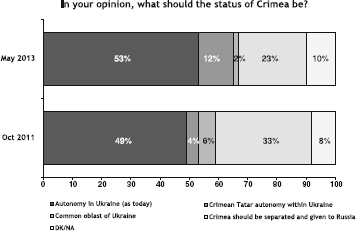
Ukrainians on the status of Crimea, May 2013
As one can clearly see, only 23 % of Crimeans supported unification with Russia, while 53 %–-a clear majority–-wished to remain an autonomous region within Ukraine. Although somewhat dated, the poll provides an accurate representation of Crimean opinions, as it was taken during a time of peace. Although many Crimeans may have been troubled by the events on the Maidan, the IRI data absolutely refute the notion that the percentage of Crimeans supporting independence from Ukraine could have swung so dramatically over the last year. A 74 % swing, from 23 % to 97 %, is highly improbable. Consequently, IRI encourages analysts to use caution when referring to the ‘overwhelming’ preference of Crimeans to join the Russian Federation, as these polling data suggest otherwise.
IRI polling data taken in March 2014 also disprove President Putin's assertion that Russia must defend the rights of Russians abroad. When asked whether Russian-speaking citizens of Ukraine are under pressure or threat because of their language, only 5 % of respondents answered with ‘definitely yes’. In fact, as the tables below illustrate, 71 % of the population, a clear majority of Ukrainians, including Russian speakers, believe that Russian speakers are not under threat. More significantly, when disaggregating the results, this sentiment is held by strong majorities in all of the regions of Ukraine, including the south (Figs. 2, 3).
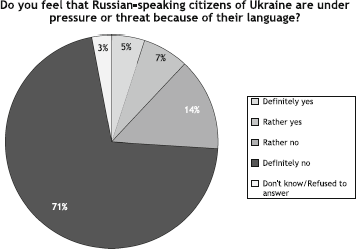
Rights of Russian speakers (general), March 2014
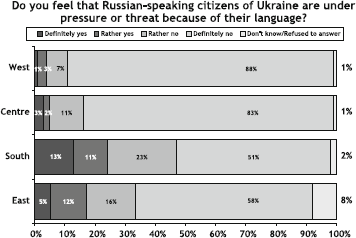
Rights of Russian speakers (by region), March 2014
Additional IRI polling data on the Russian-led Customs Union (CU) show that only 28 % of Ukrainians would vote to join the CU in a referendum. These data stand in stark contrast with the percentage of Ukrainians who would vote to join the EU. With 53 % of Ukrainians in favour of joining the EU, public opinion in Ukraine demonstrates a clear preference for the West over the East (Figs. 4, 5).
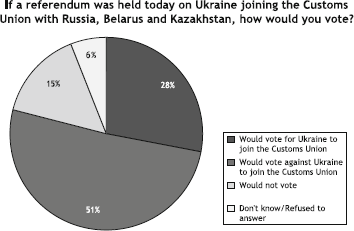
Joining the Russian-led CU, March 2014
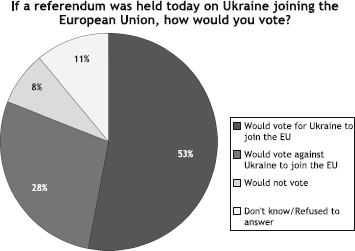
Joining the EU, March 2014
Initial responses to the annexation of Crimea
Since the Russian invasion of Crimea, Europe and the US have been forced to consider appropriate countermeasures, from economic sanctions to diplomatic measures. The initial response, of imposing sanctions primarily on Moscow's elite, proved ineffective in deterring the Russian annexation of Crimea, prompting the Ukrainian ambassador to the United Nations to refer to the sanctions as ‘shy’ and nothing more than a ‘mosquito bite’ (Bremmer 2014).
Europe continues to grapple with an appropriate punitive response, sparking an intense debate among interested parties over the best way to respond to Russian aggression. On the one hand, there is concern that increased efforts to deter Russia will backfire, causing a potential escalation of the crisis in the areas of Eastern Ukraine, Moldova and possibly Georgia. Proponents of this view tend to support measures aimed at bolstering the new Ukrainian government in Kyiv, rather than punishing Moscow (Bremmer 2014). Yet many others believe that the current response on the part of Europe and the US is simply not enough, arguing that Russia has blatantly violated all accepted norms of international law by forcibly taking Crimea, with no real punitive response from the West. IRI firmly believes that such a display of weakness on the part of US and European powers is unacceptable, and now is the time to act.
Long-term responses to counter Russian expansionism
While the International Monetary Fund has given Ukraine a generous aid package of up to $18 billion to stabilise the new government (Harding 2014), there are other important measures that the international community must take to bolster the new Ukrainian state and other Eastern Partnership countries, while isolating Russia. There is little doubt that some of the measures will be difficult for the US and European powers to implement, but it is largely in the best interests of everyone that the international community work together to contain the spread of Russian influence.
Defence and security
The Russian invasion and annexation of Crimea has raised significant concerns over the defence capabilities and security of the Eastern Partnership states. The move marks the second time in recent years that Russia has ‘humiliated and dismembered an ex-Soviet state without encountering strong reaction from the West’ (Lucas and Wess Mitchell 2014). This Russian military aggression is a direct challenge to post-Cold War security in Europe and has profound implications for the balance of military power in the region.
In order to adequately address these security concerns, defence ministries from Central and Eastern Europe must be encouraged to increase their spending on defence. Currently, the regional average for defence spending by the frontline NATO states of Central and Eastern Europe is 1.1 % of GDP, which is well below the 2 % suggested by NATO (Lucas and Wess Mitchell 2014, 2). Such a low percentage is dwarfed by Russian military spending, which amounts to 4.5 % of its GDP each year (Lucas and Wess Mitchell 2014). Although this underspend is, in part, due to the effects of the economic crisis in the eurozone, spending must increase in order to deter future Russian aggression. This is not to say that NATO forces are outmatched by Russian ones, but it is important to stress the inconsistent defence capabilities among each of the NATO countries. Take, for instance, Poland. Poland is exceptional in Central and Eastern Europe as it spends 1.9 % of its GDP on defence–-0.8 % above the regional average. Nevertheless, when comparing the Polish and Russian armies, there is little competition. With nearly 1 million active troops, Russian forces are 10 times larger than Polish ones (Lucas and Wess Mitchell 2014, 4). This imbalance must be altered dramatically.
In addition, when evaluating Central European security, it is imperative that NATO reassesses its commitment to collective defence under Article 5 of the treaty. According to McFaul (2014), a former US ambassador to Russia and special assistant to the president at the National Security Council, NATO must respond with ‘greater placement of military hardware in the front-line states, [and] more training and integration of forces’. Collaboration, in other words, will be key. In order to accomplish this, Poland and Germany in particular must assume leading roles in advocating for the strengthening of these eastern NATO countries.
Democracy assistance
The events on Kyiv's Maidan and the departure of former Ukrainian President Viktor Yanukovych have underscored significant democratic deficits which had been plaguing the Ukrainian state since its independence. From the growing power of oligarchs to widespread corruption, Ukrainian democratisation has been mired in instability since its beginning.
The protests in Ukraine and Russia's subsequent willingness to take advantage of the situation illustrate an important foreign policy consideration for European powers: the EU should work to bolster the democratic governments of its neighbours before extending its influence into other regions of the world, such as the Middle East. Indeed, such a policy is prudent, as some scholars argue that ‘before democracy can spread further, it must take deeper root where it has already sprouted’ (Diamond 2008). By focusing democracy-assistance programmes on neighbouring at-risk or backsliding democracies, the EU can help to contain the spread of authoritarianism and reduce instability in the region. Potential democracy-assistance strategies include
institution building to help curb corruption,
media and civil society support to help citizens hold their government accountable, and
political party development to ensure that parties are representative of their constituents.
For example, since 1994 IRI has sought to promote democratic, citizen-oriented governance in Ukraine by supporting the development of national, broad-based and well-organised democratic political parties; by working with elected officials to improve government responsiveness; and by assisting civil society organisations in establishing links with political parties. By reorienting their democracy-assistance efforts to the Eastern Partnership countries, European leaders can help to reduce the likelihood of future instability in the region.
Energy
Europe currently imports almost 425 million cubic metres of gas per day from Russia (Wara 2014), and this dependency has only helped to embolden and finance the Russian government. To counter this, there are significant measures related to the US energy supply that could help to ease European dependency and improve Europe's ability to respond to Russian aggression. Namely, IRI feels that the Obama administration should facilitate US gas exports to help counter the stranglehold Russia has on Europe's energy needs.
The US currently lacks the capacity to ship any of its natural gas overseas. However, there is an export terminal capable of supplying nearly 85 million cubic metres of liquefied gas per day under construction in Cameron Parish, Louisiana (Wara 2014). There are also many other terminals in the planning and permission stages. Such initiatives will take time, as Europe also currently lacks the necessary infrastructure to import gas from the US (Mufson 2014). Nevertheless, these vast projects, when completed, could help to diminish Russian influence in Europe. To expedite the process, the Obama administration should issue an executive order finding that liquefied natural gas exports to the EU meet the legal standard (Wara 2014).
By flooding European markets with safe and secure US energy, the US will help to ensure that Europeans have a degree of flexibility when faced with an increasingly powerful Russia–-without fear of retaliation or disruptions in the supply of energy to their countries. Additionally, and this is key, the US should make an effort to sell its energy supplies to the Eastern Partnership countries at a significantly discounted price in order to compete with the already low prices of Russian oil and gas.
Markets for European goods
In order to impose lasting punitive measures on Russia, European powers should consider finding alternative markets for their goods. In 2012, European trade with Russia totalled €267 billion, while US trade with Russia was only €18.9 billion (Burwell 2014). Although unemployment levels in Europe are quite high and its economies have not fully recovered from the global recession, an effective strategy to contain Russian influence in the region will require some difficult decisions to be taken. The EU, under the leadership of Germany's Angela Merkel, should consider banning Russian state companies from Western capital markets and banning government insurance and loan guarantees for new investments in Russia (Burwell 2014).
The Ukrainian presidential election
In addition to increasing the cost of Russian aggression and expansionist policies, it is critical that the West should strongly support the new Ukrainian government. With the presidential election set for 25 May, the US and the EU must work together to ensure that the elections meet international standards. If Ukraine, and particularly its eastern region, can administer an election that is peaceful, open and transparent on 25 May, it will have the opportunity to continue as an independent and sovereign country and will be able to remain on a democratic, constitutional and Western path. The West must do everything it can over the next two months to assist in this endeavour, and this must be our collective priority. In addition, transparent elections would create space for Ukraine to be able to develop sound economic policies and continue to build its democratic institutions. In light of this, it is difficult to overstate the importance of a free, fair and well-administered election on 25 May for the future of the country.
Conclusion
Russia cannot be allowed to flout international laws and agreements with impunity–-not now nor ever again. While the invasion of Crimea was unsettling for many, the international community is capable of delivering an appropriate punitive response that seeks to limit Russian influence in the region over time. At this critical juncture, it is especially important that the US Congress should develop its own assistance package for Ukraine to supplement and strengthen any reforms made by the new Ukrainian government. Close cooperation and leadership from both the Obama administration and members of Congress will therefore be essential. Presenting a clear and coordinated message, the US must then work closely with European leaders to devise an effective strategy to confront Russia and shore up the Eastern Partnership countries.
The reality is that Western powers can no longer afford to de-prioritise the defence needs of the front-line NATO states of Central and Eastern Europe. By reassessing its commitment to collective defence, NATO should begin to shore up its eastern border, thereby increasing its capacity to defend the sovereignty of its members and deter future Russian aggression. Additionally, when evaluating its foreign policy, the EU would be wise to prioritise democracy-promotion efforts in the Eastern Partnership countries over other regions, as regional instability will only create further opportunities for Russian aggression.
By reducing dependency on Russian oil and gas exports, the US and the EU will slowly diminish Russia's power in the region. To begin with, European leaders should announce their intention to significantly reduce energy imports from Russia, perhaps by 20 % over the next year (Burwell 2014). A strong, clear message from the EU will immediately affect the Russian economy. This sort of long-term change will require significant collaboration and effective leadership, particularly from Germany, as will decreasing the volume of European exports to Russia.
Additional efforts should be made to bolster domestic Ukrainian media platforms that could effectively counter the Russian propaganda that currently dominates the available media sources in Ukraine. For instance, Russian companies own and operate all of the most popular social media sites available in Ukraine, which is problematic as young Ukrainians are not seeing Ukrainian-centred messages during this uncertain time. This issue is quite considerable in the eastern and southern regions of Ukraine, where Russian is widely spoken.
It is clear that these aforementioned changes will be challenging for both the US and Europe to implement; however what is clearer is that inactivity will be even costlier. As President Vladimir Putin proclaims his right to defend Russians and Russian speakers everywhere, the international community must demonstrate that it will not tolerate violations of international law, especially military invasions of other sovereign states. There are international norms that must be upheld, even if doing so requires sacrifices. Moreover, the international community must make it a priority to ensure that the upcoming Ukrainian presidential election is free and fair. By uniting and working together, US and European leaders have the opportunity to preserve liberal values and contribute to long-lasting security, safe and secure energy choices, and democratic governance. It is time to act.
Footnotes
Acknowledgments
The author gratefully acknowledges the research, editing and drafting assistance provided by Catherine LaRoque, Programme Assistant in the Eurasia Division of the International Republican Institute.