




Abstract
Estonia has used e-voting since 2005, and because e-voting is more accessible, more flexible and saves time, the result has been an increase in voter turnout. Compared with traditional voting in which a person must go to the polling station, a process that takes about 44 minutes, e-voting requires only 6 minutes. So far, supporters of right-wing parties and the Reform Party (Liberals) are more likely to use e-voting, with the result that Isamaa and ResPublica Liit (Conservatives) gained the majority of e-votes during the last parliamentary elections in 2011.
Introduction
The Estonian e-voting system was introduced in 2005 with the intention of increasing the participation of voters by making voting easier. Compared with many other countries–-Finland, for example–-Estonian e-elections are a success story. How is this possible and what are the reasons behind it?
Over the past 20 years, Estonia has developed a complete, well-functioning and secure estate. IT solutions developed within the construction of the estate constitute a part of our government administration. IT is used to increase administrative capacity and to ensure an innovative and convenient environment for citizens and business. In Estonia 94% of people file their taxes electronically via the country's e-Tax Board, a process that takes less than five minutes. Company registration online takes 18 minutes and annual financial reports can be submitted electronically. And since everything is ‘e’, it is logical for Estonia to use e-voting for elections.
X-road and ID card: the key factors for Estonian e-success
When Mart Laar became Estonia's Prime Minister in 1999 he prioritised IT. At the time, the political opposition and the public opposed ID cards, but Laar pushed the measure through nonetheless. In 2001 a government database connection, X-road, was introduced. Instead of developing a single, all-encompassing central system, Estonia created an open, decentralised system that links various services and databases. X-road is a combination of technical, legislative and organisational frameworks that enable government-level interconnectivity. All Estonian e-solutions which need to interact with multiple databases use X-road. In 2002 Estonia introduced the electronic ID card as the primary document for identifying its citizens and alien residents living within the country. The card, besides being a physical identification document, contains advanced electronic functions that facilitate secure authentication and a legally binding digital signature, to be used with nationwide online services. 1
The Estonian ID card is used to gain access to a number of Internet-based services, including viewing and changing data in the Estonian Citizenship and Migration Board systems, running queries through the national registers, using e-Tax, gaining access to several banks, giving digital signatures, purchasing and using ID tickets, and many other things.
Today, more than 600 public and private information systems, together with the more than 2,600 services they provide, are part of the state information administration system. Approximately 44 million digital signatures have been processed in Estonia since the system became available and more than 40,000 digital signatures are given each day in the country.
These decisions, made more than 10 years ago, clearly created a foundation for the further success of e-Estonia. Today, Estonia is one of the visible global leaders in the sphere of e-government and represents a goal and a benchmark in e-government for many of the world's developed and developing countries.
Estonian e-voting system
The Estonian e-voting system was used for the first time in 2005 for local council elections. In 2007, e-voting was available for parliamentary elections, a world first. The goal of e-voting was to make electoral participation easier for voters and so increase their participation.
E-voting allows registered voters to cast their ballots from any Internet-connected computer, anywhere in the world, without going to a polling station. E-voting is meant to supplement, not replace, traditional voting methods. During a designated pre-voting period, the voter logs onto the system using an ID card or mobile ID, and casts a ballot. The voter's identity is removed from the ballot before it reaches the National Electoral Commission for counting, thereby ensuring anonymity.
In Estonia there are two ways of voting: physically going to the polling station and e-voting. Both are based on the ‘two envelopes’ system. The procedure for those going to the polls is as follows:
Voters present an ID document to be identified.
They then receive the ballot and two envelopes.
They fill in the ballot paper and put it into the envelope, which has no reference to the individual voter's identity.
The voters then enclose this envelope in an outer envelope, on which they write their personal details.
The envelope is delivered to the individual voter's polling division. The eligibility of the voter is determined by using the outer envelope. The outer envelope is opened, and the inner (anonymous) envelope is put into the ballot box.
The system guarantees that the voter's choice remains secret. Recording the voter's identification in the polling division prevents anyone from voting more than once.
E-voting procedure
E-voting is carried out according to the same scheme. From their own computers, voters download an application that encrypts the vote. The encrypted vote can be regarded as the inner, anonymous envelope. After that, voters give a digital signature to confirm their choice. The voters’ personal data, or outer envelope, are then added to the encrypted vote. The procedure is as follows:
Voters insert their ID card into a card reader and open the webpage for voting.
They then verify who they are using the first pin code of their ID card.
The server checks whether voters are eligible, using data from the population register.
Voters are shown the candidate list for the appropriate electoral district.
They make their voting decision, which is encrypted.
Then they confirm their choice with a digital signature by entering the second pin code of their ID card.
At the vote count the digital signatures are removed, and in the final stage, the members of the Estonian National Electoral Committee can open the anonymous e-votes for counting (Fig. 1).
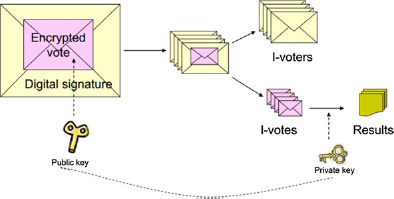
The envelope method.
The e-voter application encrypts his or her choice (the number of the candidate) with the system's public key 2 and signs the result digitally. The votes are collected and sorted, the voter's eligibility is verified and invalid votes (double votes and votes of ineligible voters) are removed. The votes are then separated from the inner envelopes (encrypted votes). Voters lists are compiled from the outer envelopes. The inner envelopes (which are no longer associated with the identity of the voter) are forwarded to the vote counter who has the system's private key. The vote counter (application) outputs the totalled results of e-voting. The following requirement ensures that the privacy of e-voters is maintained: at no point should any party of the system be in possession of both the digitally signed e-vote and the private key of the system.
Public key cryptography uses a key pair: private key and public key. When a source text is encrypted with a private key the resulting cryptogram can only be decrypted with the corresponding public key and vice versa; once the source text is encrypted with a public key then the resulting cryptogram can only be decrypted with the corresponding private key. For more information see www.vvk.ee.
Before verifying voting results on the evening of the election day, the encrypted votes and the digital signatures with personal data, or the inner and outer envelopes, are separated. Then the anonymous e-votes are opened and counted. The system opens the votes only if they are not connected to personal data.
E-voting is possible only during the seven days of the advance polls–-from the tenth to the fourth day before election day. This is necessary in order to guarantee that only one vote is counted for each voter. The list of voters who have voted electronically is drawn up and sent to the polling stations. The officers at the polling station note on the voters list that the person has already voted. This prevents them from voting for a second time at the polling place. To ensure that the voter is expressing their true will, they are allowed to change their electronic vote by voting again electronically during the advance polls or by voting at the polling station during the advance polls. The traditional means of voting (with a paper ballot) is given priority. Should the voter go to the polling station during the advance polls and cast a vote, his or her e-vote is deleted. On election day a registered electronic vote cannot be changed or made void. During the 2011 elections, according to official statistics, 3% of e-voters opted to change their vote by voting more than once. It is not known how they voted the second time, making it difficult to know whether e-voting reflects last-minute changes based on the campaigns or the news.
All votes cast in polling stations are counted after 8 p.m. The division committee prepares a record of the voting results, and all ballot papers and documents are packaged and forwarded to the county electoral committee (rural municipality or city electoral committee in the case of council elections). The results are published on the website of the National Electoral Committee.
Security of e-voting
E-voting has raised many questions, especially related to security. Technically, thanks to the existing system of ID cards and X-road, e-voting is just another application for the ID card, with some specific requirements. The system authenticates the user via his or her ID card, and the voter confirms his or her choice with a digital signature. Basically e-voting can be compared with any other similar procedure where a digital signature is being given: making a bank transaction, establishing a company, making queries of the commercial registry, sending documents to notaries, signing contracts and so on. The report E-voting concept security: analysis and measures identifies the main problems as being trust of the central system–-the trustworthiness of ID cards and mobile IDs–-and concern about human error (Estonian National Electoral Committee 2010). Trust issues extend, therefore, to both computers and personal behaviour. In Estonia the central system has proven its reliability for more than 10 years. The defence of the use of personal computers is that those with the knowledge, resources and access to infiltrate the computers of a large number of voters have no motivation to do so, and that the political forces who have the motivation cannot afford to take the risks associated with that kind of intrusion. People who conduct business and financial transactions using computers take higher risks in their everyday lives than during e-voting (Estonian National Electoral Committee 2010).
Results of e-voting
The e-voting system is gaining popularity and the number of voters who use it is also constantly increasing. E-voting also allows Estonians abroad to participate in the politics of their homeland (Table 1).
General statistics for elections
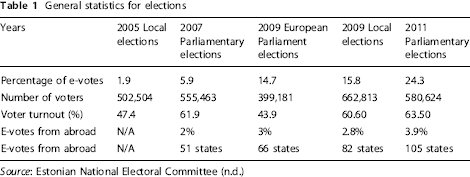
Source: Estonian National Electoral Committee (n.d.)
It is important to mention that voting is not mandatory in Estonia, and the number of potential voters in local elections differs from the number in parliamentary elections; only Estonian citizens can participate in parliamentary elections. It is hard to say whether people who are abroad at the time of an election have started to participate more actively or whether Estonians in general travel more, but it is clear that the number of countries from which people vote is constantly increasing, a phenomenon that could be the result of an increased awareness of e-voting.
Supporters of right-wing parties are more likely to use the opportunity to vote online. According to statistics from the last parliamentary elections (2011), the Reform Party (Liberals) was the biggest winner in terms of e-votes. The IRL (ProPatria and Respublica Union) was second and the Social Democrats came third (Fig. 2).
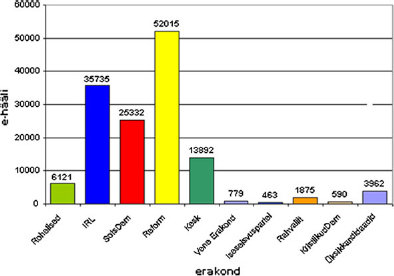
Number of e-votes received by each party (2011).
E-elections are expected to mostly attract the young but in practice the difference between age groups is not significant. People over 55 also use e-voting (Fig. 3).
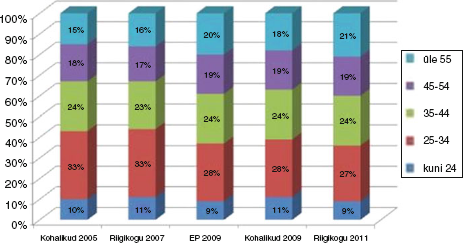
E-voters by age.
Looking at the differences between men and women we can see that women use e-voting more often. There are many possible explanations but clearly e-voting offers the opportunity to save time. According to a recent survey conducted by the Institute of Baltic Studies and Praxis Centre for Policy Studies (Kalvet et al. 2013), casting your vote via e-voting takes 6 minutes, compared to 44 minutes for voting ‘physically’. E-voting clearly lowers the costs of participating, and the time-saving effect becomes more significant the higher this cost is for an individual voter (Trechsel and Vassil 2011). In addition nearly 75% of the respondents state that e-voting has made the election procedure easier (Fig. 4).
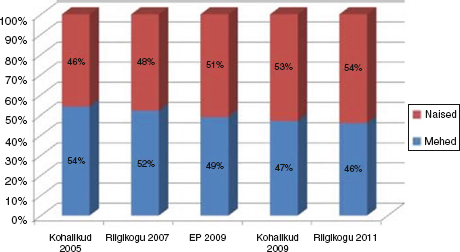
E-voting by gender.
The survey also points out that e-voting has saved 1,500 man days for polling stations. Cost saving was not the prime goal, but this again proves that e-services can save time and money.
Conclusions
The ID card and X-road systems have allowed Estonians to enjoy e-services in all major fields of their everyday lives. Estonia introduced e-voting in 2005 with the goal of making electoral participation easier and increasing the number of active voters.
Based on Estonia's experience we can see that e-voting has increased the level of voter turnout. Accessibility and flexibility are the main factors behind that. People in Estonia can easily vote using their ID card, independent of time or location. In addition, citizens find the e-voting procedure easier and simpler.
In the decade of smart phones and Facebook, it is normal that citizens also expect convenient ways to participate in national politics. E-elections offer one way to do this. In most countries, political campaigning is moving more and more away from the streets and onto electronic channels. Politicians address their voters online through Facebook, blogs, Twitter and forums. E-voting provides a system where the final act of voting can also be carried out online, offering voters the opportunity to exercise their will in a convenient and secure way.
Footnotes