




Abstract
The centre-right is a values-based political family which is currently facing two interrelated challenges, both of which result from the pressures on representative democracies in the twenty-first century and the attacks on established political procedures. First, the centre-right needs a credible and long-term response to the politics of simplification as an answer to the complexity of populist-demagogic forces. In many European countries, populist parties have succeeded in national elections. Second, it has to respond to a new field of politics given the label net politics, an online representation of political processes that uses the new technologies. The current rise of populism may be no more than a temporary aberration on the road to normal European party politics. Parties have to adapt while keeping up stability, credibility and loyalty among the electorate. The centre-right, with its values-based approach, is in a good position and can be optimistic about further challenges.
Introduction
Democracy in Europe is now a multilevel governance system with a sometimes opaque interdependence of policies, institutions and actors such as entrepreneurs, media and lobbyists. At the same time, society is changing, a result of the age of freedom, self-determination and globalisation. Votes for political parties increasingly fluctuate, less and less providing a stable base because of the fragmentation of society. Representation itself is guided by changing popular moods, in a system of so-called Stimmungsdemokratie (democracy based on popular moods). This has an impact on all political forces. The centre-right is confronted with two challenges which are interrelated through their enforced tensions with the old rules of representative democracy. First, it needs a proactive answer to the politics of simplification, an answer to the complexity articulated by populist-demagogic forces. In many European countries, populist parties have succeeded in national elections. Second, it has to react to a new field of politics, net politics, and an online representation of political processes that uses the new technologies. Based on the new technologies and therefore on social networks, a new, third revolution of participation and social movement (after the first cultural one in the 1970s and 1980s in Western Europe and the second system-changing revolution in Central and Eastern Europe in 1989–1990) could sow the seeds of protest and anti-elitism, as well as pitting populist parties against the common political decision-making process and the political elites themselves. The virtualisation of politics obviously leads to high-speed, unfiltered democracy, especially in the field of communication. The following article portrays both challenges as key issues for the present and future, sees populism more as a content-based issue and sees the new technologies as more than a technique-related theme. At the end, it gives some recommendations.
How do we distinguish ourselves from populists?
In the field of political debate, the centre-right is often included within the envelope of right-wing populism. The political left particularly tries to confuse the issue with tactics and strategies that attack the existence of credibility and loyalty as permanent values of the centre-right. A comparison of the centre-right and populism, however, highlights the differences. 1 Conservatism and the Christian Democratic approach towards democracy are oriented towards strictly universal values and ideas, for example freedom, solidarity and subsidiarity. They would appear stable from a normative perspective. In part marked by religion, the centre-right leads a debate over the role of tradition in a changing society. It defends institutionalised social structures such as family and marriage, develops strategies to combat loosening factors within society, is represented by traditional elites in orderly ratios and transcends fundamental questions in the field of politics. The conservative idea is deeply rooted in the nineteenth century, as opposed to socialism and liberalism. The state is required to have an authoritative character in jurisprudence and in internal and external security. Conservatism also mediates economic-political matters and, as much as possible, supports private initiative and the individual.
See as an exception Hartleb (2011b).
Right-wing populism, on the other hand, is unpredictable and opportunistic. Populists may sometimes use the term ‘values’, which has a nostalgic appeal for nations facing globalisation and immigration. According to their own claims, populists seek to reinforce state power with energetic crime fighting and prevention. Those positions can be seen superficially to be genuinely conservative. Conservatism and right-wing populism join in their upholding of societal traditions and their use of them as a counterpoint to an overly progressive society which, for example, wants to liberalise soft drugs and give up the institutions and privileges of marriage and family, and which believes uncritically in multicultural societies. In spite of these similarities, the two are not interchangeable; in fact, they reject each other. Thus, conservatism and Christian Democratic attitudes, by default, are a vision of a society with an elite and a hierarchy based on mutual respect, while populism is clearly oriented against that vision in its opposition to the establishment, even going so far as to attempt to make it appear ridiculous. This is clear in the attitude towards Europe: where centre-right parties are the originators and trendsetters in the process of European integration, which is in some respects necessarily an elite project, populists are Eurosceptical, using the EU as a scapegoat and an enemy as they pursue their politics of simplification (Hartleb 2011a).
What populism has to offer is simplification in a complex world; it is a movement that personalises the solution to problems. It gives the idea that a charismatic leader can do what has traditionally been the sphere of legitimate institutions. Instead of debates via working groups and voting a posteriori, the charismatic leader simply assumes knowledge of the majority's wishes, a priori claiming to speak for the so-called silent majority and the homogeneous people. The British scholar Paul Taggart defines some characteristics of populism and populists (Taggart 2000, 2):
Populists are hostile to representative politics in the sense of being anti-elite.
Populists identify themselves with an idealised heartland within the community they favour.
Populists offer simple solutions to complicated problems.
Populism is an ideology lacking core values.
Populism is a powerful reaction to a sense of extreme crisis.
Populism is a chameleon, adopting the colours of its environment. The Freedom Party of Austria (FPö) has always claimed to purify Austrian politics; meanwhile the party is involved in scandals, including corruption, and the former leading figure Jörg Haider has lost his mythical status.
The rise of populism is rooted in some real, existing conflicts within modern representative democracies:
Populism is the substitute for the eroded left-right divide in politics. It replaces it through the populist cleavage of the establishment versus the people. The elites are perceived as false unities and indeed pose a potential threat to the pluralist and constitutional dimensions of democracy.
Populism is a revolt against the perceived powerlessness of the political class, which must tackle and try to influence the often unpredictable and rapid forces of globalisation and financial markets and the logic of the EU.
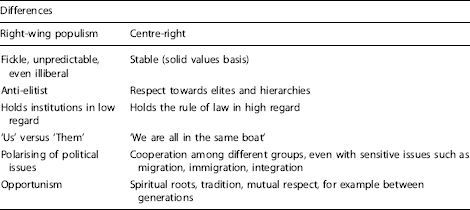
The following example vividly shows the differences between conservatism, Christian Democratic and liberal approaches and those of populism, which is genuinely anti-liberal: the two sides have remarkably different attitudes towards the institutional procedures of the democratic constitutional state. Conservatism holds the regulations of representative democracy in high regard, but populism holds them in low regard. The latter expresses suspicion against contributions by corps intermédiaires; it finds that they mediate between the people and the government and thus bastardise the true will of the people. Populism pursues the aim of weakening the institutions it regards as inconvenient, in particular those unable to prove that they were legitimised by popular vote.
Overall, the comparison between right-wing populism and the centre-right can be concluded thus:
Populism was born of protest against ideological mainstream parties. As a result, modern right-wing populism is a ‘response to a strategic position problem of a people's conservative major party, which, in the eyes of its right-wing conservative regular clientele, proclaims a programme that is too blurred in specific areas’, as emphasised by the Austrian political scientists Fritz Plasser and Peter A. Ulram (1989, 155). Thus, conservatism is urged to defend its policies because it has a more fluctuating, flexible clientele, beyond church or other pillars of society, and more issue-based voters who are compelled to react to a strengthened, right-wing populism which pushes a flexible politics without values. The most common demand in this context is that the centre-right parties should hone their programmes so that they are clearly distinguishable from the social democrats or socialists. But of equal concern is refining responses to the urgent questions of social justice and preserving wealth in the context of an increasingly international economy. Also central are the questions of a modern national and international environment policy, educational justice and the vision of the European Union itself in terms of exploring the philosophies of austerity versus growth based on economic stimulus.
With regard to the organisational strengthening of the parties, there are various proposals which aim to make membership more attractive and to make the processes of a party more transparent and open. The Social Democratic Party in Germany (SPD), for example, has recently made some attempts to integrate non-members into the party branches, which is highly controversial and risky. Letting non-members vote would devalue party membership and leave room for manipulation by opposition forces. The reason for these initiatives lies in the decline of party membership throughout Europe: the SPD has lost almost half of its members since 1990 and the average age of party members is now almost 60. Populist parties are already heading in new directions in this respect, as shown most commonly by the Dutch single-member Party for Freedom (PVV) under the leadership of Geert Wilders. This party is therefore not even a couch party, more a one-chair party. Mainstream parties also have to frequently contend with losses among their members and junior members. To a certain extent, the first steps for activating members and making membership attractive again have already been taken or are in their planning stages. However, the extent to which such activities are able to help recover from the electoral downfall of the major parties and their organisational weakening is yet to be determined (Wilp 2011, 129–162).
A particular challenge is the division and fragmentation of society due to individualisation and secularisation combined with globalisation. It puts pressure on the mainstream parties to implement ever greater integration measures in order to bond the various groups and settings. Populism has here an opportunity structure, a risky response to deeply held societal trends and changes, which should be taken very seriously. It constitutes an alarm that something fundamental is missing when it comes to political representation; to political communication from the current political, cultural and economic elite; and to dealing with violent social developments. But it can also be regarded as an alarm that there is something fundamental missing within such developments.
What we need is a new deal between generations given the fact that activists in institutions such as churches, assemblies and political parties tend to be older; a pact of solidarity within the EU and its Member States based on values; and a pro-European attitude, mutual understanding and reliability. We need an agreement defined by socio-economic security within the model of a social market economy and based on the proud preservation of the ideals of the welfare state, of cultural openness, of an international attitude against xenophobia and against inward-looking nationalism which still upholds national democracy. Such a pact could constitute an answer to populism (Cuperus 2011, 163–178).
One further demand is that the established parties must agree on an approach to the issues raised by populism. All political parties certainly have to deal with topics such as violence, immigration 2 and national identity. One can also see in this strategy a danger to democracy: if the populist topics are established in the democratic mainstream, then values like equality, protection of minorities and mutual respect in political discourse are at risk. Many European governments are already adopting stricter immigration policies because of the (in)direct influence of populism. In Belgium, for example, the Vlaams Belang brought about a change to existing migration and integration policy despite its inability to participate in government because of the cordon sanitaire set up by the established parties.
See Novotný (2012).
Representative democracy is based on pluralism, and the entry of a populist into the system, bringing the politics of resentment, polarises opinions because of the populist distinction between us and others and its blaming of elites. For non-populist parties and politicians in the ranks of the mainstream parties, it means an immense challenge: they have to avoid broad simplification and make the complexity of the things in question understandable, as the great thinker Ralf Dahrendorf said (2003, 160).
How do we respond to technological progress?
In modern democracies, political parties tend to be professionalised media communication parties with the following features (Jun 2004):
professional communication management;
issues quickly adopted based on the criteria of media logic, via Twitter;
oriented more to single issues than to a coherent programme;
perceived competences filtered through a strategic centre of power; and
reduced importance of active members.
The new technologies bring with them the advantage of virtual activism and the possibility of grass roots movements in a democratic and global way. Such developments also contain some anti-democratic tendencies, however, including the creation of a more passive and drifting base of support, less able to hold leaders accountable, and the emergence of a new, narrower digital elite that has displaced the older, more traditional activist base. Parties which can no longer rely on the notion of membership for their legitimising myth work instead on their digital presence; they find themselves suffering a loss of real members and general support and having to turn to alternative resources to retain influence (Margetts 2001). The rise of newer, user-driven Web 2.0 technologies such as blogs, social networking sites and video-sharing tools has raised new opportunities for party activism and organisation. As well as offering new means for parties to organise their supporters and activists, these applications also stimulate the growth of unofficial groups and networks, which are loosely aligned with party politics but are not under their control.
Digital politics requires a new design of power; the new currency is represented not by traditional ownership, but rather by potential access. Access–-online as well as offline, material as well as idea-based–-opens up new options. Which party will be able to master the future by providing new access? Professional parties also suffer from permanent communication stress, which has increased in digital democracy. Everything they do now is public, under real-time conditions. Party leadership, which now adheres to new participation formats, including attempts to activate non-party members, is placed under additional participation and performance pressure. There is also a danger that the requirements for a good politician might get slightly twisted. Is it becoming a necessity for a proficient candidate, for example, to have the good looks, good performance skills and aptitude to act as a media person instead of bringing deep content and strategies (Korte 2012)? In this environment the party's name and symbols are merely branding, similar to corporate marketing devices for products. Like virtual corporations in the networked information technology, cyber parties network across traditional organisational boundaries, based on spin doctors, PR and policy bites. But rebranding is needed for cases in which the substance in government (reform processes which need ongoing interaction with ministerial bureaucracies) is not enough. Professional media-communication parties, such as New Labour in Britain and the Social Democratic Party of Germany (Jun 2004), failed under the conditions of realpolitik.
All political parties have to accept the fact that democracies are developing from party democracies into virtual audience democracies. 3 Politics can literally be regarded as serious theatre: just as the actors are assessed after the show–-by standing ovation, applause and so on–-the electorate today has a retrospective opinion on the performance of political parties and politicians. As a consequence, parties now are pretty much focused on media communication. The attributes of such audience democracies are
As early as 1997 Bernhard Manin used the term ‘audience democracies’ (Manin 1997).
a greater distance between representatives and the electorate;
multi-channel, but unselective, political communication (the information superhighway with an overkill of unproven messages);
despite an active role in social media and Web 2.0, a reactive role in the highspeed decision-making process which is sometimes, at the top, still a closed-door politics.
Of course, not everybody participates in the theatre of politics. As parties lose members and stable voters the picture has positive elements (concerning the possibilities of virtual activism) and negative (concerning activism with real membership and stable voting). Party organisations have to deal with this. One can observe two extreme positions or models: one is a strictly authoritarian form of leadership; another is consistent with the model of the Pirate Party, currently so successful in Germany, which involves more participation via the Internet and a new style of participation and organisation. The centre-right will never follow these extremes, opening up all the decision-making processes in an anarchist way or putting all decisions in the hands of a single person.
The structure of the established parties will not change at the core, at least not yet, even while new competitors pop up, focusing more on campaigning than on organisational life between legislative periods. Not all people can or want to use all the technological devices and opportunities available. So for the foreseeable future, possibly decades, parties will also have to deliver their messages in the traditional way. There will be more participation, as can be seen in the US-inspired primaries of the French Socialists and the use of membership surveys. There will be more participation and active involvement in leadership selection and in matters to be resolved by the leadership. Much hope has been placed on Web 2.0 to facilitate more people participating in party activities, but that avenue will not produce miraculous results. Nevertheless, Facebook, Twitter and other social media can contribute to activating and mobilising members and (already politicised) non-members.
Of course, the classic membership parties on the national level are losing significance. In none of the long-established Western European democracies have raw memberships fallen less than 25 % (Van Biezen et al. 2011, 24–56). This also means that it will be possible to vote in elections for ad hoc movements absent vital party life. The example of Wilders shows that even one member (Wilders himself), even only one chair instead of one couch, is enough to create a successful political party. Besides these extremes, membership parties will prevail–-on a low level in Western Europe and with weak civil society in Central and Eastern Europe. Also in the future, parties will claim a monopoly on linking citizens and political institutions, people's interests and political decision-making. With less penetration in society, the question is whether parties in this form still possess the necessary legitimacy.
Perspectives and recommendations
For centre-right parties, the central challenge will be to implement new, realistic forms of participation without surrendering political leadership and the values of representative democracies. The change in communication that results from the new technologies should not lead to a new gap in society, for example, between old and young, educated and non-educated, globalised or locally oriented people. Changes will be smaller than some party strategists and marketing experts are now claiming, because parties can reform or transform their organisational patterns only to a certain extent. On the local level, many parties still use the same methods they used in the 1960s, merely replacing postal invitation letters with e-mails. The central functions of parties will remain. Participation, selection and articulation of interests, and recruitment of people who are in charge of policymaking up to the level of prime minister will continue, as will the parties’ role in legitimising the political system as a whole (Hartleb 2012). But it is possible that Internet-based parties will emerge, beginning in a virtual community but transferring to a real one, as is now being tried in Austria. Future discussions about the organisation and structure of parties will involve questions of membership surveys and decisions as well as virtualisation, especially after the success of the Pirate Party and the dynamics of the social media community, which can sometimes already be regarded as the agenda setter for classic media. Open-minded centre-right parties could take a lead here.
It is possible that the current rise of populism is just a temporary aberration on the road to normal European party politics. An alternative explanation is that there is a process of profound political transformation, with traditional programmatic parties gradually giving way to new, situational political players. In this age of populist politics there is no need for coherent party platforms and stable loyalties. Parties have to adapt their communication using slogans and sound bites, which they have already started to do, while keeping up stability, credibility and loyalty among the electorate. Otherwise, political parties are simply interchangeable vehicles of unpredictable emotions produced by (social) media and marketing, and their deeply rooted functions in society and the transformation of people's interests (inputs) into the decision-making process (outputs) will be lost. The centre-right is, with its values-based approach, in a good position and can be optimistic about further challenges.
Guidelines for the centre-right parties can be organised so that parties remain a credible alternative for voters who are tempted by the new framework of politics. The author concludes with the suggestions that the centre-right
strengthen and promote the role of political elites instead of indulging the nationalist politics of making them appear ridiculous, emphasising that politics is a highly specialised and exhausting profession;
attack the populists by pointing out that their tendency to present the homogeneous people with scapegoats (creating a distinction between us and them) would automatically lead to a new era of the kind of authoritarianism we just overcame in Europe in 1989/90;
emphasise the role of Christian Democracy and conservatism in the framework of humanism, pointing out that socialism has a tendency towards a so-called proletarian revolution and populism has no tradition at all;
give the floor to new ideas and a non-arrogant, non-elitist approach to politics based on personal achievement and substance, not on hierarchy or career opportunism;
emphasise that centre-right parties are honest, that political matters are complex and long-standing, and that there are rarely simple solutions to complicated problems such as the current global financial and euro crisis;
point out the role of the centre-right as a frontrunner in the process of European integration;
blame the populists for not having any positive idea about Europeanisation and multifaceted globalisation;
open up some participation tools within the parties in a filtered and structured way without following the Pirates and the Socialists in such matters as active involvement of non-members and conducting primaries;
use the tools of modern e-participation without abandoning respect for the institutions within representative democracies;
deal with policies of growing importance such as cyber security and tension between Internet freedom and data protection;
find a values-based approach to the new technologies without neglecting the big groups of unaffiliated people, the role of classical political communication and the balance of the young and the old, creating a fair, new contract between generations in the ageing European societies.
Footnotes