




Abstract
The idea of a ‘two-speed Europe’ has often been viewed negatively, as a threat to European unity and a departure from the European ideal. This article argues that the EU has always allowed ‘variable geometry’, or selective membership, in certain policies and projects. Speaking of ‘the danger’ of a two-speed Europe therefore makes little sense. Instead of fearing a multi-speed Europe, we should embrace the term as a positive expression of the EU's ability to accommodate the preferences of different national electorates. The variable geometry makes it possible to keep countries inside the EU instead of forcing them out of the Union by imposing unacceptable policies on them. The new set of laws concerning economic governance has introduced even more ‘speeds’; however, in principle this does not represent a departure from the existing pattern.
Introduction
A spectre is haunting Europe—the spectre of a multi-speed Europe. The threat of a two-, three- or multi-speed Europe has been invoked many times in relation to different EU policies and legislation. It has been brought to the fore by the ongoing discussions on how the EU should address the current economic crisis. For example, in January 2011, Polish Prime Minister Donald Tusk, when discussing the intergovernmental Treaty on Stability, Coordination and Governance in the Economic and Monetary Union (the Fiscal Compact), stated: ‘From the beginning of the Polish presidency [July to December 2011] we have emphasised our commitment to solving…problems [with countries’ participation in the EU's economic governance structures]. The last thing we would wish for is a two-speed Europe’ (‘Poland wishes Denmark success’ 2012).
As another example, the UK newspaper The Guardian exclaimed: ‘Now it's three-speed Europe. And we're left on the hard shoulder’ (Rawnsley 2011). This was following Britain's decision not to sign the Fiscal Compact and referred to the fact that Britain has not adopted the euro as its currency.
This article argues that the ‘unity dogma’ (cf. Thym 2005) has been part of the process of European integration since the 1950s. However, there has always been an opposite tendency, one that allows differentiated involvement of the Member States in the EU's policies and institutions. The former has pushed forward the European project; the latter is why the EU has not fallen apart.
Definition
‘Two-speed Europe’, ‘multi-speed Europe’ or, more colourfully, ‘Europe a là carte’, refers to EU Member States participating in some EU policies and institutions but not others.
Table 1 shows examples of 5 policies in which fewer than the EU's 27 Member States participate. The Schengen area refers to the EU's passport-free zone (which also includes several non-EU countries). The euro is the EU's common currency, agreed in the Maastricht Treaty of 1992 and adopted since 1999. The single European patent was agreed in 2011 after 30 years of discussions. Italy and Spain have not acceded to the agreement because European patent applications can be lodged in English, French and German but not in Italian or Spanish (Pompidou 2011). International divorces refer to common rules for divorce between couples of different European nationalities: 14 Member States have decided to utilise a provision in the Lisbon Treaty, which allows ‘enhanced cooperation’ among countries that want to adopt a particular policy initiative. This has followed the inability of the EU's 27 justice ministers to adopt a common EU-wide procedure (Goldirova 2008). Finally, the Fiscal Compact of December 2011 binds signatories to maintain national budgets that are in balance or in surplus; it has been signed by 25 of the Member States.
The table gives only a sample of the large number of EU policies that have the less than complete participation of Member States. Many new policies have emerged in response to the economic, financial and debt crisis. For instance only 23 countries signed the Euro-Plus Pact on fostering competitiveness in the EU in March 2011.
Some EU policies that have the less than complete participation of Member States
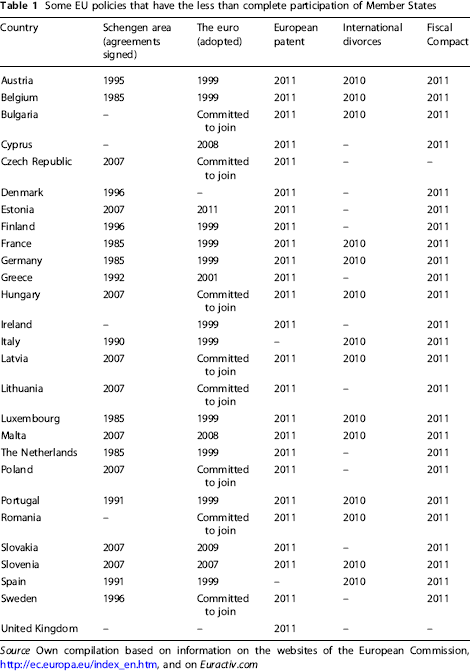
Source Own compilation based on information on the websites of the European Commission, http://ec.europa.eu/index_en.htm, and on Euractiv.com
Opinions on a multi-speed Europe
The range of opinions on the threat, or existence, of multiple speeds is vast. Nevertheless, several schools of thought can be identified, with countries fitting into these groups. At the risk of oversimplification, the views represented by these groups are as follows.
Encouraging a multi-speed Europe from the ‘fast lane’
This school of thought accepts that groups of Member States develop policies selectively. It often encourages ‘different speeds’. This opinion has most forcefully been advocated by France in relation to managing the EU's economic and debt crisis, and to building up economic governance in the eurozone as a response. The French government has repeatedly stated its preference for an integrated core of eurozone countries, with the remainder of EU Member States not participating in these structures. This is in line with French efforts to institutionalise governance in the eurozone in order to provide a powerful counterweight to the European Central Bank. Following this long-term French policy, President Nicolas Sarkozy (2007–12) first promoted the idea of a permanent gouvernement économique by convening an extra summit of the heads of state of the eurozone in 2008 at the outbreak of the financial crisis (Jamet et al. 2011, 46). France also proposed a permanent secretariat for the eurozone economic government. Despite German objections, four ad hoc meetings of the eurozone heads of state or government had taken place by October 2011. The Fiscal Compact of December 2011 envisaged that these meetings would become regular.
Some countries which belong to this group do not encourage asymmetric policies but nevertheless want to be in the ‘fast group’. As Estonian President Toomas Ilves said when explaining his country's desire to join the euro, ‘If [a two-speed Europe] happens, we'll be in the fast group. We're not for it and in terms of willingness to participate in the integration of Europe, we opt in, not out’ (Pop 2010).
As in all generalisations, there are exceptions. France tentatively detached itself from the ‘hard core’ of European integration in spring 2012 when it threatened to withdraw from the Schengen agreement unless the EU properly guards its external borders.
Deliberately staying in the ‘slow lane’
This school of thought is marked by a paradox, related to the adoption of the euro. Countries that have stayed outside the common currency are not achieving slower economic growth than countries that have joined (Open Europe Blog 2011).
Taking into account EU policies overall, several countries stand out as belonging to this group: the UK, Denmark, the Czech Republic and Sweden.
The UK is the most prominent representative of this group, having stayed out of the euro and out of the Schengen area (although it does participate in some aspects of the Schengen agreement, such as the Schengen Information System). It has negotiated derogations from the justice and home affairs part of the Lisbon Treaty and secured an opt-out from the Charter of Fundamental Rights of the European Union. In December 2011 the UK, along with the Czech Republic, was one of only two countries not to sign the Fiscal Compact. British Prime Minister David Cameron characterised this as a preference for a ‘flexible network’ over the ‘rigidity of a bloc’ (Cameron 2011). Given long-standing British Euroscepticism and difficulties with the ratification of European treaties, there is little doubt that the UK would not have agreed to sign the consecutive treaties had it not been allowed to opt out of some EU policies.
Struggling against the retrenchment of multiple speeds
This view has most forcibly and consistently been expressed by the European Commission, which has opposed plans for institutionalising ‘multiple speeds’ in relation to all EU policies in general, and the euro in particular. For example Commission President José Manuel Barroso stated in a speech in November 2011 that the Commission stood against ‘a union with different parts engaged in contradictory objectives; a union with an integrated core but a disengaged periphery; a union dominated by an unhealthy balance of power or indeed any kind of directorium’ (Pop 2011).
In his speech, Barroso even suggested that all EU countries should adopt the euro, despite the fact that the Treaty on the European Union gives the UK and Denmark a permanent opt-out.
Among the Member States, Poland is the most prominent player in this group. It has criticised, for example, the EU's Common Agricultural Policy, as common ‘only in name’. This is based on the fact that direct payments for farmers in the Central and East European Member States are linked to farm size, while those in the ‘older’ Member States are measured by historic stock or crop levels. This system puts Polish farmers at a disadvantage (Willis 2010). Poland has also put forward a forcible argument concerning appointments to the External Action Service which have reinforced the division between the ‘old’ Member States and those who joined in 2004. Although not openly using the rhetoric of the two-speed Europe, the Polish government was critical of the fact that the 10 ‘new’ countries obtained just 2 out of the 115 posts for the EU's heads of foreign missions in the newly created European External Action Service (Rettman 2010). More recently, the Polish foreign minister warned against the creation of ‘divisive mini-EU coteries’ (Sikorski 2012), that could entrench a two-speed Europe when it comes to economic governance. The concern is that the integration of eurozone countries would lead to ‘a new core and a new periphery’ (Sikorski 2012), the latter being nations which have not joined the common currency. Poland has time and again asked the European Commission to stand up for the equal participation of the Member States in important economic decisions.
Some countries are difficult to assign to one of the three categories above. Germany, for example, has long opposed ‘multiple speeds’, specifically in relation to institutionalising governance in the eurozone. In 2007, during negotiations for the Lisbon Treaty, German Chancellor Angela Merkel said that a two-speed Europe would lead to ‘the opening of new trenches in Europe’ (Jamet et al. 2011; Mahony 2007). Germany has also consistently refused to agree to the creation of eurobonds, which would lead to the mutualisation of eurozone debt and to the creation of an exclusive ‘fiscal union’ of eurozone countries. More recently, however, Germany has joined France in advocating regular meetings of eurozone presidents and prime ministers (Mahony 2011), thus implicitly excluding those countries which have not adopted the euro. According to Barysch (2010), Germany is now at the forefront of the new move towards ‘intergovernmentalism’ in which decisions are taken between the Member States rather than through the common EU institutions.
The long history of EU asymmetric constitutionalism
A look at the history of European integration reveals that these three schools of thought have existed since the creation of the European Communities. There has always been a strong tendency for a uniform application of the European supranational legal order. On the other hand, as Thym (2005) demonstrates, there has always been differentiation in the adoption of EU-wide legal provisions. The original Treaty of Rome in 1957 contained country-specific safeguard clauses. Even the Single Market, arguably the most important pillar of European integration, is subject to flexibility and differentiation (Thym 2005, 1731).
The Maastricht Treaty of 1992 permitted the non-participation of Member States in a specific policy field, with their voting rights suspended for that policy area. At the time, this applied specifically to the third stage of the monetary union, concerning the adoption of the euro. This practice then continued in the Treaty of Amsterdam (1997) with regard to the Schengen law, as well as to justice and home affairs matters (Thym 2005, 1733). The enhanced cooperation procedure of the Treaty of Lisbon then entrenched and ‘institutionalised’ this mode of policymaking in the EU. EU policies have thus always been ‘patchy and somewhat uncoordinated’ (Nugent 1999, 348–9), never reaching the ideal of complete coherence.
The most prominent area in which the concept of a two-speed Europe is being debated is economic governance. As a result of the need to present a united response to the financial and economic crisis, the EU has set up new policies and agreements that include the 17 members of the eurozone. Several non-eurozone countries are also participating in these new structures. Some commentators (e.g. Hill 2012) have argued that this will lead to a federal arrangement among the eurozone countries. Economic union may lead to political union because of the need to maintain democratic legitimacy for fiscal decisions that eurozone members take centrally. As long as the new federal structure remains open to members ‘migrating’ into it at a later stage (Hill 2012), few legitimate objections can be raised against such a process.
Of course, there are exceptions: there are areas where EU law has never been negotiable. They include the protection of human rights, the rule of law and multi-party democracy. These values are now protected by Article 2 of the Lisbon Treaty.
Conclusions
There is little doubt that the ever-higher number of members in the club increases the variety of interests that come into the EU, and that this is reflected in the growing complexity of EU institutions. The economic and financial crisis has aggravated divisions among Member States. Power is shifting from EU institutions to national capitals; and economically stronger countries are tending to have more of a voice in shaping EU policies than ever before (Barysch 2010). Among the different ways of dividing the EU by ‘speeds’, the division between the eurozone and the remaining 10 countries, and the associated disputes over the shape of economic governance, raises the strongest emotions.
In that light, all three schools of thought outlined above have their drawbacks, rooted in an exaggerated promotion of national interest. Encouraging a multi-speed Europe is already increasing the dominance of several powerful countries that form the ‘hard core’ of European integration. ‘Staying in the slow lane’ is problematic in that it discounts solidarity on the part of those countries that have the resources and potential, but not the political will, to contribute to dealing with Europe's economic problems and other policy challenges. Finally, insisting on a ‘single speed’ is questionable if the country in question wants to sit at the same table as the others but is not prepared to fulfil the necessary conditions, for example concerning entry into the eurozone. In addition, as Hill (2012) noted, the variable geometry increases the complexity of decision-making mechanisms in the EU, thus blurring the lines of authority and accountability.
Yet one always has to ask what the other options are. Power in the EU continues to lie with the Member States, which, according to the Lisbon Treaty, are entitled to leave the EU. The European Commission has been a firm promoter of the interests of the entire EU, and can be relied upon to continue in this role in the future.
From this perspective, accommodating national preferences while continuing to demonstrate the advantages of joint solutions is the preferred option. The reasons for this are threefold. First, the EU can be likened to asymmetric federations and asymmetric quasi-regionalised states: Recent history shows that these entities have a somewhat better chance of survival, taking the examples of Spain, the UK and Belgium (cf. Thym 2005). In contrast, the split of the symmetric federation of Czechoslovakia in 1992 showed that a completely symmetrical unity is difficult to maintain. Second, ‘variable geometry’ allows policy experimentation. Depending on the quality of a particular EU policy, countries make good or bad choices by joining in or opting out. Policies that are adopted by some can conflict with approaches that outsiders have decided to pursue, thus leading to a healthy competition of ideas. Finally, multiple speeds are an expression of the much-needed politicisation of the European Union. They challenge the more technocratic solutions that can sometimes emanate from European institutions and allow varying national interests to be voiced.
The EU has an almost impeccable record of including latecomers in its policies. The euro is a prime example: Since its adoption by 11 countries in 1999, 6 other countries have joined the common currency and more are expected to follow in the future. At the same time, few would dispute that the eurozone, and the EU as a whole, would have benefited from some countries joining it when they were ready rather than joining prematurely. The expansion of the Schengen area is another good example of a gradual extension (although the problems that Romania and Bulgaria are facing in acceding to Schengen show that the EU's record in welcoming new members to existing policies and institutions is less than spotless).
A Union that would demand participation in the totality of its policies would no doubt be less attractive to existing and new members alike. Instead of lamenting the multi-speed Europe, we should therefore embrace the concept. By being flexible and asymmetric, it is the European integration project that stands to gain in the long run.
Footnotes
Acknowledgments
I would like to thank Naďa Kovalčíková for her research assistance and Florian Hartleb, Santiago Robles and Rodrigo Castro Nacarino for their helpful comments.