




Abstract
Europe's debt crisis is by no means unique but quite the contrary: Canada had to face a similar challenge during the 1990s. The way this country dealt with the crisis is often presented as a success story. What are the lessons that Europe can learn from Canada's experience? This article examines the similarities between both crises, explains the main reforms Canada went through and finally analyses the key factors that influenced and enabled this country to overcome the crisis.
The fiscal-consolidation experience of Canada, or more precisely of the federal government, in the second half of the 1990s is often presented in international case studies as one of the most successful examples of fiscal consolidation in recent history. It is thus worth reviewing the lessons learned then that could be applied now and in the coming years. The Organisation for Economic Co-operation and Development (OECD), on Canada's successful 1990s-era fiscal reforms [8, 69].
Canada's fiscal corrections in the 1980s and 1990s
The debt crisis now engulfing selected European states such as Greece and Italy, and which has also led the British coalition government of Conservatives and Liberal Democrats to enact deep budget cuts, is not without precedence on the other side of the Atlantic. The factors that underlie the rise of fiscal and budget problems in Europe and the UK played out decades ago in Canada.
In Canada, beginning as far back as the 1980s, there was growing awareness and concern among some Canadians about provincial and federal ‘red ink’. By the early 1990s, concern spread across Canada, first among the provinces and then to federal politics. Federally, a new right-leaning party (the Reform Party) made fiscal responsibility its main plank and displaced the existing centre-right party (the Progressive Conservatives) in parliament. Overall, by the early to mid-1990s, reductions in spending had corrected Canada's previous chronic deficits at the federal and provincial levels. That early effort is an important reason why Canada's finances look healthy at present when compared to many other OECD countries.
Europe's present similarities to Canada circa 1993
Turn around and check out Canada, which has now become an honorary member of the Third World in the unmanageability of its debt problem. If dramatic action isn't taken in next month's federal budget, it's not inconceivable that Canada could hit the debt wall…It has lost its triple-A credit rating and can't assume that lenders will be willing to finance its growing debt forever [5].
To understand the scope of the debt problem in Canada in the 1990s or in Europe at present, consider the debt trajectory of selected European countries since 1993, about the time some of Canada's governments began to grapple with Canada's deficits and burgeoning debt. 1
All the following figures are from [9].
In 1993, net liabilities for the present-day euro area countries amounted to 42.8% of gross domestic product (GDP). The United Kingdom's net liabilities stood at 17.4% in 1993. In contrast, that year, Canada's net liabilities were substantially higher, at 64.2% of GDP. They escalated further, reaching an all-time high of 70.7% in 1995. 2
Figures quoted are for the general government sector for all countries which, as the OECD notes, is a consolidation of accounts for central, state and local governments, plus social security.
Fast-forward to 2011, and the Europe–Canada positions have dramatically reversed. Euro area net liabilities now stand at 60.0% of GDP. The United Kingdom also faces a substantially higher net debt-to-GDP ratio than it did in 1993, at 62.4% as of 2011. Canada's equivalent figure is now just 33.7%, down substantially from the early and mid-1990s (though up from the low point in 2008, when the figure was just 22.9%; Fig. 1).
A short history of Canada's long descent into debt
Canada's debts were not created in a short time frame. Canada's federal government ran deficits in 37 of the 50 years between 1962 and 2011 3 (see Fig. 2; [1], Table 1). Indeed, the 11-year string of surpluses, which ended as of the 2009 recession, was a rarity in post-1950s Canada. 4 How Canada arrived at a better fiscal position, especially given its historical trend line, requires some elaboration from recent Canadian fiscal history and internal politics.
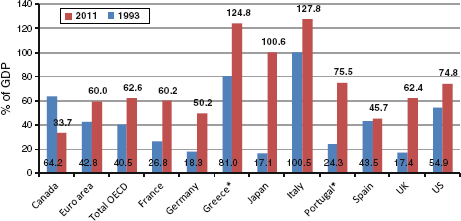
Net liabilities as a % of GDP: Canada and selected countries 1993 versus 2011.
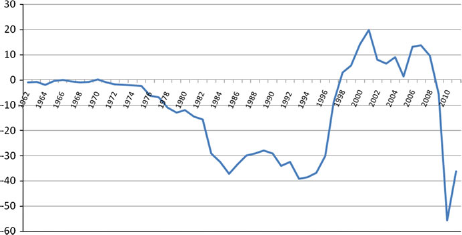
References to Canadian budget years are to fiscal years, which run between 1 April and 31 March. Thus, a reference to 1993 refers to the period 1 April 1992 to 31 March 1993.
The current forecast from the federal Department of Finance is for Canada to return to a balanced budget by 2015.
Early opposition and action on deficits in Canada's westernmost province
Debate over the sustainability of growing public debt began to be addressed, at least in one province, in the early 1980s. In 1983, a series of reforms in Canada's westernmost province, British Columbia (BC), was proposed and then acted upon.
The ‘restraint programme’, as it was known, included the abolition of rent control, the freezing of public sector pay, a 25% cut in public sector employment, a reduction in most public services and the privatisation of others, significant controls on medical and education spending, changes in the province's labour code, and the restructuring of employment in the public sector and universities.
Writing in 1987, one newspaper columnist, while critical of some aspects of BC's restraint programme, noted how ‘there are many examples of governments that did not act to contain spending and now face much greater debts than BC: Alberta, Saskatchewan, the federal government, and to some degree the US’ [10].
Fiscal reform spreads
The restraint programme in British Columbia was necessary because Canada's provincial governments had long increased spending faster than inflation plus population growth. As a provincial average, from 1961 to 1993, provincial government spending increased almost sixfold (after inflation) from CAN $1,300 per Canadian in 1961 to CAN $7,400 by 1993 [3]. Thus, the need to control public spending should have been obvious. However, British Columbia's 1980s experience was an early example of fiscal reform in Canada, and an outlier. As later acknowledged by supporters and opponents, BC's restraint programme was the model for other provinces when they decided to stop the growth of public debt [4].
Still, despite the example of British Columbia, it was only in the early 1990s that other provinces finally began to address their ongoing fiscal deficits. When they did, the degree to which restraint was applied in various Canadian provinces is demonstrated by the following summary, with the subsequent duration of the party then in power following in brackets: 5
All provincial figures are from [1], Tables 17–30.
Between 1991 and 1994, Saskatchewan, governed by a left-leaning party, the New Democratic Party, reduced programme expenditures by 10%. (The party stayed in power until 2007.)
Between 1993 and 1996, Alberta, governed by a right-leaning party, the Progressive Conservatives, reduced programme expenditures by 22%. (The party is still in power.)
Between 1993 and 1994, Ontario, governed by a left-leaning party, the New Democratic Party, reduced programme expenditures by 2%; between 1996 and 1998, a right-leaning party, the Progressive Conservatives, reduced programme expenditures by 4%. (The New Democratic Party lost power in 1995; their successor, the Progressive Conservative Party, introduced additional austerity measures and was in power until 2003.)
On average, between 1993 and 1997 provincial programme expenditures were reduced by 2% among Canada's 10 provinces.
In summary, many Canadian provinces reduced or froze programme spending for several years in the 1990s. Total provincial programme spending, which reached an all-time high of almost CAN $140 billion in 1993, did not again reach that level until 1998. This was a remarkable feat given inflation and Canada's growing population, but such measures were crucial to dealing with previous chronic provincial deficits. By the new millennium, fully nine out of ten Canadian provinces had introduced budgets that were in surplus.
Federal fiscal fixes
By 1993, a similar process was needed if the federal government was to restore balance to its books. The Progressive Conservatives, in power between 1984 and 1993 and under the leadership of Prime Minister Brian Mulroney, had not definitively dealt with the federal deficit. Similar to provincial spending patterns, by 1993 Ottawa's fiscal problems were the result of decades of escalating spending that outpaced inflation and population growth. Such spending growth was financed in part by deficits (see Fig. 2). The result was that by 1993, one in every three federal tax dollars was diverted to pay interest on the federal debt ([1], Table 1).
Brian Lee Crowley, Jason Clemens and Niels Veldhuis explain how Canada's federal fiscal position had deteriorated into the state it had by the early 1990s:
The central cause of the fiscal crisis was Ottawa's inability to control spending and unwillingness to raise taxes commensurate with that spending. From 1965 to 1993, federal government spending per Canadian increased from $2,593, adjusted for inflation, to $6,810—an increase of 163 per cent [3, 68].
In late 1993, the centre-left Liberal Party was elected to a majority government. The main, though not official, opposition was a new entity, the Western-based Reform Party. 6 The Reform Party emphasised the necessity of dealing with chronic federal deficits and openly campaigned on a platform of necessary fiscal austerity. It offered itself as a distinct, fiscally conservative alternative to the three other parties in parliament. The Reform Party garnered third place in Canada's federal parliament (from no representation in the previous parliament). It also displaced Canada's main conservative party, the Progressive Conservative Party, as the main right-leaning party in the country. Importantly for the purposes of this article, the Reform Party ran and won one-sixth of the parliamentary seats on a populist and fiscally conservative platform.
The Reform Party garnered 52 seats in 1993, just short of the 54 seats won by a Quebec-based separatist party, which led to the separatist party becoming Canada's official opposition in the federal parliament. The Progressive Conservatives, displaced by the Reform Party, fell to just two seats. The Reform Party would eventually become the official opposition in 1997. The Reform Party in a later incarnation and the Progressive Conservatives merged in 2002 as the Conservative Party of Canada. The Conservatives won power in 2006 under Prime Minister Stephen Harper, who had first been elected to parliament as a Reform MP in 1993.
Under the Liberals, federal programme spending was reduced from CAN $123.2 billion in 1995 to CAN $111.2 billion by 1997, or by 10% over that two-year period. The 1995 peak was not again surpassed until 2001; six years after the federal government first began to address Canada's fiscal problems ([1], Table 1). The austerity measures did not hurt the governing Liberal Party, which was re-elected in 1997, 2000 and 2004, and only lost power in 2006—13 years after first being elected to power.
Analysis: why were Canada's governments able to tackle the fiscal crisis?
First, the numbers mattered more than the ideology
By the early 1990s, the numbers simply became too compelling to ignore. While Canada, similar to Europe, has a plethora of viewpoints on the proper role of government, the math was unavoidable. When, by 1993, the federal government was spending fully one-third of its revenues on servicing the federal debt burden and the provinces spending an average of 15% of their revenues on debt interest ([1], Table 1), it was clear that choices between tax relief and programme spending were regularly being sacrificed simply to meet interest obligations. Thus, the debate over debt reduction became largely non-ideological. That was why governments of every political stripe decided to pare or freeze spending in Canada in the 1990s.
As the centre-left Liberal Finance Minister, Paul Martin, asserted in his 1995 budget speech, ‘We are acting on a new vision of the role of government… smaller government… smarter government’. Martin went on to make a non-ideological and non-partisan argument about the simple math of deficits: ‘The debt and deficit are not inventions of ideology. They are facts of arithmetic. The quicksand of compound interest is real’ [7].
In that sense, by 1995, what centre-right think tanks and parties in Canada had long argued—that fiscal prudence dictated control of government spending in most years, absent a severe crisis such as war—had even been adopted by political parties of the centre and left. The examples of austerity offered by the federal government under the Liberals and in the province of Saskatchewan, under a self-described socialist/left-wing government, both demonstrated this reality. This came about even though some centre-right parties in Canada had not always preached what they practised, the federal Progressive Conservative government between 1984 and 1993 being a prime example, during which deficits had continued and even deepened.
Still, insofar as centre and left-of-centre governments adopted conservative policies, they demonstrated that the arguments about austerity, balanced budgets and more prudent spending were not an ideological invention from ‘the right’ but a recognition of mathematical reality: governments could not continually overspend without endangering even existing social programmes, to say nothing of what such overspending would do to potential tax levels, credit ratings and eventually the economy.
Second, credit rating downgrades added pressure for fiscal reform
In October 1992, Standard and Poor's cut Canada's triple-A credit rating one notch. It had little effect on the markets that year. However, in 1994, when Moody's also downgraded Canada, 10-year note yields rose by 0.45% over one month while the stock market fell 6%. When, in April 1995, Moody's downgraded Canada's key sovereign debt rating by one notch from Aaa, the gap between US and Canadian 10-year bonds rose to 1.88 percentage points from 1.30 percentage points over just four months. In a 2011 Wall Street Journal article, one asset manager noted that such ratings downgrades helped prod Canada's federal government to move more quickly to balance the budget [6].
Third, domestic examples and public pressure led to reform of spending patterns
Early examples from Western Canada, especially Alberta and Saskatchewan, where a right-leaning and left-leaning government respectively both reduced programme spending—and became more popular—showed not only that governments could rein in public spending, but that there was an appetite for such reform from the voting public. That the public was ‘on side’ was also demonstrated by the rise of the Reform Party noted earlier, whose main plank was to deal with the red ink in public finances.
Fourth, even the media were largely critical of weak deficit reduction efforts
After the 1994 budget in which the federal Liberals (under Prime Minister Jean Chretien and Finance Minister Paul Martin) introduced a timid response to Canada's growing debt problems, much of the media condemned the lacklustre effort [11, 178].
Fifth, international attention and pressure mattered, as did internal bureaucratic advice
Importantly, Canada's politicians also began to respond to international pressure. I refer again to the analysis from Crowley, Clemens and Veldhuis regarding Canada's predicament in the 1990s:
The collapse of the Mexican peso in December 1994 illustrated the problem of massive government debt. Shortly after the collapse, the Wall Street Journal highlighted Canada's debt problem and suggested the country was nearing bankruptcy. The Journal article itself caused a sharp devaluation in the Canadian dollar and an increase in interest rates. Indeed, then associate deputy minister of finance and later Governor of the Bank of Canada David Dodge called the Journal article a ‘seminal event’. Finally, international organizations such as the International Monetary Fund and the Organisation for Economic Co-operation and Development were calling for a faster reduction in the deficit [3, 74].
In sum, the federal Liberal Party (in power in Canada from 1993 until 2006), responded to the public and media mood and to advice from civil servants, and also took international critiques of Canada's finances seriously. All proved invaluable in helping the country's leaders to deal decisively with Canada's own debt crisis, years before the rest of the world, which now faces a similar challenge.
Conclusion
The experience of how Canada dealt with its debt crisis is instructive. While domestic opposition to balanced budgets (and the actions needed to arrive at such an end) did exist in the 1980s and 1990s, and usually from those who in ideological terms would be categorised as from the ‘left’ or ‘centre-left’, opponents were forced to recognise that running fiscal deficits for extended periods of time damaged credit ratings and thus drove up borrowing costs. This non-virtuous circle then crowded out other policy options, regardless of whether a party's ideological preference was for additional social programmes, the possibility of lower taxes or a combination of both.
Thus, an important implicit lesson for European centre-right parties from Canada's experience is that when centre-right parties do not take on the challenge, albeit a painful one, of bringing budgets into balance, their political opponents will eventually do so anyway, and they will also take the rhetorical and political credit. Moreover, the parties that will do so can come from both the right and the left.