




Abstract
Given that the huge protest waves of 1968, the early 1980s and 1989-1990 can now be regarded as past history in European democracy, the question now is whether a new protest culture is emerging in Western Europe. New protest literature has reached the top of bestseller lists, giving some evidence of ‘citizens in anger’. The new face of protest today is influenced by political agendas in reaction to recent parliamentary and governmental actions. In fact, although confidence in legislatures and governments is decreasing, there is no general distrust of coherent polities within European national systems. European representative democracies may come under civic pressure in future unless some new means of significant participation are created.
In a recent analysis of protest dynamics in Europe, Simon Teune [14,4] notes ‘that the carriers of protest interact with several actors in resonant fields, such as public institutions, economic players, mass media, potential allies, and adversaries, but also a rather indefinite public of citizens who might support public struggle’. Political protests in contemporary Europe are multifaceted, flexible and ever-changing, and can take place in different political systems—both in modern democracies and in more authoritarian countries. When Communism fell in Eastern Europe, one intellectual argued that we had reached the ‘end of history’ through the ‘victory of liberal democracies’ [5]. After the mass demonstrations against the old Communist regimes, social movements in Europe no longer seem to be pitted against ruthless, authoritarian systems similar to those we now see in the Middle East. However, this does not mean that mass protests belong only to Europe's past. Indeed, there are a few indications that a new protest culture could be emerging in modern democracies, whereby protestors react—after the fact—to decisions made through democratic processes. This, however, can be seen as a smaller, less rapid change to the system, as opposed to the cultural-revolutionary movements in Western Europe, and to a lesser extent in Eastern Europe, witnessed in 1968.
In our current system, which has been called ‘post-democratic’ by Colin Crouch [1], politics and government are increasingly in danger of slipping back under the control of privileged elites, and everyday citizens do not always find that their interests are represented. This article, therefore, focuses on how to deal with this problem going forward. In evaluating protests, it is important to consider whether they are reactive or preventive in terms of the timing of policy intervention; spontaneous or pre-planned; characterised by pre-protest negotiations that are confrontational or preventive; illegal or legal from the standpoint of law; strict or tolerant in terms of the means of expression allowed by protest leaders; violent or non-violent, both on the part of the protestors and the police; and intended to promote a specific aim or a broader agenda [3]. In doing so, I first highlight effective examples of protest literature—publications that have recently had significant impact. I then examine the tendencies, efforts and objectives associated with modern protests. Finally, I refer back to the hypothesis and seek to answer the question of whether there is a new and specific protest culture in Europe. Moreover, it is important to note that every protest movement is the creation of the larger society in which it occurs. In a political context, this refers to the relationships between people and the political systems, political leaders and legislative outcomes that are produced.
Protest literature: a new ideological shift?
The discussion of a new protest culture goes beyond the question of how many people take to the streets during demonstrations. Over the past few years, bestselling publications have dealt with protest topics, which can be seen as one sign of a new protest culture. A series of uprisings, especially in France (such as the banlieu and student protests) and Greece in the last several years, as well as the global economic downturn in the late 1990s inspired the publication of the anonymously authored L'insurrection qui vient (The Coming Insurrection) in 2007, first in France [2]. Meanwhile, although anarchists have argued that a large-scale revolution is implausible, the representative parliamentary systems cause many inequities that can lead to decentralised, spontaneous revolts apart from larger organisational structures (‘All power to the communes!’).
One especially noteworthy example of a book conveying the protest theme is Thilo Sarrazin's [12] recent book Deutschland schafft sich ab (Germany Does Away with Itself), which spent many months on the bestseller list and is the most successful political book in Germany since 1945, with over 1.25 million copies sold. Sarrazin, a Social Democrat, economist and former Berlin councillor, based the book on certain anti-Islamic themes as a form of civic protest. Most controversially, Sarrazin claimed that Germany was being made ‘more stupid’ because of poorly educated and unproductive Muslim immigrants and their offspring, and accused the approximately four million Muslims in Germany of failing to integrate. The bookbuyers—not the politicians—are in this case the people who dominate the integration debate today, and even the act of buying such a book constitutes a statement in itself—a strange acknowledgement that Sarrazin is right. Indeed, anti-Islamic sentiments are rather successful in mobilising Western European parties, especially radical populist parties such as that of Geert Wilders in the Netherlands [15]. In the narrow sense of protest movements taking place on the streets, the anti-Islamic issue does not play as crucial a role. Sarrazin does not appeal for direct protest movements; he is, nonetheless, linked with the expression Wutbürger (citizens in anger), which incidentally was the German word of the year in 2010 [8]. The phenomenon of ‘citizens in anger’ breaks with the bourgeois tradition of a political centre that is focused, calm and composed. The Wutbürger in this description boo, shout and hate. They are conservative, wealthy and no longer young; formerly supporters of the state, they are now shocked by the political elite.
At the same time the German debate was taking place, a short book published in France entitled Indignez-vous! (Time for Outrage) [7] also gathered widespread attention, and not only in France. The author, Stéphane Frédéric Hessel, born in 1917, is a former ambassador, concentration camp survivor and French resistance fighter. The 32-page essay was first issued by a small publisher, with just six thousand copies selling for less than three euros each. By the end of 2010, six million copies had been sold. Hessel's booklet argues that the French need to become outraged once again, just as those who participated in the resistance during the Second World War were. Hessel's rationale for this outrage includes the growing gap between social classes, France's treatment of its illegal immigrants, the need to re-establish a free press, the need to protect the environment and the importance of protecting the French welfare system. He calls for peaceful and non-violent insurrection from a leftist perspective.
Reacting after the fact? New protest movement tendencies in Europe
On the radical left, the anti-globalisation movement (whose slogan is ‘A better world is possible!’) still strives for a common concrete vision and strategy, while some theorists have tried to create a new protest culture through ideologically shaped efforts (see, for example, [6]). Surprisingly, the latest financial crisis in 2008–2009 did not seem to help create a foundation for a new protest culture; the largest protests against the G-8 took place before the financial crisis, in the summer of 2007. A decisive factor behind the organisation of counter-globalisation has been the Association for the Taxation of Financial Transactions and Aid to Citizens (ATTAC), which was created on 3 June 1998 in France. Founded in France, the association now exists in over 40 countries around the world. Originally a single-issue movement demanding the introduction of the so-called Tobin tax on currency speculation, ATTAC now devotes itself to a wide range of issues related to counter-globalisation, monitoring the decisions of the World Trade Organization (WTO), the Organisation for Economic Co-operation and Development (OECD) and the International Monetary Fund (IMF). But, surprisingly, the organisation was unable to gain much headway from the financial crisis of 2008–2009 and the resulting critical views of the capitalist system. It is only the anti-globalisation advocates who seem to be promoting a ‘new Communist manifesto of the twenty-first century’ [16] and a new protest culture. ATTAC promotes Hessel's Indignez-vous! on various websites—understandable, given that Hessel has mentioned ATTAC as an important organisation.
In Europe, people most often take to the streets to protest against austerity measures and controversial projects. This trend implies that dissent arises after decisions have been made by governments on different levels and through democratic bodies such as parliaments. There is not a direct line between the recent bestselling protest books and concrete political actions other than the fact that people tend to be more sceptical than in earlier times about democratic decision-making processes. Indeed, being sceptical could be regarded as better than being apathetic, which unfortunately is a persistent theme in European politics, as evidenced by low voter participation. But protests today are influenced by political agendas reacting to recent parliamentary and governmental actions. After the Bologna Process, students began striking in France, the United Kingdom and Germany. In December 2010, Italian and English students smashed windows and clashed with police. These students, however, distinguish themselves completely from the 1968 generation of protestors. The students support the regulation of university entrance, while more general ideological issues are of little interest to most of them. After strict but necessary austerity decisions were made in Greece in order to avoid a severe crisis, violent demonstrations broke out. On 29 September 2010, the so-called European Day of Action, thousands of people across Europe rushed onto the streets to protest similar austerity measures in their countries, blocking European capitals with swarms of demonstrators. The scenes were similar from Madrid to Brussels to Athens. In France, citizens demonstrated against plans to revise the deficit-plagued pension scheme by increasing the retirement age.
From the standpoint of an input–output model for political systems [4], opinions or demands (inputs) should be articulated by people, formulated by parties, interest groups and the media, and implemented by governments through legislation (outputs). However, it seems that inputs now often arise as a consequence of outputs that have already been generated. Of course, the complex nature of European politics often lacks clarity in terms of dealing with different institutions on different levels. Many protests are aimed at budget questions (such as ‘studying for free’) and also at new and expensive innovation projects. They have a pragmatic, strategic direction dealing with specific political issues. Internet tools such as Facebook can help to give voice to the public, but their ability to do so should not be overestimated. Recent demonstrations against the resignation of German Defence Minister Karl-Theodor zu Guttenberg in March 2011 could only gather a few hundred people on the streets, despite nearly 600,000 people ‘liking’ him on Facebook (‘We want to have him back’). In that sense, the conventional media can still be regarded as a central source of information [10].
Legislation implemented only through procedural means lacks a direct link to citizenry. One example is the innovative ‘Stuttgart 21’ project in Germany. This controversial plan envisages demolishing large parts of the 1928 train station to create an underground thoroughfare for high-speed trains. Its central aim is to link Stuttgart to the Magistrate, a 1,500-km high-speed line connecting Paris and Budapest via Strasbourg, Munich, Salzburg and Vienna. The state government of Baden-Württemberg, a former conservative-liberal coalition mirroring Chancellor Merkel's national government in Berlin, insisted the €7 billion project was vital for the region's economic future. In the state parliament in October 2006, 115 members were in favour of the project while only 15 voted against it (the Greens). The clear majority opinion, however, did not mean that a majority of citizens were able to be involved in the process once the project actually commenced in February 2010. When demolition work began in the summer of 2010, protests turned violent when 30,000 people gathered to prevent mature trees next to the station from being felled to make way for the building site. European democracies—parliaments and governments—have to address such issues before they become large-scale problems. After a green-red government replaces the conservative-led government as a result of elections on 28 March 2011, Stuttgart 21 as a whole will be in danger and could be cancelled. The Greens, now the strongest force, have acted as advocates for the whole anti-campaign, as they are doing in new protests against nuclear power after the Japan earthquake and tsunami disaster. Now they are planning a referendum on this topic which can be viewed as a populist measure for getting along with the protesters. If there were a new protest culture, Green parties in Western Europe, which are traditionally linked with social causes such as the peace and feminist movements, would gain an advantage through consolidating support from society. In March 2011 more than 200,000 people took to the streets protesting against nuclear power, both reflecting the old protest culture of the early 1980s and creating a new wave.
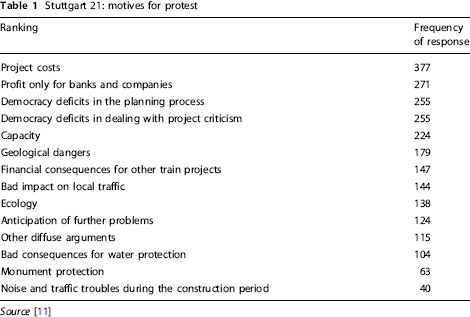
Dieter Rucht, a well-known German protest researcher, conducted a survey asking which issues were most important to protestors of the Stuttgart 21 project. Interestingly, the results indicate that a number of different motives played a significant role (Table 1).
Stuttgart 21: motives for protest
Source [11]
Moreover, the backgrounds of the protestors are diverse, with students, workers and civil servants all having been involved. Many of those with a left-green political orientation took their cue from older protest cultures, such as that of 1968. Over 90% believed that demonstrations would indeed help to achieve the aim of abolishing the whole project. Also, many of them no longer trusted the local media as reliable sources of information about the project [11].
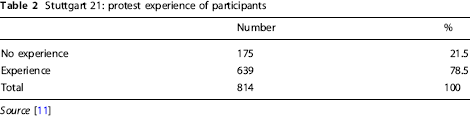
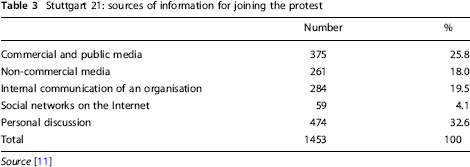
Despite this, social networks played only a small role within the movement (Tables 2 and 3).
Stuttgart 21: protest experience of participants
Source [11]
Stuttgart 21: sources of information for joining the protest
Source [11]
So far, social unrest over the financial crisis has varied from country to country. In some of the worst affected nations, such as Ireland, acceptance and even apathy has prevailed, while Greece saw fatalities and street clashes in December 2010. Increasingly, there are signs of rising social pressures. Many Western European countries are only just embarking on multi-year deficit-reduction packages, a hard sell in states where expectations have risen for generations. Greek protesters clashed with police in central Athens recently as tens of thousands marched against austerity measures aimed at pulling the country out of a debt crisis. Today's atmosphere of political discontent, dissatisfaction, scepticism and cynicism is widespread but not (culturally) revolutionary. There is decreasing confidence in legislatures and governments but no general distrust of coherent polities within European national systems [13, 23]. Protest movements can gain from this situation, as the True Finns party did in Finland's national election of April 2011. This Eurosceptic protest party won almost 20% of the votes by criticising the euro currency and strongly opposing any financial support for profligate Eurozone members—most recently, Portugal—during its election campaign. It appealed directly to people's fears of losing welfare as a result of European-wide solidarity.
Conclusion
So far, protest mobilisations ‘have played only a marginal role in the master narrative of Europe’ [14,1]. In Western Europe, countries such as France and Germany still have their own protest culture despite common projects such as the counter-globalisation movement ATTAC. Some evidence for a new protest culture has emerged in the form of popular publications dealing with protest topics characterised by a broad public and media debate. These publications appeal to citizens’ resentment towards government elites and decision-making procedures at the local or national level (not specifically at the European level). Transnational movements have only played a partial role in student and austerity-related protests and in the anti-globalisation movement that has targeted G-8 summits. As Dieter Rucht concludes, the ‘Europeanisation of protest is still a myth’ [9], because only a small number of protests of this type have taken place. The existing anti-elitist aspect, however, does have a direct connection to the European Union, where decisions gain ex post facto legitimisation. Future politics at both the European and national levels should take this trend into account by ensuring that the political process includes the means to evaluate policy and take public consideration into account pro- or retroactively. Otherwise a new, fully fledged protest culture could very well emerge in Europe.
European representative democracies may come under civic pressure when ‘citizens in anger’ do not feel politically enfranchised and assert themselves more aggressively. This does not relate, however, to the anti-globalisation movement, which surprisingly did not profit from the global financial crisis and the obvious failure of the system to prevent such negative developments. It does not matter that the Stuttgart station project had gone through a long legitimisation process within democratic institutions. The ‘citizen in anger’ has the feeling that he or she speaks for the majority of people and can assess a situation better than the political elites can. Nearly every development or austerity initiative is controversial, because it does not necessarily reflect the everyday needs and wants of the people [10]. Movements intend to bring changes by way of legislation and to spur legislative activity. When initiatives have already passed through decision-making systems, social protest movements can only react defensively and have less political impact than they would during the process of decision-making itself. Successful protest movements need an opponent—a contrast—in order to create an identity. Such a new opponent may yet lie in the non-transparency and complexity of modern European democracies, which could sow the seeds of a new protest wave.