




Abstract
During the lead up to and assessment of the Copenhagen Climate Conference in November 2009, the effects of the celebrated Kyoto Protocol were often overlooked. Although the aims of the Kyoto Protocol can be relegated to the dustbin of history, the targets set out in the agreement allowed Europe to put itself in a dominant position. Not only did the Kyoto Protocol force Europe to invest heavily in green technologies, but in addition it led to the creation of a European energy policy with the aim of reducing Europe's dependence on fossil fuels which can be seen, from a strategic point of view, as an undesirable dependence on sources abroad.
The Kyoto Protocol came into force on 16 February 2005, after almost a decade of turbulent negotiations, and now has its place on the international scene with all the strengths and weaknesses of any international treaty. Five years ago, its final and not entirely foreseeable signing was hailed by environmentalists with great enthusiasm as a success for campaigns that had been trying to awaken public opinion and the world's governments to environmental issues. Above all, however, it was hailed as further evidence, following the Montreal Protocol, of the real possibility that cooperation leading to multilateral environmental agreements was possible, and that the conflicts of interest among countries that arise from the cross-border allocation of costs and benefits associated with the international management of global public goods could be overcome.
Nevertheless, bearing in mind the complex structure of the political trading that surrounds international negotiations on the ‘global commons’, such as addressing climate change, the Kyoto Protocol may appear to be a paradox or a limited achievement. In fact, a multilateral agreement on environmental issues, like the Kyoto Protocol, generally faces far greater structural difficulties than arise with other types of international negotiations, such as WTO agreements. As in the latter cases, there are many actors representing various and often contrasting interests, but in addition to the normal free-riding tendencies there is yet another problem: the costs of the agreement loom large and clear over the short term while the benefits are expected only in the long run, wrapped in the mist of uncertainty. This additional feature of the negotiation process generates powerful disincentives for national governments to cooperate, since their decisions are ultimately made on the basis of an economic calculation of cost and benefits, in which the future value is directly or indirectly discounted at the long-term interest rate. Moreover, the Kyoto Protocol has an impact on crucial aspects of economic competitiveness—for example, the cost of energy production—as well as on powerful economic interests such as the oil industry. Implementing the protocol entails substantial social costs distributed unequally amongst the players. In this framework, therefore, what is really surprising is not the difficulty and the length of the political and diplomatic manoeuvring that characterised the negotiating process for the Kyoto Protocol, but rather the fact that it finally succeeded, eventually being ratified by 184 states.
Some might argue that the issue's crucial importance for the future of humanity led governments to take on a quite extraordinary kind of collective responsibility. But this hardly seems to be the case if we look into the real contents of the agreement and the real consequences involved. In this paper we present a narrower (and less multilateral) interpretation of the Kyoto Protocol, looking at the relationship between environmental and energy policies. In our opinion, the Kyoto Protocol can be considered part of the EU's strategy (and also a tool of that strategy) to reduce its energy dependency and to minimise the cost of doing so to the international competitiveness of its economy. This interpretation is less optimistic about the consequences of the Kyoto Protocol for the future of humanity, but probably more consistent with a political economy approach and models explaining international negotiation processes.
As a matter of fact, at a distance of nearly five years since it came into force, the Kyoto Protocol on balance offers scant cause for enthusiasm. The one truly positive aspect is that the negotiating process did not end as a miserable flop. The agreement eventually emerged unscathed from a fierce contest between the negotiating positions of the US and Europe, but at the cost of further diluting its already minimal effectiveness, to the extent that it is now increasingly difficult to answer US accusations of excessive costs for decidedly paltry results. Moreover, today it should be honestly recognised that if countries meet the commitments they agreed to, this will be due to the economic crisis of the last two years and the reduction in energy consumption because of the collapse of industry in the major countries of the Annex II of the United Nations Framework Convention on Climate Change (UNFCCC) rather than the virtuous will of the signatory states.
The point that we are arguing here is that the seeming paradox of the success of the negotiations for the Kyoto Protocol may indeed be only apparent, and the success may depend on the fact that, in the course of negotiation, the agreement took on a role and significance that differed greatly from those stated in the official preambles. As often happens, it would appear to be the involuntary result of interaction between forces and strategic interests directly and indirectly stirred up around the points under negotiation. In fact, most of the 184 countries that have so far ratified the agreement have no costs to bear for the time being, being entitled to dispensation as developing countries. They might even benefit from it, given the possibility of gaining foreign investment thanks to the Clean Development Mechanism. 1 The transition economies, for their part, not only have no costs to bear but have the certainty of gaining direct economic benefits in the short term by selling emission rights or by attracting foreign investments thanks to the Joint Implementation mechanism. 2
This is a flexible mechanism set out by the Kyoto Protocol, which enables industrialised countries to implement, in a developing country, a project aiming at reducing emissions in addition to those that would have resulted from business as usual. The investor country can meet part of its commitment through this reduction.
This is another flexible mechanism provided for by the Kyoto Protocol, which enables industrialised countries to work together to achieve their emission targets. According to this mechanism, an industrialised country can achieve part of its target through a project that reduces emissions in any sector of another industrialised country.
Indeed, ultimately the only countries actually subject to costs under the original terms of the agreement were the EU-15 members, the United States, Japan, Canada and Australia. After a series of vacillations, and although it had undertaken to implement an 8% decrease in emissions, Australia refused to accede to the agreement for a long time, claiming that it would be too damaging to its economy, and eventually ratified it only in 2008, to avoid being isolated in the face of a virtually universal consensus. Japan and Canada, former members of the Umbrella Group and so initially fairly cool towards the agreement, obtained some forms of compensation, reducing their effective costs to a minimum. For example, in the face of fierce opposition from major environmentalist movements, Japan managed to gain the right to deduct from its reduction targets the carbon absorbed by the trees planted for industrial purposes by Japanese firms in Indochina and Indonesia. These industrial plantations were usually created on land recently denuded of rain forests, the destruction of which contributed to increasing carbon emissions in the atmosphere. Although Japanese firms were responsible for this action, it was formally imputed to the developing countries—which enjoyed an exemption—in which the deforestation took place. From the point of view of real global emission accounting, this resulted in zero net benefits, if not, indeed, a negative balance. But thanks to the subtle game of diplomatic manoeuvring, the whole business ended up as a bargaining concession offered to Japan in return for acceding to the agreement. Similarly, Canada found a way to deduct from its reduction commitments the carbon absorbed by the extensive areas planted with maize. This, however, is clearly a negotiating concession to a country that is already a major global cereal producer intending to specialise yet further in the maize sector.
Thus the two major actors on the world scene before the protocol came into force, the EU and the US, remained so thereafter, and this probably explains why they have been the undisputed protagonists throughout many rounds of keen diplomatic bargaining.
At first sight, the position of the US appears more comprehensible. It has a model of economic growth and mobility traditionally based on intensive exploitation of cheap fossil resources which have not been subject to the degree of taxation that exists in most European countries. Any limitation on the use of fossil fuel, therefore, could seriously jeopardise the competitiveness of the US economy vis-à-vis competitors not affected by the agreements, such as China, and would be particularly burdensome. Moreover, it would be unpopular with the public. However, the US is one of the major producers and exporters of highly energy-efficient technologies, with limited emissions, in the transport sector. This includes, in the first place, fuel-cell technology, which was, moreover, developed despite oil interests. To an appreciable extent this accounts for the preference for incentives for technological innovation over programmes such as taxes or higher standards that would restrict the exploitation of fossil fuel. Therefore, in refusing to ratify the protocol the US was acting entirely in accordance with its own national interests.
The explanation for the non-failure of the Kyoto Protocol negotiation process, therefore, can be found in the reasons that led Europe to take on the role first as promoter, and then as keen supporter of the agreement, to the extent that it was eventually ready to ‘buy’, with bargaining concessions, the accession of the Umbrella Group countries.
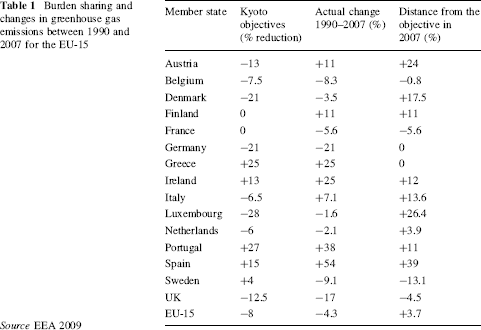
From the very outset the EU had been an enthusiastic and vigorous supporter of the Kyoto agreements. To make their motivation clear and offer a good example, the EU-15 countries unilaterally decided to commit themselves to reductions significantly greater than was required of the other Annex II countries. In the course of procedures to draw up the agreement, they voluntarily set themselves the joint objective to reduce their emission levels by 8% below 1990 levels, unilaterally taking on greater costs than the other participants in the agreement. Subsequently this joint objective was distributed, differentiating between the various Member States with the burden-sharing agreement of the EU Environment Council of Ministers on 17 June 1998. With this agreement within the EU, Luxembourg, Germany, Austria and Great Britain took on commitments much greater than the average in order to offset the lower reductions, and in some cases even increases, negotiated by the other Member States (see Table 1).
For the countries of Europe, pursuit of the objectives meant four possible complementary lines of action:
a proportional reduction of levels of economic activity;
an increase in the energy efficiency of production processes;
the development of alternative energy sources;
adoption of flexible mechanisms provided for in the Bonn–Marrakesh agreements.
Burden sharing and changes in greenhouse gas emissions between 1990 and 2007 for the EU-15
Source EEA 2009
The first type of intervention has obviously been ruled out a priori by all European governments, even though, as we have noted, it could turn out to be a side effect of the present economic crisis, which could help to achieve the objective of reducing carbon emissions in the transition economies.
The second type of intervention could, however, have positive secondary effects of a strategic nature, encouraging the long-term growth in competitiveness within the continental production system. Today this is, in fact, one of the principal tools of the EU's 20-20-20 strategy. Moreover, some virtuous European countries like Germany, Luxembourg, Great Britain and Sweden have already seen an appreciable increase in energy efficiency, for reasons quite independent of emissions control, 3 since 1990. This explains why 1990 was chosen as the reference year for an agreement that would be implemented only 15 years later. For other countries, however, this level of intervention requires a time frame longer than that allowed for by the protocol. In Italy, for example, an increase in energy efficiency achieved on the basis of the technology now available would allow for a 46% reduction in energy consumption per unit of GDP. However, if it is not to have a traumatic impact on the economy, the renewal of the domestic manufacturing plant necessary to achieve this result would have to be carried out over a period somewhere between 10 and 30 years, depending on the type of plant at issue. Moreover, encouraging this process of renewal means adopting a mix of instruments, including taxes, subsidies and regulations, to orient the choices of producers and consumers in the desired direction without entailing costs for the community in the short run.
Great Britain and Germany enjoy the benefit of the switch from coal-fired to natural gas power stations, accomplished in the early 1990s. Luxembourg benefits from the dismantling if its steel industry, while Sweden has in its favour the fact that over 90% of its electricity production is hydroelectric or nuclear.
With the technologies available today, the introduction of factories using alternative and renewable energy sources such as wind power and photoelectric systems could reduce carbon emissions of EU countries by an average of 20% by 2020. Thirteen years ago it would have been difficult to achieve a reduction in emissions of 5% by 2012. It would therefore have made far more sense, if the intention were to respect the Kyoto commitments, to contribute to the revival of nuclear power, which already accounted for a considerable proportion of Europe's electrical energy, over the medium and long term. It is in fact significant that the European nuclear lobby has joined forces with the major supporters of the protocol, alongside the environmentalist lobbies promoting the development of photoelectric systems, wind power and hydrogen technologies.
Given the tight time frames agreed to in the protocol, it was, however, far more probable that most of the less virtuous governments of European countries would focus above all on exploiting the flexible mechanisms provided for by the Bonn–Marrakesh agreements, and acquire emission rights from transition economies or invest in projects to enhance energy efficiency in the developing countries. And this was in fact what happened. Indeed, this type of intervention not only entails lower marginal costs in general, but also favours the spread of technologies and proprietary products in new emerging markets, enhancing the interests of European industrial and financial groups.
According to the letter of the agreements, the flexible mechanisms should be utilised only in a complementary manner, with the explicit authorisation of the UNFCCC Secretariat upon demonstration that all of the most likely ways of reducing emissions at the national level had already been tried. In fact, however, the strictness of control has been inversely proportional to the number of defaulting countries. In this respect the prospects are certainly not too bright: indeed, the European Environment Agency reported in 2009 [2] that of the EU-15 states only Belgium, France, Germany, Great Britain, Greece and Sweden, for reasons we have already noted, appeared able to respect the commitments they had taken on. Of course, after 2008 the previous economic trend was interrupted by the financial and economic crisis. The sharp decrease in European industrial activity has probably greatly reduced Europe's energy demand, which is the main driving force of carbon emissions. The real question is whether, after the crisis, the European economy will return to its previous trend or will follow a new, flatter one. If the second is the case, the economic crisis could help Europe to meet its emission commitments, but it would be a very undesirable result.
Today, nobody claims that the Kyoto Protocol has successfully addressed global warming. Some think it has been useful in laying out the rules of cooperation to manage future climate agreements. But the question remains: Can the rules of an international agreement be independent of the relevance of its contents?
Since December 2005, the Conference of the Parties (COP) serving as the Meeting of the Parties (MOP) has obtained few concrete results. The Bali Action Plan was rich in ideas and good intentions, but the Copenhagen Accord of 18 December 2009, hailed by environmentalists with great enthusiasm because of the avowed good intentions of the US and China, reflected all the dangers looming on the horizon of future negotiations. The proposed financial contributions, amounting to $10 billion per year over a period of 10 years, which seems a significant commitment, is only one-tenth of the sum allocated in one year to save the global financial system from the crisis. In economic theory, willingness to pay is a way to assess the real relative importance attributed to the pursued objectives.
Ultimately, the commitments voluntarily taken on by the EU have inevitably yielded few immediate benefits and, although not always so great as might appear at first sight, have resulted in increased costs in the energy and transport sectors that are not negligible, affecting as well all the other productive sectors and their competitiveness on the international markets. Thus the big question to be asked is this: Why did the EU decide unilaterally to take on costs that will not generate significant benefits in terms of climate change at the global or even at the local level? This question became still more relevant when the EU unilaterally decided to achieve the objective to reduce carbon emissions by 20% by 2020, while the post-Kyoto scenario remains very uncertain.
The radical position adopted by Europe in favour of curbing greenhouse gas emissions is clearly motivated, at least in part, by a genuine cultural orientation. In the past, in revisions to the EU's constitutive agreements, this orientation played an important part in identifying the environment as a real value in itself which can, as such, legitimately come into conflict with other social objectives like economic growth or full employment. In the course of negotiations this position probably also found support from other kinds of interests, not always as noble although equally deep-rooted, such as the French nuclear lobby or the German lobbies associated with development of alternative energy sources, concentrated around the new photoelectric and hydrogen technologies. These particular and undeniable interests tended in turn to converge with other general and strategic interests on the continent, including the growing need to move away from its traditional dependence on foreign sources of fossil fuels, which came dramatically to the fore once again with the recent crises in the supply of natural gas from Russia and the dramatic hike in oil prices.
The production of renewable sources of energy became increasingly a key objective of the Community and then of the EU from the mid-1980s, long before global warming and climate change became central issues in the political debate. As early as 1986 the European Council officially placed among its energy objectives the exploitation of renewable sources.
After the oil ‘counter-shock’ occurring in the same year, Europe, like much of the rest of the world, effectively benefited from the new, ample availability of cheap fossil-fuel energy. To some extent, however, this came about precisely because of prior progress in the electro-nuclear programmes of France, Belgium and Spain, and in part, too, thanks to the growing use of natural gas in important production and consumption sectors like domestic heating, and the production of electrical energy itself, which made a significant contribution to reducing the pressure of global demand on the supply of oil products.
Internal sources of fossil-fuel energy, responding to about half of Europe's needs, are being rapidly exhausted given the increasing consumption. Present projections of the extent of Europe's oil reserves suggest that dependence on external sources will increase over the next 20 to 30 years to 70–90% of requirements. This would increase political vulnerability vis-à-vis exporting regions like Russia and the Middle East.
The European Council and Parliament [3,4], a good two years before promulgation of the protocol, had already identified the conditions necessary to guarantee Europe's energy production over the long term with diversification of energy sources, increased energy efficiency and energy saving. Finally, in the white paper ‘An Energy Policy for the European Union’ [1], the European Commission identified the production, transport and distribution of energy products as fundamental factors in the competitive capacity of the European economy and the living conditions of its citizens. It thus defined as essential the community's coordination of national energy objectives, identifying the common objectives of energy policy and the instruments to achieve them. The main objectives consisted in the enhancement of competitiveness, certainty of supply and protection of the environment.
With the subsequent research Framework Programmes, together with certain pilot projects such as Joulethermie, Inco and Fair, a powerful boost was given to the development of a European industrial sector of energy technologies operating with renewable sources, giving it a leading position in many fields of specialisation.
These projects and programmes generated those convergences of interests that, albeit indirectly, eventually became factors supporting the acceptance, even unilaterally, of the social costs entailed in respecting the objectives of the Kyoto Protocol. Ultimately the EU opted for a policy of ‘no regrets’: although there can be no certainty of a positive outcome for the principal objective, actions were initiated which were believed to have a strategic validity of their own on other important fronts. The exponential growth of oil prices, which in fact began in 2001, the year of a decisive turning point in negotiations, further facilitated this process, both making the social costs of a reduction of fossil fuel consumption more sustainable and attributing greater strategic value to encouraging the exploitation of alternative energy sources.
Given this background, the Kyoto Protocol thus came to represent for Europe an excellent opportunity to commit itself to a process of technological adjustment, costly in social terms over the short term but strategic in the long term. The new surge of idealism around the themes of environmental protection at the global level played a positive role in mobilising the energies of citizens for the sake of a noble cause, making the immediate sacrifices more acceptable. Moreover, another advantage, which appeared to be opening up for a limited time with the protocol before the defection of the US, was that, if widely accepted at the international level, it would rapidly narrow Europe's competitiveness gap with the other industrialised countries, due to the unilateral adoption of measures to substitute fossil energy with alternative sources.
Ultimately, therefore, the non-failure of the Kyoto Protocol and its survival in its present bland and relatively ineffective form can be attributed solely to the ways in which it serves European strategic interests in the energy field. Thus it tends to matter more as a means of regulation within Europe, much like the Maastricht agreements in many respects, than as a multilateral international agreement showing the collective capacity of humanity to take control of its global destiny.
This strategic role of the European position in the negotiations for the Kyoto Protocol still has validity in the future post-Kyoto negotiations to tackle climate change. In this framework, the unilateral objective to cut carbon emissions by 20% by 2020, reducing the share of fossil fuels in the consumption of energy resources, is a way to use a single strategy to pursue objectives concerning both the environment and energy. In this respect, the EU supported the Kyoto Protocol and post-Kyoto negotiation, gambling on synergies that would maintain its international competitiveness but being prepared unilaterally to implement its commitments as a no-regrets policy. This is a fine example of how to implement a national strategy—by transforming it into an international commitment.