




Abstract
Since the introduction of direct elections for the European Parliament, the politics of this institution have presented a very low degree of adversarial confrontations amongst the two major European parties, the EPP and the PES. In the last round of elections, however, there have been signs of substantial change in direction of a more direct electoral confrontation between the PES and the EPP. According to the author, both the party manifestos and the strong political activity that preceded the nomination of the new President of the Commission signal the emergence of a sui-generis government-opposition relation between the two major parties in the European Parliament. This, still far from resembling the spirit of national politics, may represent the beginning of a new and more dynamic political confrontation around the European institutions.
Keywords
The greatest challenge faced by all European parties since their inception has been to make themselves relevant to their member parties. 1 For many years they focused on developing coordination mechanisms, building a space for communication and exchange of views and developing a sense of commonality and shared goals. Over time, the European People's Party (EPP) and lately the Party of European Socialists (PES) have focused their activities on organising leaders' summits on the eve of European Councils, thus becoming much more visible within the EU's political system. What these parties recently faced when campaigning for the European Parliament elections is an even more important change, as they were given the opportunity to contribute to the electoral success of their member parties and thereby become relevant to all of them.
This article is a summarized version of a research paper published by the Centre for European Studies devoted to the elections of the European Parliament and the role of political parties at the European level; see [6–8]. The full research paper can be consulted at www.thinkingeurope.eu.
What is still far from clear, however, is what effect the increased electoral involvement of European parties may have on the distribution of political power in EU institutions. Although in this recent campaign the level of political competition between the major European parties and especially between the EPP and the PES was probably the highest in history, the institutional architecture of the European Union nevertheless makes it hard to identify the factors that in the medium or long term would lead to the emergence of an adversarial, government–opposition model, even at a symbolic level. This article aims to consider this question. I will first review the institutional environment that discourages the emergence of an adversarial form of government at the EU level; next, I will analyse the patterns of competition between the EPP and the PES during the early stages of the 2009 European Parliament campaign. Finally, I will consider the question of the nomination of the President of the European Commission along party lines and the possible consequences of such a scenario.
The institutional limits to the emergence of a government–opposition model
One of the major problems in developing a government–opposition model is the lack of a direct link between European Parliament elections and the composition of the European Commission, which can in a certain aspect be compared to a government. However, from its inception, this organ has been thought of as a non-partisan, primarily expert body that was to stand above all political divisions, be a guardian of EU law and represent the interests of the European Community as a whole. This does not mean that the President of the Commission and the commissioners are not politicians, or at least do not enjoy political backing. Quite the contrary—their nomination depends entirely on the governments of the EU Member States and they are subsequently, as the College of Commissioners, approved by the European Parliament. However, once they enter the Commission, they are expected to leave their national, partisan and political connections behind. For the European parties, such an approach creates problems in defining their own role. On the one hand, all of them nowadays call themselves ‘parties’, but according to established definitions in political science they are not typical political parties, since they cannot run for power in the elections. To give an example relating to the European Commission, the largest European parties often claim to be represented by a certain number of commissioners. In this way they try to build a link between the commissioner nominated by a certain Member State and the party orientation of that country's government. For example, if the British labour government nominates a commissioner, then it is assumed that this commissioner also represents the PES, because the Labour Party belongs to the PES. However, the commissioners usually do not highlight their political role but instead focus on their expertise and qualifications that enable them to fulfil the role of commissioner. The link between commissioners and European parties is in no sense comparable to that between national ministers and their parties, where ministers are expected to realise the programmes of the parties and depend on party support to keep their posts.
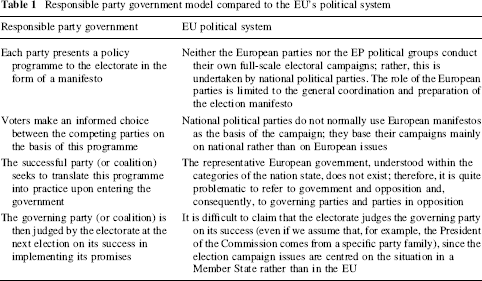
This point leads us to the main obstacle in the EU's institutional structure that makes the development of partisan politics at the EU level so difficult. If the commissioners are in fact apolitical and if they represent all parts of the political spectrum (because they are represented by various governments of different political stripes), the development of a typical adversarial approach is quite complicated. To stay in power, the Commission does not need the backing of the political groups in the European Parliament; and for this reason also the subsequent European Parliament elections are not fought on the basis of the Commission's governing practices. In consequence, the European parties do not shape their campaigns around their approval or criticism of the previous Commission (as would be the case nationally with governing and opposition parties), but instead focus on their ideas and solutions for the EU without much reference to the previous government's record. Table 1 contrasts the concept of ‘responsible party government’, as characterised by the political systems of Member States, with the EU's political system (for more details see [10], 63-65; [11], 108-110).
Responsible party government model compared to the EU's political system
The increasing political competition between the EPP and the PES
Although formally speaking such an adversarial form of government at the EU level may be difficult to imagine, the significance of the more direct political competition between the EPP and the PES should not be overlooked. To understand the change that has taken place in the past few years, it is worth going back to the 2006 PES Porto Congress, during which the Socialists proclaimed that ‘we are working hard to make of the PES a true European political party, capable of influencing European politics, a party that is more visible, more effective and that can relate to the people and to its members’ [18].
This quote aptly illustrates the challenges that European political parties face today and gives some idea of how one of them defines the point at which it will become a ‘true European political party’. It is not only the PES, then, that wishes to continue and strengthen its traditional focus on cooperation and exchange among national member parties while also aiming to build a life of its own—to have its own political campaigns (that is, be more visible) and to directly communicate with the public. From a more general point of view, in making a true European political party of the PES, its leadership clearly wishes to emphasise that there is something at stake where European political parties are concerned. ‘If we want people to be interested in Europe, we need to show that the choices made at the EU level are the same choices made at the national level, that is, between the Left and the Right. It is a real political fight with different choices … we need this European public fight’ [5]. In other words, the emergence of a fiercer political confrontation at the EU level can be seen as desirable from an institutional point of view and, even more importantly, as an incentive for voters to become interested in the European Parliament elections and transnational party politics.
This approach was very visible in the campaign strategy of the PES during the 2009 European Parliament elections. It is important to notice the unprecedented level of direct criticism expressed by the PES towards its political opponent [19]. In this sense, the PES manifesto clearly resembles the British style of election manifesto, filled with criticism of political opponents. This is an important change compared to previous PES manifestos. Whereas in the PES manifestos of 2004 and 1999 their political opponents—labelled as ‘right-wing parties’—were criticised only twice, in the 2009 manifesto there were at least 14 direct critical references to their opponents and many more indirect ones. The PES manifesto claims that the choice between the PES and the EPP is very important, because it is a choice ‘between political parties with very different ideas for the future of the European Union’. The European elections have frequently been criticised for not offering meaningful choices for the future of Europe, since no matter what the outcome of the election, the EPP and PES groups who have controlled the Parliament ultimately have led it in a very pro-European direction. By claiming that the two largest European parties are distinctly different, the PES was attempting to address this criticism. They use the term ‘conservatives’ to embrace both the EPP and its member parties, although some of them clearly are not Conservative but Christian Democratic or Liberal. Nonetheless, the PES's characteristic criticism takes the following form:
For the past five years, the conservatives have had a majority in Europe—in most EU Member States and in the EU institutions. What have they done with it? Did they tackle the global financial crisis? Did they address rising food and energy prices? Have they fought poverty and inequalities? Is society fairer than it was five years ago? Did they support our initiatives to deliver more and better jobs? They follow the market. We follow our convictions [19].
The PES's criticism of the EPP is found not only in its manifesto. PES President Poul Nyrup Rasmussen regularly issues press releases that directly criticise the ‘conservatives’. On the very same day that the EPP presented its draft manifesto in late January 2009, Rasmussen issued a press release criticising the EPP's calls for tax cuts [20]. He said, ‘EPP tax cuts mean EPP spending cuts. Why don't they just come out and tell us they want to axe public services? They don't dare because public spending cuts are the last thing you need at a time of rising unemployment. It is the same old conservative rhetoric, the same old tired ideology.’ Rasmussen also highlighted five ‘cast-iron cases of EPP hypocrisy’, directly engaging with EPP proposals and solutions. For example, he refused to accept the EPP claim that the Socialists want to push nationalisation, stating instead that ‘nationalization is a short-term necessity, not a Socialist goal.’ He also challenged the EPP for not being committed to fighting climate change, since in his opinion the EPP Group in the European Parliament spent ‘months trying to water down the climate package’. Quite often the PES has criticised the Commission and its President, José Manuel Barroso. Not only, however, does the PES critically engage with EPP policies and proposals, as noted above; it also accuses the EPP of lacking openness, against which the PES places its inclusive and interactive model of preparing its manifesto. Therefore, Rasmussen observed, ‘our policies are more inclusive than the conservatives and we do our politics in a more inclusive way too.’ Usual targets are also the Conservative EU governments and their leaders, such as Angela Merkel or Nicolas Sarkozy—or even the EU Presidency, in claims such as ‘Conservative Czech Presidency faces defeat on child care targets.’
The EPP counters the PES criticism, although the EPP activity in this regard is not as intense as that of the PES. There is no space here to go into details (see [8], but the EPP manifesto itself was less combative than that of the PES.
Although it contains some criticism of the Socialists, this is not as visible and direct as in the case of the PES's criticism of the EPP. An example of such style of argumentation is an article of EPP President Wilfried Martens published in European Voice three days before the elections. While listing extensively EPP priorities, the general point it makes pertains to arguing that ‘socialist ideologies will not help the European Union achieve its goal of creating a better Europe’, but also to pointing out that the PES failed to come up with a counter-candidate to José Manuel Barroso, who was supported by the EPP [17]. Antonio López-Istúriz, EPP Secretary General, claimed ‘the left-oriented marketing and agitprop is saying we are responsible for everything. But who were in European governments during the last 20 years? It was the Socialists who had the majority of governments in Europe’ [22]. López-Istúriz also hinted that the PES combative approach came from the lack of their own, real programmatic foundations, and hence, their campaign strategy could only be based on criticising EPP personalities and ideas [6]. The EPP often uses a standard formula in which it highlights its numerical strength as its main advantage over competitors. On its website it proudly claims that ‘with 72 member parties from 39 countries, 19 Heads of Government (13 EU and 6 non-EU), 9 European Commissioners (including the President), and the largest Group in the European Parliament with 265 members, the EPP is the leading political force on the continent’ [4]. The main election video introducing the EPP was based on the presentation of such numerical strength and of the main personalities of the EPP and its member parties. Its manifesto, however, clearly distanced itself from its competitors:
Facing the new challenges of 2009, we are well aware of what others are proposing. Socialists see the financial and economic crisis as a chance to push their age-old agenda of nationalisation, protectionism and permanent deficit spending. We, on the other hand, are acting in order to preserve a competitive Social Market Economy and make it more sustainable. Nationalists are using the crisis to advocate their well-known plans against a strong Europe that would quickly leave us unable to cope with the challenges of the twenty-first century. We, however, are determined to push ahead with the ratification of the Lisbon Treaty and with modernising and strengthening the Union. In other words, this election is about a fundamental choice: between the dangerous recipes of Socialists and nationalists, and a secure future based on values, responsibility, competence and coordinated action [3].
The EPP also emphasised that the founders of Europe—Adenauer, Schuman, de Gasperi—were all Christian Democrats, and that the EPP ‘has influenced the historical development of Europe like no other political force.’ The EPP has always identified the President of the European Commission, José Manuel Barroso, among its leading personalities. Quite often the EPP President issues statements in which he supports the Commission's plans and policies in various areas, which at least on the symbolic level would mean support for the government by the largest party at the EU level. However, the most visible and important example of government and opposition dynamics can be shown by analysing the recent nomination of José Manuel Barroso for the President of the European Commission.
The nomination of José Manuel Barroso for the Commission Presidency
The overall intensification of the PES criticism of the EPP and its member parties explained above should be seen in a particular political and legal context, revealing the importance of the 2009 elections. In 1999, the Socialist Group lost its majority in the European Parliament to the EPP-ED Group. The PES identified the growing economic crisis that characterised the pre-electoral atmosphere as a chance for them to regain their lost majority. However, the battle was not only about the majority in the EP but also about the Commission Presidency. From this election onwards, thanks to a combination of legal and political circumstances, the nomination of the President of the European Commission would depend much more on which political family—that is, which political party at the European level—won these elections by securing the majority in the European Parliament.
In order to fully understand how European parties can influence the nomination of the President of the European Commission, we need to return to the year 2004. Some time before the 2004 European elections, Hans-Gert Pöttering, then Chair of the EPP-ED Group, announced that in the spirit of the treaty establishing a Constitution for Europe (whose final text was settled in June 2004), he would not accept any candidate for the job coming from a political family that had lost the European elections. He knew that it was most likely that the EPP would win these elections, but he also suspected that European leaders would not take this into account and would propose a candidate from another European party. The EPP Summits supported this stance. As it happened later, French President Jacques Chirac and German Chancellor Gerhard Schroeder agreed between themselves to ignore other heads of governments by proposing the Belgian Liberal Prime Minister Guy Verhofstadt as candidate. Due to the opposition of the EPP Heads of Governments (although not unanimous), this candidature failed. In turn, the EPP decided to propose a candidate from among its own ranks. The EPP Summit mandated Wilfried Martens to personally consult EPP party leaders on who would be their best candidate. In the end, Martens came up with José Manuel Barroso, who was later accepted as Commission President by the European Council and the European Parliament [9,15], chap. 9).
Already during the 2009 campaign, EPP President Wilfried Martens made it clear that no matter which political family won the European Parliament elections, the winner should have the right to propose its candidate for the Commission Presidency [16]. A few months before the elections, José Manuel Barroso made it clear that he wished to remain in office as Commission President. During his Presidency, although formally independent, Barroso did not deny his political connection with the European People's Party, often participating in its activities and enjoying its support in return. Most importantly, the EPP summit of 16 March 2009 formally supported Barroso's candidacy for the next term as the Commission President, and so did the EPP Congress gathered in Warsaw at the end of April. EPP opponents, however, saw this as a partisan proposal against which they should offer their own candidate. The idea that the PES should propose its own candidate had been in the air already for a few years, but PES member parties were divided over whether this was the proper strategy to win that office in the end. The Commission Presidency is seen as a nonpartisan position, which is why making it clearly partisan could be counterproductive. This is why, as noted above, the PES focused on criticising Barroso's policies, waiting until the election results for a possible counter-candidacy. In these circumstances, the lead was taken by the European Greens. Just before their electoral congress at the end of March, its political group in the European Parliament issued a straightforward resolution entitled ‘Stop Barroso’. The Greens believed that the Commission President should not be reappointed without taking stock of his performance. In their opinion, the fact that the EPP family and some other heads of government (among them Socialists) supported the Barroso candidacy without knowing the election results, ‘prejudges the results of the European Parliament elections.’ In their criticism of the Commission President, they claimed:
Too often he has abdicated his responsibilities, demoting the Commission from ‘guardian of the treaties’ to lapdog of the most dominant Member States and most influential industries. When he attempted to lead, he has pulled into the wrong direction. His policies have contributed to the financial and economic crisis and failed to respond to them. They have consistently put the interests of unfettered trade and big business ahead of the environment [2].
The entire resolution featured 25 reasons to oppose Barroso's candidacy, among them his passive approach to the financial and economic crisis, reckless deregulation at the cost of social policy, putting competition and deregulation ahead of development and solidarity, neglecting climate change and failing to promote democracy and human rights in the EU. The main Green politicians, such as Daniel Cohn Bendit, said that, given their size, the Greens were not in a position to propose their own candidate for the Commission Presidency, but encouraged PES President Poul Nyrup Rasmussen to run for the job, based on a coalition of the Socialists, Liberals, Greens and Communists. However, the fact that the four PES-affiliated EU governments—Portuguese, Spanish, British and Bulgarian—openly supported Barroso already before the European Parliament elections made it difficult for the PES to find its own counter-candidate—and even to decide whether the PES should nominate a candidate in the first place. This happened despite a call to the PES to find a counter-candidate against Barroso—a call signed a few days before the elections by former Socialist leaders such as former German Chancellor Gerhard Schroeder, former Spanish Prime Minister Felipe González and former French Prime Minister Lionel Jospin [23]. In the end the question was solved by the very disappointing election results for the Socialists, which deprived them of any legitimacy to think about the Commission Presidency. (For a detailed comparative and case study analysis of European Parliament elections in EU-27 see [7].)
After the elections, Barroso was fully supported by his own EPP (265 MEPs) and a newly created European Conservatives and Reformers Group (ECR) (54 MEPs). According to the current rules established by the Treaty of Nice, in order to be elected it was enough if Barroso gathered a majority of votes of those present. However, according to the Lisbon Treaty (at that time expected to come into force after a positive result of the Irish referendum in early October), he would need an absolute majority (half of the total number of MEPs plus one), amounting to 369 MEPs. Given that some MEPs were calling for the vote to be repeated once the Lisbon Treaty was in force, such a strong, absolute majority of 369 MEPs would give Barroso greater legitimacy. However, in both cases, apart from the EPP and ECR votes, he also needed the support of at least the Liberal ALDE Group (84 MEPs). Despite the generally negative approach of the Socialists and Democrats groups (S&D) (184 MEPs), created on the basis of the former PES Group, he could also count on those Socialist MEPs whose national parties or governments supported his candidature. Finally, it was clear that he could not count in any way on the support of Greens (55 MEPs), Communists (35 MEPs) or Eurosceptics (32 MEPs), for various reasons. Above all, he had to choose a balanced strategy to ensure the proper recognition of the Parliament's rights as a whole. It was important, therefore, that he speak to all political groups in the EP. The subsequent events can be analysed by looking at the motivations of the actors in this process.
The EPP Group was trying to ensure that the Barroso candidacy was voted on as soon as the EU Heads of States and Governments agreed on his candidacy, which took place on 18 June. Soon after, the Chair of the EPP Group, Joseph Daul, said that the technical agreement to share the EP Presidency between the EPP and the PES should be based on the willingness of the PES to vote for Barroso already in July, on the first session of the newly elected Parliament. The Socialists rejected such a link and argued that if Barroso's candidacy was voted on already in July, they would not have enough time to discuss his programme [12]. At this stage the PES President, Poul Nyrup Rasmussen, still believed that they would be able to find a counter-candidate, and demanded a vote only after the holidays. As for the position of the Liberal ALDE Group, already before the elections, its then leader, Graham Watson, made their support for the Barroso candidacy (and for an early vote in July) conditional on an agreement to share the Parliament's Presidency between the EPP and the ALDE, rather than between the EPP and the PES. This agreement did not come into being, partly because the EPP did not want to break the grand coalition, and partly because under the new leadership of Guy Verhofstadt (who replaced Watson) the ALDE ruled out a centre-right alliance in the EP. Not without importance was the fact that Verhofstadt, unlike Watson, was reported to be sceptical about Barroso and at a certain stage was even mentioned in the press as a possible counter-candidate in his stead. However, Verhofstadt denied that he was trying to bring down the Barroso candidacy; instead he argued that he wanted to be sure that the new Commission President had the right programme for the next 5 years [24]. In these circumstances, the ALDE Group joined the PES and the Greens and succeeded in, first, postponing the vote at least until September, and second, demanding that Barroso present a written programme for his next 5 years in office. Soon after the Socialists presented 11 demands for Barroso (calling for the adoption of a charter of women's rights and for effective regulation of financial markets), and the ALDE issued a list of five demands (most importantly, calling for the creation of a separate commissioner for human rights and the creation of a European financial supervisory body) [13].
In September Barroso presented a 41-page document, listing his priorities for his next 5 years in office. Apart from trying to offer a very balanced programme containing some elements of the programmes of both the ALDE and S&D groups, Barroso defined the Commission as political but not partisan and offered the Parliament ‘a special relationship’ for working together on political priorities. Barroso then appeared before all the political groups to convince them to support him. Against the accusations that his views were too conservative, he replied, ‘my party belongs to the European People's Party, so I could be considered centre right, but I am not a conservative. Not that it's a crime to be a conservative, but I'm not … I'm a reformist of the centre’ [21]. A few days before the vote (scheduled for 16 September) Barroso managed to win the support of the ALDE Group (except for 14 MEPs from the French MoDem). To Barroso's advantage was the fact that the S&D was deeply divided over whether to vote against him. However, it was clear that smaller groups, the Greens, the Communists and most of the Eurosceptic Freedom and Democracy Group (EFD), would vote against him. In sum, a few days before the vote it was very likely that he would receive the majority of votes, but it was not clear what kind of majority he could count on.
However, during the actual vote, Barroso did unexpectedly well, winning an absolute majority of 382 votes in favour, 219 against and 117 abstentions. This meant that the newly appointed Commission President met the demands set out by the yet-to-be-ratified Treaty of Lisbon. Apart from the EPP and ECR votes (319 in total), Barroso won 63 extra votes. According to the press, these extra votes came mainly from the majority of the ALDE Group, but also from some in the S&D.
Conclusions
All of these factors led to a situation where—at least on the symbolic level—a typical government–opposition power struggle has started to emerge, although it is still far from resembling that of national politics. Nonetheless, to simplify the matter somewhat, we could say that on the one hand the government is represented by three actors: the President of the European Commission, José Manuel Barroso, who was running for another term; the largest group in the EP, the EPP; and the majority of EU governments represented in the European Council, which are affiliated with the EPP. On the other hand, the opposition is represented by the Party of European Socialists and its political group in the European Parliament (S&D). Such was the dynamic of this campaign at the European level before the elections, when the PES fiercely attacked the EPP and its policies, being however unable to come up with a counter-candidate. The PES also proved not to be united in its opposition against Barroso. In the subsequent bargaining process the candidate tried to build a sufficient majority, first within the European Council and subsequently in the European Parliament, supported by the ‘governing’ EPP.
The problem is that this conflict between government and opposition, even on the symbolic level depicted above, is not so obvious to the electorate, since they do not recognise the connection between the overall results of the European Parliament elections and the future nomination for the Commission President. Furthermore, the nomination of the subsequent EU Commission was postponed until three months after the elections. This meant that the link between the election results and the nomination of the new EU Commission President was even less visible to the voters. Finally, while fighting for the support both of the European Council and of the European Parliament, the candidate himself, José Manuel Barroso, had to balance between being seen as a partisan candidate proposed by the EPP and as a candidate for the non-partisan position of the President of the European Commission. During his speech to the European Parliament on the day preceding the vote on his candidacy, he said,
A strong Commission has to be a political Commission. But a political Commission must not be a partisan Commission. As President of the Commission, my party is Europe. The next College, like the current one, will contain an important number of members from a variety of political families. I am attached to having Europe's political diversity reflected in the College [1].
However, as the result of the final vote showed, Barroso's calculations aiming to win the support of all main pro-European political families, including the Socialists, did not prove to be possible, and this sends a very important message for the future. On the other hand, it has also shown that partisan considerations at the European level may not always conform to national motivations. Although the PES manifesto strongly criticising the conservative policies embodied by José Manuel Barroso was supported by all PES member parties, some of them later supported Barroso's candidacy, putting the unity of the Socialist family in question, at least where this matter is concerned. Finally, it would be nearly impossible to expect the Portuguese Socialist government and the Portuguese Socialist MEPs to oppose Barroso, even if he represents a party which they fight at the national level. The question of nominations for EU jobs is still often treated in terms of national, rather than partisan or ideological interests.
Because of the institutional architecture of the EU, then, it is perhaps misleading to expect the emergence of such government–opposition conflict at the EU level. Nevertheless, it should be borne in mind that politicians active at the EU level are primarily national politicians. They tend to think about the competing political interests at the EU level in exactly the same way as they do in national politics, even if the EU political system features entirely different characteristics than do Member States. The politicians need a fiercer political fight in order to function, and they think that the citizens also need it in order to become more interested in EU politics, to notice that there is something at stake where EU elections and EU political parties are concerned. As this article has shown, the conventional wisdom that there is no competition because the EPP and the PES do not compete in direct elections diverts our attention from the fact that they compete at other levels. In this sense, the two parties have adapted the form of adversarial politics to the conditions of the EU's institutional system. It is therefore important for them whether they have more Prime Ministers than the other parties do; whether they have more MEPs, members of the Committee of the Regions and members of the European Convention; and, finally, whether the President of the European Commission also comes from their ranks. By the same token, as the preparation of the PES manifesto showed, the parties also compete as to which of them is more inclusive in terms of opening itself to the public and to external organisations. In this case, the notion of competition takes on different contours, but that does not mean that EU party politics is left without competing political forces.