




Abstract
While most analyses of demographic change focus solely on quantitative changes and accompanying predictions for the future, this article combines evidence of population quantity shifts with human capital quality shifts. That is, it examines the demographic debate in light of human capital and education. The author argues that if skilled individuals in a population are the ultimate resource ensuring sustainable development, it is of utmost importance to address declining levels of education. In sum, he advocates large investments in human capital formation as the key to managing the future.
Introduction
People are the agents of history. It is the change in the numbers and structures of human populations, as well as their changing composition by place of residence, culture and norms, education, economic activity and health status that shapes the rapidly changing world. While some key individuals can make defining contributions to history, they do so only in the context of major ongoing demographic, social and economic changes. Of these changes, the demographic ones may be the most fundamental because they determine the very existence of people within a given age and sex at different places on the planet. This matters at every level, from families and villages to global geopolitical considerations. But as this article will argue, it is not only the sheer number of people that matters but also their skills and capabilities as these can be meaningfully measured by the level of education.
A demographically divided world
Current global demographic trends and the associated challenges are somewhat confusing to many observers. On the one hand, in many developing countries population growth rates are still very high due to birth rates well above replacement level (of two surviving children per woman) and a very young age structure. For this reason, in a number of countries the population is still likely to more than double over the coming decades. On the global level, this leads one to expect that the world population will increase from its current 6.6 billion to somewhat below 9 billion by the middle of the century. Yet at the same time, there is an increasing number of countries in which the birth rates have fallen to well below replacement level, while life expectancies continue to increase; as a consequence, the population is ageing rapidly. In the future, one expects an even more rapid pace of population ageing and, in many cases, a shrinking of total population size. Because of these significantly different demographic patterns, in some parts of the world there is still concern about the negative consequences of rapid population growth, while simultaneously, in other parts of the world there is concern about the negative implications of rapid population ageing.
Demographic transition as the main driver
Why are some populations still growing so rapidly (sometimes referred to as a ‘population explosion’)? Why do others already have very low fertility? People in these societies are not fundamentally different, they are just at different stages in the universal process of demographic transition, in which first, death rates fall due to better nutrition and health care, and then after a certain lag (due to the fact that large families are part of traditional systems of norms), birth rates also fall. During the intermediate period, where death rates are already low but birth rates are still high, populations continue to grow. If the difference between birth and death rates is as great as it is currently in many African countries (despite AIDS), then population growth is very rapid.
In Europe, the demographic transition began in the late eighteenth and nineteenth centuries; in the developing world it only began after World War II. In Finland, a significant mortality decline started after the famine years of the 1860s and the birth rate started to fall after 1900. In Finland, as in most other countries of the world, education and in particular, increasing female education was an important factor in the transition to small families. More generally, the theory of demographic transition predicts that as education increases and health conditions and family planning services improve, countries that still have high fertility rates today will eventually see them decline. The faster the fertility rate declines, the lower population growth will be which, in turn, makes it easier to further expand education which, in turn, will foster economic growth. Many of the countries that have seen rapid declines in fertility during the 1960s and 1970s have subsequently experienced significant economic growth. Economists call this economic growth induced by fertility decline the ‘demographic dividend’.
While in the past, demographers assumed that the demographic transition would ultimately lead to replacement level fertility rates (two surviving children per woman), reality turned out to be different. In a large number of countries, fertility continued to fall to much lower levels. While there is still no useful theory to predict the future fertility level of posttransition societies, an interesting difference among industrialised countries has recently emerged: countries in Northern Europe and France, where women can easily combine work and childrearing, have relatively high fertility rates, not far below replacement levels, whereas countries in Southern Europe and East Asia have much lower birth rates. Due to the combination of more traditional family and gender roles and a modern economy with good employment opportunities, women in these countries have to make a choice between family and work and increasingly choose the latter. It is not clear whether this is merely a transitory stage or a development that will result in very low fertility rates in the longer run. Japan, in its most recent official population projections, assumes that in the long run women will only have 1.2 children on average, while in Finland this level is 1.8.
The likely end of world population growth in the twenty-first century
All three components of demographic change–-fertility, mortality and migration–-are uncertain in their future trends. But there are good scientific reasons to assume certain plausible ranges. Probabilistic population projections translate these uncertainties into quantitative ranges for future population growth and the future path of population ageing. The International Institute for Applied Systems Analysis (IIASA) recently produced new probabilistic projections of the world population [5]. One of the key findings was that with a probability high of above 85%, world population will peak over the course of this century and then start to decline. Figure 1 puts current demographic trends into a very long-term perspective. It shows the empirical growth of world population over the past 1,000 years and gives the likely range for the coming 100 years. As can be seen, the increase in world population only started to accelerate around 1,800; by 1,900 the population had reached 1.6 billion. The twentieth century became the century of ‘population explosion’, with the population quadrupling in size to 6.1 billion in 2000. This was predominantly driven by the mortality decline (in particular, improved child survival), which marked the beginning of the demographic transition in the developing world and which resulted in more rapid population growth than Europe had ever experienced. But by the beginning of this century the fertility decline had started on a massive scale. For this reason, the different trajectories shown in Fig. 1 (which mark the 95% uncertainty range of likely future population size) mostly show a peak during the second half of the century, followed by a decline. The reason why at least another 2 billion people are almost certain to be added to the world population is the so-called momentum of population growth, the fact that due to past high fertility, more and more young women will enter reproductive age. Even if there are fewer children per woman, the total number of births will increase. This further population growth will be heavily concentrated in the developing world, with the highest growth in Africa.
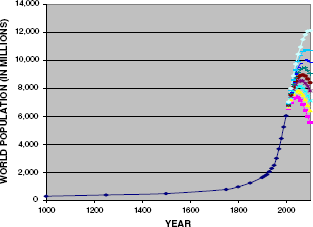
World population growth from 1000 to 2100 AD; lines for the twenty-first century show the 95% uncertainty range of future trends.
The coming acceleration of global population ageing
The twenty-first century will also bring significant population ageing in all parts of the world. The global proportion of those above age 60 is currently 10% of the total population. The proportion will increase to between 24 and 44% (80% uncertainty interval). Even more significantly, the proportion of the world population that is above age 80 will increase from the current 1% to between 4 and 20%, depending largely on the future course of life expectancy. Figure 2 shows that for Western Europe the proportion above age 80 is likely to increase much more dramatically than it will on the global level. The figure shows that currently around 3% of the population is above age 80, and that this proportion will only slightly increase over the coming decade. After the year 2030, however, the range opens up very quickly. This reflects the great uncertainty surrounding the future trend in life expectancy: will it soon level off and reach a maximum, as some scholars assume, or will it continue to increase or even accelerate due to new biotechnologies, as other scholars assume? By the end of the century, the 95% interval is extremely wide, ranging from the current level of 3% to an incredible 43% of the population above age 80, with the most likely level around 20%. Societies with such significant proportions of the population above age 80 clearly will be very different from today's societies. Most likely, however, an average 80-year-old person towards the end of this century will be in much better physical health than an average 80-year-old person today.
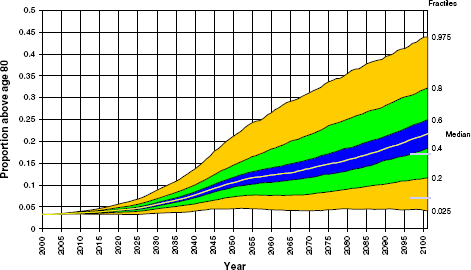
Projected uncertainty distribution of the proportion of the population above age 80 in Western Europe.
The geography of population ageing in Europe
The populations of Europe are far from uniform in their level and speed of ageing. The pattern is depicted in Fig. 3 and the data provided in Table 1. In terms of one of the most commonly used indicators of ageing–-the proportion of the population that is above the age of 65–-the level is currently lowest in Turkey, with only 6%, and highest in Italy and Germany, with 19.9 and 19.8%, respectively. These differences in the age structure are largely a consequence of the demographic history of each country. The results stem from the combination of past fertility levels that determined cohort size, the history of in- and out-migration as well as mortality conditions. Although countries with low levels of fertility generally have the highest proportions of elderly, there are some important exceptions. While the countries with the current lowest fertility rates in Europe are all in Eastern Europe, the proportions above the age of 65 in these countries are only at an intermediate level because of the history of rather high fertility up to the political changes that took place around 1990.
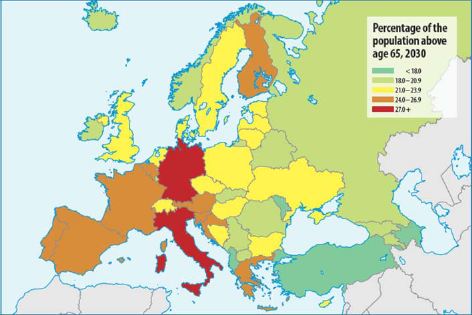
Proportion of the population projected to be above the age of 65 in 2030, in individual European countries.
Population size and ageing in Europe
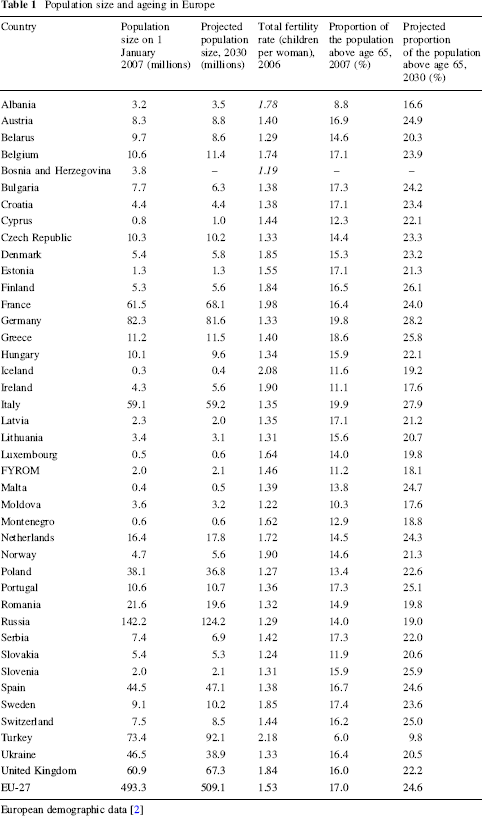
European demographic data [2]
Figure 3 and Table 1 also give projections of the pattern projected for 2030 based on the projections presented in the European Demographic Data Sheet [1,2]. In this picture, Germany and Italy clearly appear as the axis of the elderly in Europe, with over 27% of the population 65 years and older. This results from the combination of an extended period of very low fertility with high life expectancies. But the ranking of countries is not frozen over time and will likely change in a dynamic fashion. Finland, for instance, has one of the higher fertility levels in Europe but with a specific feature, namely, the timing of its baby boom, which happened in the late 1940s, while in most other countries it was in the early 1960s. Hence, in 2030 in Finland, the exceptionally large cohorts born during the baby boom will be above the age of 65, whereas in the rest of Europe, they will still be below that age. Those countries can expect an upward push in the proportion of this group in the subsequent years.
While population ageing affects all countries of Europe, shrinking currently affects only a small number of countries, mostly in Eastern Europe. Bulgaria, for instance, had around 9 million inhabitants before 1990. They are now down to 7.7 million due to a combination of strong out-migration, very low fertility and rather high mortality–-all forces working towards lower population size. The population is projected to shrink further to just above 6 million in 2030, which is a loss of almost one-third of the entire population between 1990 and 2030. Most other countries in Eastern Europe are also on a trajectory of a shrinking population. In most countries of Western Europe, population size is still increasing. Even where the balance between the number of births and the number of deaths is negative, in-migration is at such a level that populations continue to grow. Over the coming decades, in most countries, the number of deaths is expected to exceed the number of births. Whether this will cause moderate shrinking or moderate growth in the near future will be largely a function of future migration levels.
Future human capital
Returning to the global level, the above-described demographic trends will result in a major shift in the distribution of the world population over different continents and regions. Europe is not only likely to age rapidly and shrink in absolute numbers in the longer run, but it will also see its proportion of the world's population decline rapidly. As significant as these changes in relative population size are, it is not clear exactly what they will imply for a Numbers in italics refer to years different from the one on the column heading. Population projections were calculated by the Vienna Institute of Demography. EU-27 total population excludes French overseas departments. Some indicators for the EU-27 are computed as weighted averages. For further information about data sources and country-specific definitions, see http://www.populationeurope.org region's geopolitical standing. The strength and influence of a nation or a continent is not a direct function of its population size. If this were the case, then Africa today should have a similar standing in international politics, economics or military strength to that of Europe, and this is not remotely the case. What seems to count more than the sheer number of people is human capital, which can be defined in a simplified way by looking at the people of working age stratified by their level of education. The global distribution of human capital is changing as well, but the pattern looks rather different from that of mere population numbers.
The first global projections of human capital were recently produced by IIASA [3]. The proportions of people with certain levels of educational attainment can be projected relatively easily because education is typically acquired at a young age and then maintained throughout life. The fact has also been that more educated people live longer and have fewer children. Figure 4 shows the results for men and women of working age for four educational categories for four ‘mega-regions’. It shows that currently Europe and North America together still dominate the world in terms of human capital (the dark grey areas show people with secondary and tertiary education), although South Asia and the China region are larger in terms of the total working age population. The figure also shows the different paths of China and South Asia (mostly India), which reflects the fact that unlike South Asia, China has invested heavily over the past decades in primary and secondary education, and will see a peaking of its population size over the coming decades. South Asia will soon surpass China in terms of population size, but will fall back in terms of human capital. Even under the most optimistic scenario, Africa will see only very moderate increases in human capital. An interesting point worth noting is that China's human capital is increasing so rapidly that by around 2015, China will have more people of working age with secondary or tertiary education than Europe and North America together. These global shifts in human capital are likely to result in changing geopolitical and economic weights and will have significant implications for global health and well-being.
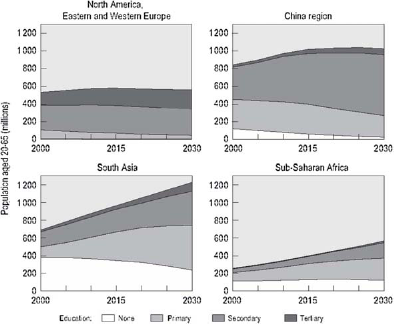
Population (in millions) aged 20-65 by level of education in four mega-regions, 2000-2030.
Human capital drives development
In conclusion, this paper first described the major demographic changes that Europe and the world are currently experiencing and which will determine the future. It then added an important new aspect to the analysis of global population trends, namely, the changing composition of the population by education. This helps to shift the focus from exclusively studying the quantity of people to adding the quality of dimension. In this context the notion of human capital can best be defined as ‘Human Capital = Population x Health x Education’. Since education is probably the single most important health determinant at the level of the individual, a better-educated population will mean a healthier population.
In addition, based on a new global dataset of educational attainment by age and sex, a long-held hypothesis that a better-educated population has greater economic growth potential has recently been statistically proven [4]. Such a population is also expected to be less vulnerable to all kinds of upcoming threats to health and well-being and to have a greater adaptive capacity to climate change. More broadly, there is reason to assume that human capital can indeed be considered the ultimate resource for sustainable development. While there is a danger of running out of many resources, ranging from natural to financial ones, and while Europe may even run out of young people, it is imperative to try to learn more throughout life. Unlike other resources, there seems to be no limit to improving collective skills.
On all continents one finds experiences of various countries that illustrate this point. For example, Finland moved from being one of the poorest countries in Europe a century ago to the world's most competitive economy today. Endowed with very few natural resources, the early and massive investment in human capital almost exclusively triggered this success story. The stories of Singapore and South Korea teach similar lessons. The bad news is, however, that some countries–-mostly in Africa–-are actually seeing declining levels of education (in part due to excessive population growth) and thus are seriously compromising their chances for the future. These lessons clearly point to policy priorities for the future: both for poor developing countries as well as for ageing European populations, massive investments in human capital formation are the key for managing the future.
Footnotes