




Abstract
Due to divergent fertility rates, the demographic gap between the US and Europe is steadily increasing. Despite significant regional variation, European fertility rates are currently well below replacement level. On the other side of the Atlantic, the continuing upsurge in fertility is definitely unique within the industrialised world. Demographers are quite perplexed by the exceptional American demographic pattern. The aim of this paper is, first, to examine the differing fertility patterns in the US and Europe; second, to identify possible explanatory factors behind the current divergence; and, finally, to present current challenges and future implications.
Introduction
It has become an axiom of conventional wisdom that poor countries have high birth rates; family size falls with socio-economic progress. This is generally true, although demographic trends are not that straightforward. Over the last decades, fertility transition has been gaining momentum, and steadily declining fertility rates have become a universal experience. No longer the exclusive territory of developed nations, below-replacement fertility rates are spreading rapidly, 1 leading to a global convergence of fertility indicators. Former high-fertility countries in Latin America, Southeast Asia, even certain parts of the Arab and Muslim world–-traditionally associated with high birth rates and large families–- have joined the sub-replacement club [3]. Due to this general and unexpected trend, 2 the world's population is presently at a turning point: today, more than half of all humans are living in countries or regions where the total fertility rate (TFR) has fallen below the magic number of 2.1 children per woman [12,21]. Surprisingly, the first signs of rebounding fertility are coming mainly from (a limited number of) affluent countries.
Replacement fertility is a frequently used demographic term referring to the level of fertility (described as the average number of children per woman) required to ensure that a population maintains its size. In other words, one generation needs to have at least as many potential mothers as the previous one. The level of replacement fertility is, therefore, determined by mortality rates till the end of reproductive age and sex ratio at birth. Currently, at a global level, a TFR of 2.1 children per woman is taken as a rough approximation of replacement fertility. Obviously, replacement fertility is higher in regions with elevated child and young adult mortality or a skewed sex ratio at birth.
Just a few decades ago, the unprecedented high population growth rates, with their economic, social and environmental implications, raised concern among scientists. Garret Hardin and Paul Ehrlich, among the most influential of the neo-Malthusians, used provocative titles like The tragedy of the commons and The population bomb to set the tone for public debate about the disastrous effects of uncontrolled population growth. Moving towards the end of the first decade of twenty first century, concerns about global population growth have been tempered as growth rates have steadily declined. Long-term population projections have been repeatedly revised downwards and humanity seems to have escaped the nightmare of overpopulation.
Whereas the fertility gulf between developed and developing countries is gradually narrowing, a new divide is emerging, this time within the industrialised world. In demographic terms, the gap between the US and Europe is gradually widening, bringing to light one more aspect of the often-evoked ‘American exceptionalism’ [3]. This paper focuses on the fertility divide between traditional transatlantic competitors; it offers a brief literature overview of the major explanatory factors and discusses future economic and social implications.
The US and Europe: divergent fertility and demographic paths
Rich countries are associated with close-to-zero natural growth rates as a result of a combination of low birth and low mortality rates. Of all industrialised regions, Europe has been the pioneer in the course of declining fertility. This transition occurred throughout the continent but with different timing and at a different tempo in different regions. It first happened during the 1970s in Scandinavia as well as in certain countries of Western Europe. In those regions, where declining birth rates were associated with female employment and lower rates of marriage, the process was gradual and consistent. Southern and Eastern European countries followed the downward trend in fertility rates with a lag of a decade or two. In this case, the TFR drop was more abrupt and went down to significantly lower levels, despite the relatively low rates of female labour force participation.
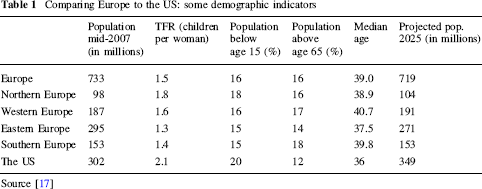
Overall fertility rates have remained for more than three decades below replacement levels. Europe seems to be currently caught in a so-called low-fertility trap. 3 It is definitely not the first time Europe has experienced exceptionally low fertility rates. 4 However, the current situation is undoubtedly without precedent, due to its intensity, its wide geographical dispersion as well as its duration. Despite essential geographical disparities across the continent, sub-replacement fertility has been commonplace in Europe for more than a generation. Moreover, some regions are seeing the lowest fertility rates worldwide. From the Mediterranean to Central and Eastern Europe, 5 the TFR has dropped as low as 1.2-1.3 children per woman, the lowest rate ever registered globally. It is often referred to, therefore, as ‘lowest-low fertility’ [10]. To make the European fertility map even more complicated, a belt of recovering fertility rates currently stretches from France to Scandinavia; those countries seem to have escaped the fertility trap and are registering fertility rates higher than 1.8–-in some cases even close to replacement level (Table 1).
Comparing Europe to the US: some demographic indicators
Source [17]
This term is used to describe sustained TFR of around 1.5 children per woman [13].
A commonly cited example of low fertility is that of France during the World War 1.
In most post-communist countries, economic hardship and political uncertainty have caused an even more precipitous decline of fertility than in the Mediterranean.
Smaller families are not the only facet of altered childbearing preferences. The new European fertility pattern suggests later maternity, higher rates of out-of-marriage births as well as increased levels of childlessness. The mean age of first maternity has, on average, increased by one and a half years within a decade; it reached the age of 26 in 2002 as opposed to 24.4 in 1990, while it exceeds the age of 28 in certain northern countries [2]. Maternity postponement is directly related to rising involuntary infertility. Meanwhile, childlessness as a new lifestyle is gradually becoming quite popular, as the remarkable examples of Germany and Austria indicate [16]. Declining marriage rates and the increasing number of divorces, along with decreasing ideal family size and rising rates of non-marital childbirth, are evidence that we are seeing transformed family models, ideational changes and increased individualism, as suggested by the ‘second demographic transition’ theory [19].
On the other side of the Atlantic, the demographic landscape is quite different. The US is growing at a faster pace compared with either its European counterparts or Japan. This is attributed to two main causes: higher net migration and higher fertility rates. In 2006, and for the first time since 1971, fertility rates in the US reached the desired level of 2.1 children per woman.
Historically, the US and European fertility paths, though not identical, have gone more or less in similar directions. The US experienced the post-World War II ‘baby boom’ followed by the ‘baby bust’, as was the case for several of its European counterparts. During the second half of the twentieth century, fertility fluctuations were more pronounced in the US than in Europe. The TFR peaked at more than 3.7 in the late 1950s; it touched its lower level of 1.7 children per women less than 20 years later in the mid-1970s. During the next two decades fertility steadily increased and finally surpassed the replacement threshold in 2006.
Since the 1960s, the fertility pattern of American mothers has changed. The mean age at the time of first birth increased by 3.5 years, while the percentage of first births that were to women above 30 years of age tripled and reached 22%. In the early 2000s, the mean age of first-time American mothers was 24.9, more than a year lower than the European average and more than three years below the EU-15 average. American fertility is still characterised by high teenage birth rates, despite their shrinking share. Currently, one out of four-first births is to a mother younger than 20 years of age [14]. Meanwhile, 20.4% of women between 40 and 44 years are childless [18].
Analysing the US's fertility counter-trend, experts mention the role of the multi-ethnic composition of American population on one hand, and the significant differences across states on the other. In both cases, the impact seems to be rather exaggerated [3]. Regional diversities are far from negligible, of course; they definitely exist. American fertility rates vary between 1.7 and 2.5 children per woman. In other words, TFR levels in low-fertility states are comparable to those in the recovering-fertility regions of Europe. Moreover, only slightly less than a third of the American states have below-replacement levels of fertility, whereas in Europe only one country (Iceland) reaches the minimum required level of 2.1 [17]. Obviously, regional differentiations fail to provide a sufficient explanation for the consistently higher American fertility rates. Racial disparities are also important: Hispanics have the highest fertility rates (2.9), followed by blacks (2.1), Asians (1.9) and non-Hispanic whites (1.86). Then again, ethnic fertility differentials do not adequately explain the observed divergence between the US and Europe, for two main reasons. First, due to the share of Hispanics in the total population, their fertility rates cannot account for the total fertility rate. Second, there is no racial argument for the higher non-Hispanic white fertility rates observed in the US.
How can the widening fertility gulf be explained?
Fertility patterns are dictated by a complex nexus of demography and economic conditions, social situations and political circumstances. The unusual–-for an industrialised country–- level of fertility rates registered in the US has attracted the interest of demographers as well as other experts who are trying to unravel the complex mix of implicated factors. Different possible explanations have been put forward, providing some clues about, though not sufficient evidence for, the most important factor responsible for the divergence observed.
The European experience of low and late maternity is regarded as a reasonable response to the high unemployment and economic uncertainty that young Europeans currently face. Long-term commitments, like childbearing, are postponed while young adults give priority to investments in education, professional experience and human capital [9]. Smaller families are directly related to labour market rigidity. The limited flexibility of working hours coupled with difficulties in re-entering the labour market after a short absence make it difficult to find a balance between career and family life.
On the other hand, it is generally accepted that it is easier for American women to reconcile work with family duties [15]. The US labour market is considered to be more flexible, with a relatively higher availability of part-time jobs, greater job security for working mothers and higher female remuneration. Additionally, social and economic conditions, ranging from more helpful husbands and spacious houses to late-night and weekend shopping possibilities, provide a more family friendly environment than there is in Europe. 6
Surprisingly, rigorous pro-natalist government policies are neither a sufficient nor a necessary condition for an upsurge in fertility rates. The US has no family policies and its fertility rate is increasing: this is also the case in the UK, Scandinavia, France, the Netherlands as well as Germany are typical examples of high welfare countries: the rate of fertility is increasing in all except the latter.
Nevertheless, the main reasons for the widening US-Europe fertility gap are possibly to be found beyond material issues. Eberstadt [3,4] suggests that rather than economic and social factors, it is a combination of attitudes towards life and personal moral values that explains America's fertility divergence. According to opinion surveys, Americans are more optimistic and have greater faith in the future than do Europeans [7]. Obviously, in societies where childbearing is a choice, a positive attitude towards life and the future correlates with a higher likelihood of bringing children into this world.
To continue on the subject of personal values, patriotism and religiosity are ideals more often met among Americans than Europeans. The former are more likely to express pride in their nationality and country, and they register higher percentages of households that actively worship [4,20]. The correlation between widely held religious values and childbearing, though not hard to imagine, cannot easily be established. Many European countries as well as certain states in America refuse to collect and disseminate any information about the religion and religiosity of their people. Despite the lack of official data that would allow for an international comparison, the connection between religion and fertility has been confirmed: actively religious persons tend to have higher marriage rates and more stable unions [1], circumstances that undeniably encourage childbearing; not to mention the impact of religion on issues such as abortion and contraception.
Labour market conditions, economic prosperity, a family friendly society, personal values like patriotism and religiosity, lifestyle and positive attitude towards life are the major parameters suggested as plausible explanatory factors. Nevertheless, no accurate answers can be advanced about the factor of greatest importance for the upsurge in fertility rates. Neither can the impact of each and every variable be quantified. Incontestably, fertility patterns are too complicated to be determined by one single factor.
Current challenges and future implications
The fertility divide between the US and Europe is already having its effect on certain demographic indicators relevant to population ageing. Fertility trends directly and profoundly affect population size and structure. In a low-mortality context, one major impact of declining fertility is the acceleration of the demographic ageing of a society. In contrast to the ageing resulting from increasing life expectancy, low-fertility ageing has an effect on the bottom of the population pyramid; it leads to a shrinking share of young in a population and directly affects the old-age dependency ratio. 7 This development translates into transformed population pyramids that look more like whirligigs (Fig. 1).
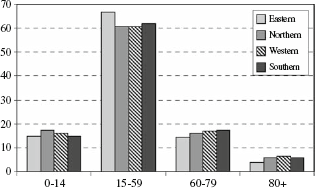
Population distribution by broad age groups (in %) in European regions, 2007.
The old-age dependency ratio refers to the number of persons over 65 years of age relative to persons at economically productive ages, that is, from 15 to 64 years. It is often used as an indicator of the economic burden the productive portion of a populaiton must bear to support retired people.
During the past five decades, the median age of the European population has increased by about 8.5 years, reaching the age of 39, 8 or 3 years higher than the median age of the American population. In Europe, elderly persons (those above 65 years) represent about 16% of the total population, as much as the percentage of children below the age of 15. In the US the percentage of children is two-thirds higher than the percentage of the elderly (Table 1).
Median age refers to the age at which half the populaiton is older and half younger. The EU-27 median age is already above 40.
All developed countries are particularly sensitive to the age composition of their populations, since their pension systems, founded on a pay-as-you-go principle, need new entrants to support current and future retirees. Maintaining the dependency ratio at relatively low levels is essential for the preservation of intergenerational solidarity, the fundamental principle of most social security systems. The unfavourable economic and financial implications of population ageing have been widely studied. Ageing has a positive impact on public spending for pensions and on long-term health care while it has a negative impact on domestic savings, yet its total budgetary implications have not yet been fully assessed. 9 One thing is certain: the European demographic pattern seems rather incompatible with the current European welfare state [11]. Population ageing will most likely affect all aspects of everyday life with its economic, social, health and political implications (Fig. 2).
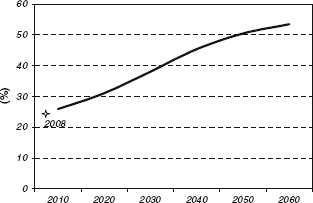
Projected old-age dependency ratios, 2008-2060. Source [8]
The impact, for instance, of demographic changes on tax revenues, education and unemployment expenditures is less clear, as the phenomenon is currently in its initial stages [6].
Accurate measures of population growth trends over the coming generation are hard to achieve in practice; this is the case for both US and European forecasts. Unanticipated variables may occur at any time and profoundly modify the demographic trends. One thing is certain: under current projections, the demographic gap between the old and the new world is expected to increase. Europe is currently experiencing negative population momentum, with zero natural population growth. In the near future, the total annual number of deaths is expected to exceed that of births and signal European depopulation. According to UN projections [17], over the next two decades Europe is expected to lose almost 15 million people. By 2025, its share of the global population will shrink to 9% from the current 12%.
On the other hand, the American population will continue to increase. Based on UN baseline projections, by 2025 the US will have added about 47 million people for a total of about 350 million persons, steadily maintaining its 4% share of the global population. By that time, the US median age is projected to be 39 years; three years higher than today, but still well below the current median age in the EU-15. Moreover, the US is expected to be among the few industrialised countries with a growing working-age population. In absolute terms, young Americans will outnumber young Europeans, even though the total European population will be higher than the American.
The structure of population age influences, in a multitude of ways, the economic performance and social development of a country. Production and consumption, technology and innovation, savings and investment, income and social benefits, all are directly affected by the percentage of the working-age population. People are more productive and creative during their first working decades. As they get older, consumption progressively rises and tends to exceed production. In an ageing society, as life expectancy increases, the period of ‘net consumption’ grows longer, with obvious implications for macroeconomic performance.
America's youthful population is expected, therefore, to offer greater opportunities for innovation, creativity and development. It will enhance economic competitiveness and put less pressure on pension and health care costs. For its part, Europe's great challenge in the years to come is to alleviate the economic and social implications of population ‘greying’. Far from being pessimistic about the future, European governments have to find ways to enhance prosperity through ‘healthy and active ageing’ [5]. Promoting the ongoing structural reforms towards a knowledge-based economy, requiring work that is less physically arduous, increasing female labour force participation, providing incentives to elders to remain active (mainly by eliminating tax disincentives and correcting structural distortions in labour markets)–-these are only some of the options that lie ahead. It goes without saying that fundamental reforms demand profound changes in the way people think and live, but it is now commonplace that inertia in the face of coming demographic changes is no longer an option.
Footnotes