






Abstract
Nostalgia, a sentimental longing or wistful affection for the past, confers self-oriented, existential, and social benefits. We examined whether nostalgic engagement is less beneficial for individuals who are high in neuroticism (i.e. emotionally unstable and prone to negative affect). Specifically, we tested whether the benefits of experimentally induced nostalgia are moderated by trait-level neuroticism. To address this issue, we conducted a high-powered individual participant data meta-analysis (N = 3556, k = 19). We found that the benefits of nostalgia were not significantly moderated by neuroticism, as they emerged for both high and low neurotics. This finding upheld when the self-oriented, existential, and social benefits of nostalgia were analysed jointly and when they were analysed separately. Taken together, individuals high and low in neuroticism are equally likely to benefit psychologically from engagement in nostalgic reverie.
In the 17th century, Swiss physician Johannes Hofer coined the term nostalgia, a compound of the Greek words ‘nostos’ (meaning homecoming) and ‘álgos’ (meaning pain). He used this term to describe the adverse symptoms displayed by Swiss mercenaries serving abroad (e.g. fainting, high fever, indigestion, stomach pain, and insomnia; Sedikides, Wildschut, & Baden, 2004). Although the view that nostalgia is characterised by dysfunction and disorder prevailed for centuries, recent research has led to a reappraisal of the emotion as a useful resource that individuals recruit to counter adversity (Sedikides, Wildschut, Routledge, & Arndt, 2015). This research has shown that nostalgia is a ‘self‐conscious, bittersweet but predominantly positive and fundamentally social emotion’ (Sedikides, Wildschut, Routledge, & Arndt, 2015, p. 190), which is prevalent in everyday life. Indeed, in a sample of British undergraduates, 79% reported experiencing nostalgia at least once a week (Wildschut, Sedikides, Arndt, & Routledge, 2006). Memories that evoke nostalgia are self-relevant, atypical, and positive and often include close others, important events, or time periods, and also locations, animals, or objects (Van Tilburg, Bruder, Wildschut, Sedikides, & Göritz, 2019; Wildschut et al., 2006). Nostalgia is often triggered by external stimuli, such as music (Nash, 2012; Routledge et al., 2011), scents (Reid, Green, Wildschut, & Sedikides, 2015), or tastes (Supski, 2013), and by internal stimuli, such as negative affect (Wildschut et al., 2006), lack of meaning in life (Routledge et al., 2011), or loneliness (Zhou, Sedikides, Wildschut, & Gao, 2008). The emotion is observed cross-culturally (Hepper et al., 2014) and across ages (Hepper, Wildschut, Sedikides, Robertson, & Routledge, 2020; Madoglou, Gkinopoulos, Xanthopoulos, & Kalamaras, 2017).
Much of the literature reviewed above, and the rehabilitation of nostalgia, is due to an experimental approach. The emotion has been experimentally induced, for example, by instructing participants to recall and emotionally relive a nostalgic (vs. ordinary or positive) autobiographical episode (Stephan, Sedikides, & Wildschut, 2012; Wildschut et al., 2006), listen to nostalgic (vs. cheerful) music (Routledge et al., 2011), or read nostalgic (vs. control) song lyrics (Cheung et al., 2013). The most frequently used induction method is the event reflection task (ERT; Sedikides, Wildschut, Routledge, & Arndt, 2015; Wildschut et al., 2006), which relies on targeted autobiographical recall. In the ERT, participants are randomly assigned to recall either a nostalgic or ordinary event from their past and to think about how it makes them feel. Then, they list keywords that capture the gist of the event and, more often than not, write a narrative account of their experience.
Experimental evidence reveals that nostalgia serves three vital intrapersonal and interpersonal functions (Sedikides, Wildschut, Routledge, & Arndt, 2015). First, nostalgia fulfils a self‐oriented function by augmenting self‐esteem (Hepper, Ritchie, Sedikides, & Wildschut, 2012; Wildschut et al., 2006), boosting optimism (Biskas et al., 2019; Cheung et al., 2013), and facilitating psychological growth and authenticity (Baldwin, Biernat, & Landau, 2015; Baldwin & Landau, 2014; Stephan et al., 2012). Second, nostalgia serves an existential function, as it sustains perceptions of meaning in life (Routledge et al., 2011; Routledge, Wildschut, Sedikides, Juhl, & Arndt, 2012; Sedikides & Wildschut, 2018; Van Tilburg, Igou, & Sedikides, 2013) and instils self‐continuity (i.e. a sense of connection between one's past and present selves; Sedikides et al., 2015, 2016; Sedikides, Wildschut, & Stephan, 2018; Van Tilburg, Sedikides, Wildschut, & Vingerhoets, 2019). Third, nostalgia enhances sociality by promoting social connectedness (i.e. a sense of acceptance and belongingness; Sedikides & Wildschut, 2019; Turner, Wildschut, & Sedikides, 2012; Wildschut, Sedikides, Routledge, Arndt, & Cordaro, 2010; Zhou et al., 2008) and social action tendencies (i.e. a social approach orientation; Sedikides & Wildschut, 2020; Sedikides et al., 2018; Stephan et al., 2014; Zhou, Wildschut, Sedikides, Shi, & Feng, 2012). Indeed, a meta-analysis revealed robust main effects of nostalgia on self-oriented (self‐esteem and optimism), existential (meaning in life and self‐continuity), and sociality (social connectedness) functions, as well as on positive, but not negative, affect (Ismail, Cheston, Christopher, & Meyrick, 2020). Increasingly, however, researchers have been turning their attention to the role of personality: Are certain persons more capable of reaping the psychological benefits of nostalgia than others?
Generality of nostalgia: the role of personality traits
The lion's share of attention has been enjoyed by a small number of traits. Two studies have examined the role of nostalgia proneness, the dispositional or trait-level tendency to experience nostalgia (Barrett et al., 2010; Wildschut & Sedikides, in press). In an ERT experiment, Cheung, Sedikides, and Wildschut (2016) assessed nostalgia proneness prior to the nostalgia induction. Recalling a nostalgic (compared with ordinary) life event was more beneficial (i.e. increased self-esteem, social connectedness, and optimism) for participants who were high (compared with low) in nostalgia proneness. Layous, Kurtz, Wildschut, and Sedikides (2020) examined the role of nostalgia proneness (assessed at baseline) in a 6‐week ERT‐based intervention study. Well‐being was assessed at the end of the 6 weeks and at a 1‐month follow‐up. The nostalgia intervention increased well‐being at both time points for participants who were high in nostalgia proneness but decreased it for those who were low in nostalgia proneness. These findings are consistent with the person‐activity fit principle in well‐being interventions (Lyubomirsky & Layous, 2013). Individuals who experienced nostalgia regularly in their everyday lives (i.e. those who were relatively more nostalgia prone) benefitted the most from nostalgia inductions.
Two further studies examined individual differences that can be classified under the domain-level trait of neuroticism or emotional instability in the Big Five taxonomy of personality (John & Srivastava, 1999). Neuroticism is the enduring tendency to experience distress and negative emotions, such as fear, sadness, anxiety, loneliness, worry, self-consciousness, or dissatisfaction (John, Naumann, & Soto, 2008), and is considered a fundamental domain of human personality (McCrae & Costa, 2003). Verplanken (2012) assessed individual differences in habitual worrying (i.e. the tendency to engage repetitively and persistently in mental problem solving of uncertain or unresolved difficulties or challenges; Verplanken, Friborg, Wang, Trafimow, & Woolf, 2007) prior to an ERT-based nostalgia induction. Worry is a cognitive marker of neuroticism (Segerstrom, Tsao, Alden, & Craske, 2000) and is positively related to it (Muris, Roelofs, Rassin, Franken, & Mayer, 2005). Results revealed that nostalgia (compared with control) increased positive mood irrespective of habitual worrying. However, for participants scoring high (vs. low) on habitual worrying, nostalgia (compared with control) also increased feelings of anxiety and depression. In an ERT experiment among Syrian refugees residing in Saudi Arabia, Wildschut et al. (2019) assessed individual differences in resilience (i.e. the ability, when meeting adversity, to maintain psychological equanimity and cope adaptively with stress; Wagnild & Young, 1993) prior to the nostalgia induction. Vulnerability to stress is a core facet of neuroticism, and, accordingly, resilience is inversely related to neuroticism (Campbell-Sills, Cohan, & Stein, 2006). Compared with high-resilience refugees, those lacking resilience derived fewer psychological benefits, and suffered greater psychological costs, from the nostalgia induction.
There is a danger, when examining the moderating role of personality traits, of becoming mired in a piecemeal and atheoretical exploration of ‘the thousands of particular attributes that make each human being individual and unique’ (John & Srivastava, 1999, pp. 102–103). To avoid this trap, we adopted a common, integrative framework that synthesises diverse systems of personality description—the Big Five taxonomy. To be precise, the specific findings for habitual worrying (Verplanken, 2012) and resilience (Wildschut et al., 2019) point to a particular role of neuroticism. Our key objective, then, was to examine if the psychological benefits of nostalgia inductions depend on trait-level neuroticism.
The potential role of neuroticism
The postulated role of neuroticism as a suppressor of nostalgia's benefits is based on two premises. First, despite being predominately positive, nostalgia commonly contains elements of negativity (Batcho, 2007; Hepper et al., 2012; Hertz, 1990) and has a unique bittersweet affective signature (Sedikides & Wildschut, 2016; Van Tilburg, Bruder, et al., 2019; Van Tilburg, Sedikides, & Wildschut, 2018). On the one hand, the content of nostalgic narratives is more positive than negative (Abeyta, Routledge, Roylance, Wildschut, & Sedikides, 2015; Madoglou et al., 2017; Wildschut et al., 2006), and nostalgia inductions typically (Hepper et al., 2012; Stephan et al., 2012; Wildschut et al., 2006, 2010; Zhou et al., 2008, 2012, Study 1), but not always (Turner, Wildschut, Sedikides, & Gheorghiu, 2013; Van Dijke, Wildschut, Leunissen, & Sedikides, 2015; Zhou et al., 2012, Studies 2‐4), increase positive affect. On the other hand, nostalgia is not devoid of negative affect. Whereas nostalgia inductions tend to increase positive affect, they typically do not reduce negative affect (Cheung et al., 2013; Routledge et al., 2012; Routledge, Arndt, Sedikides, & Wildschut, 2008; Sedikides et al., 2016; Sedikides, Wildschut, Routledge, & Arndt, 2015; Wildschut et al., 2006, 2010; Zhou et al., 2012). Analyses of laypersons’ conceptualisation of nostalgia suggest that this negativity comes from missing or longing for aspects of the past. Specifically, laypersons regard ‘longing/yearning’, ‘missing’, and ‘wanting to return to the past’ as central features of the construct ‘nostalgia’ (Hepper et al., 2012, 2014). Second, neuroticism is linked to negative affectivity (Gray, 1981; Hamann & Canli, 2004; Rusting & Larsen, 1998) and so may undermine nostalgia's benefits through several mechanisms. These are grounded in the availability, accessibility, and processing of emotional memories.
We start by considering the availability of nostalgic memories. Nostalgic memories can contain positive aspects (e.g. momentous life events or meaningful social interactions) and/or negative aspects (e.g. the loss of a loved one; Wildschut et al., 2006). The relative degree of positivity and negativity differs across memories and between individuals. Neuroticism is associated with several negative life outcomes, such as lower subjective well-being (Steel, Schmidt, & Shultz, 2008), higher levels of psychopathology (Malouff, Thorsteinsson, & Schutte, 2005), and higher likelihood of criminal arrest (Huo-Liang, 2006). Thus, the pool of memories about which high neurotics (compared with low neurotics) could be nostalgic may be more negatively valenced on average. Indeed, high neurotics appear to report a larger proportion of negative autobiographical memories (Denkova, Dolcos, & Dolcos, 2012).
Additionally, irrespective of the availability of certain memories, neuroticism may entail a tendency to draw upon nostalgic memories that are more negatively valenced and thus have lower potential to convey psychological benefits. That is, there may be systematic differences between those high and low in neuroticism with respect to the accessibility of memories that they select for nostalgic reflection. Consistent with this, high neurotics (compared with low neurotics) are more likely to retrieve affectively negative content in cued or free recall tasks (Rusting & Larsen, 1998). Further, research on life stories (i.e. top-level narratives that people construct from personal experiences to derive and maintain a sense of self) indicates that high neurotics are more likely to include affectively negative content in their life stories (McAdams, Reynolds, Lewis, Patten, & Bowman, 2001; Raggatt, 2006; Thomsen, Olesen, Schnieber, & Tønnesvang, 2014) and to revive especially bitter memories (Cappeliez & O'Rourke, 2002).
Finally, in regard to the third and perhaps most important mechanism, individuals with elevated levels of neuroticism may process nostalgic memories differently. The same emotional memory may convey psychological benefits for someone low in neuroticism but may be costly for someone high in neuroticism. High neurotics (compared with low neurotics) may benefit less from nostalgic engagement, because their dispositional style of emotional processing could exacerbate the negatives inherent to the nostalgic experience that are otherwise reappraised or outweighed by the positives. That is, they may be particularly sensitive to the negative aspects of the nostalgia experience. Research on the functioning of neuroticism in the broader context of autobiographical memory indicates that high neurotics (compared with low neurotics) experience autobiographical memories as more emotionally and physiologically intense, rehearse them more, and see them as more central to their identity (Rubin, Boals, & Hoyle, 2014; Rubin, Dennis, & Beckham, 2011; Sutin, 2008). Boelen (2009) found that high neurotics (compared with low neurotics) who lost a loved one are more likely to perceive the event as central to their identity and suffer more severe psychological harm. Similarly, Ogle, Siegler, Beckham, and Rubin (2017) reported that highly neurotic individuals suffer more serious consequences from traumatic events, because they respond more emotionally to traumatic memories, rehearse them more, and perceive them as more central to their identity.
Overview
We conducted a comprehensive meta-analysis to test whether neuroticism attenuates the psychological benefits of nostalgia. Although meta-analyses typically aim to summarise an existing literature, we relied on meta‐analysis here to address a focused question. As such, we searched for studies (publishes or unpublished) that measured trait neuroticism and experimentally manipulated nostalgia. We derived the effect sizes of interest using raw data from these primary studies. This approach is sometimes referred to as two‐step individual participant data meta‐analysis (Riley, Lambert, & Abo‐Zaid, 2010). We considered a wide range of dependent variables encompassed by the tripartite (self, existential, and social) taxonomy of nostalgia's psychological benefits. That is, we examined whether the effects of nostalgia on these three domains are smaller for high neurotics than low neurotics. Additionally, we explored whether the effects of nostalgia on positive affect and negative affect differ as a function of neuroticism.
Method
We used the R environment for statistical computing (R Core Development Team, 2017) to process and analyse all data. We fit robust variance estimation (RVE) models using the robumeta package (Fisher, Tipton, & Zhipeng, 2017). Effect-size data and analysis scripts are publicly available at osf.io/sfx6h. The study was not preregistered.
Inclusion criteria and data collection
Studies were eligible for inclusion in the meta‐analysis if they (i) experimentally manipulated nostalgia, (ii) contained at least one control condition, (iii) randomly assigned participants to conditions, (iv) measured trait neuroticism, and (v) measured at least one outcome that could be classified as a self‐oriented, existential, or social autobiographical‐memory function. Some studies that met these criteria also contained positive and/or negative affect as outcomes. For these studies, we also analysed positive and negative affect. However, we excluded studies that assessed exclusively positive and negative affect, as this was not our focus. We only included studies for which we had access to the primary (or raw) data. To identify relevant studies, we contacted active researchers in the area of nostalgia. We further sent queries for data through mailing lists of the Society of Experimental Social Psychology and the Society for Personality and Social Psychology. Additionally, we conducted an electronic literature search of the Web of Science Core Collection (in October, 2019), searching all fields for the terms ‘nostalg* AND (neurotic* OR personality OR big five)’. For all relevant articles, we requested full data sets as well as any available materials and documentation. When information was missing or unclear, we consulted the primary authors to resolve ambiguities.
Data preparation
We applied a standardised data‐processing protocol to all studies to make effect sizes comparable. We coded the nostalgia manipulation as 0 for the control condition and 1 for the nostalgia condition. For studies that used multiple controls, we included the most neutral one. For example, if an experiment used both ordinary-memory and positive‐memory control conditions, we calculated an effect size for the comparison between nostalgia and ordinary memory. We standardised neuroticism scores and all outcome variables by calculating z scores (M = 0, SD = 1). In supplementary analyses, we converted neuroticism scores to a 5‐point scale to enable comparisons of the mean level and dispersion of neuroticism across studies. We reverse scored all dependent variables that reflected negative outcomes (except negative affect), so that higher scores indicated more beneficial outcomes. For example, we reverse scored the No Meaning in Life Scale (Kunzendorf, Moran, & Gray, 1995) for higher scores to reflect greater sense of meaning in life. Finally, we estimated scale reliability by computing Cronbach's alphas for neuroticism and all outcomes.
Effect‐size computation
We computed three effect sizes for each outcome per study: (i) nostalgia main effect, (ii) neuroticism main effect, and (iii) Nostalgia × Neuroticism interaction. We used Cohen's d for all effect sizes. For the main effects of the nostalgia manipulation, we computed Cohen's d effect sizes as the mean difference between the nostalgia and control conditions divided by the pooled standard deviation. Higher values indicate higher means in the nostalgia condition. For neuroticism main effects, we calculated Pearson correlations (r) between neuroticism and the respective outcome variable. We then transformed all correlations to Cohen's d (Borenstein, Hedges, Higgins, & Rothstein, 2009). For interactions, we fitted a multiple regression model for each outcome per study, predicting the respective outcome (z‐standardised, Mean = 0, SD = 1) from neuroticism (z‐standardised), nostalgia (0 = control, 1 = nostalgia), and the Nostalgia × Neuroticism interaction. We then retrieved the regression coefficients and standard errors of the interaction term from each analysis. The regression coefficient indicates the predicted change in the nostalgia main effect when levels of neuroticism in the sample increase by one standard deviation. The metric of the nostalgia main effect is standard deviations, so the regression coefficient is also in the metric of Cohen's d.
We considered a range of outcomes. Analysing these diverse outcomes involves a trade‐off between construct validity and statistical power. Power is maximised when all outcomes are synthesised into a single summary effect. However, this may entail combining psychologically distinct constructs. On the other extreme, construct validity is maximised when outcomes reflecting the exact same construct (e.g. self‐esteem) are aggregated separately. This, though, may yield small subgroups of outcomes, and so statistical power to detect effects within these subgroups may be low. Taking this trade‐off into account, we adopted a sequential procedure.
We started by synthesising all outcomes to arrive at a single summary effect (prioritising statistical power over construct validity). Next, we grouped outcomes in terms of the three previously established superordinate autobiographical‐memory functions of nostalgia: selforiented, existential, and social (Sedikides, Wildschut, Routledge, & Arndt, 2015). Subsequently, we calculated summary effects for these three superordinate categories (striking a balance between construct validity and power). Finally, we divided outcomes within the three superordinate categories into subcategories according to the psychological construct they reflected (yielding seven subcategories: self‐esteem, optimism, inspiration, meaning in life, self‐continuity, social connectedness, and social action tendencies—see below for details), and then we derived summary effects for these specific subcategories (prioritising construct validity over statistical power). We analysed positive and negative affect separately in subgroup analysis.
Study coding
We coded for a range of study and outcome characteristics. We included some for descriptive purposes and others for examination as meta‐moderators of the Nostalgia × Neuroticism effect size in meta-regression analyses. We reasoned that these meta‐moderators may account for variation in the magnitude of the Nostalgia × Neuroticism effects across studies and outcomes.
Type of nostalgia induction
The magnitude of the Nostalgia × Neuroticism interaction effect may depend on type of nostalgia induction. For instance, manipulations may differ in the degree of negativity they induce, and thus the degree to which their effects are moderated by neuroticism could differ. We coded whether nostalgia was induced by the ERT or music.
Type of control condition
Several control conditions have been used in the nostalgia literature. For the ERT, procedures that involve the recollection of ordinary events are advantageous, because they provide a neutral reference point. Thus, the comparison of a neutral control condition and a nostalgia condition allows all psychologically active components of nostalgia to contribute to the effect. More stringent control conditions have also been implemented to isolate incremental effects of nostalgia manipulations. For example, in some studies participants in the control condition listened to happy music, which allowed researchers to examine the effects of nostalgia above and beyond positive mood. We coded whether the control condition was intended to be neutral or non-neutral.
Type and reliability of neuroticism scale
Neuroticism scales differ in several ways. First, measurement reliability may vary depending on number and type of items included in the scale. We expected for more reliable neuroticism scales to yield stronger interaction effects. Second, scales may assess distinct components of neuroticism, and some components may interact with nostalgia more strongly than others. We therefore coded for type of neuroticism scale and its reliability (indexed by Cronbach's alpha). We set the reliability of single‐item scales to the minimum of all reliability estimates in the meta‐analysis, as a conservative lower‐bound estimate. Additionally, and in an effort to mark the relative length of neuroticism scales, we coded studies that used the Big Five Inventory (BFI—eight items; John et al., 2008) as ‘long’, and we coded studies that used either the Ten‐Item Personality Inventory (TIPI—two items; Gosling, Rentfrow, & Swann, 2003) or the TIPI‐Revised (TIPI‐r—one item; Denissen, Geenen, Selfhout, & van Aken, 2008) as ‘short’.
Publication status
We coded all studies that were published in peer-reviewed journals as ‘published’. We coded the remaining studies as ‘unpublished’. Two (out of 19) studies were published, and both were reported by Cheung et al. (2013).
Mean sample age
We calculated participants' average age, separately for each study. Doing so enabled us to examine whether focal effects varied as a function of the mean age within a sample.
A utobiographical-memory functions and type of affect
We only included studies reporting at least one outcome that was classifiable as self‐oriented, existential, or social. Some of these studies also measured positive affect or negative affect as outcome variables. We coded all studies in terms of these five outcome categories. We tested whether the moderating role of neuroticism differed among the outcome categories.
Outcome subcategory
Within the three major outcome categories (self‐oriented, existential, and social), effect sizes could be further classified into subcategories. For the self-oriented category, subcategories comprised self‐esteem (e.g. state version of the Rosenberg Self‐Esteem Scale; Rosenberg, 1965; e.g. ‘I feel that I’m a person of worth, at least on an equal basis with others’), optimism (e.g. Life Orientation Test‐Revised; Scheier, Carver, & Bridges, 1994; e.g. ‘In uncertain times, I usually expect the best’), and inspiration (e.g. Inspiration Scale; Thrash & Elliot, 2003; e.g. ‘I feel inspired’). For the existential category, subcategories comprised meaning in life (e.g. Meaning in Life Questionnaire; Steger, Frazier, Oishi, & Kaler, 2006; e.g. ‘I understand my life's meaning’) and self‐continuity (e.g. Self‐Continuity Index; Sedikides, Wildschut, Routledge, Arndt, Hepper, & Zhou, 2015; e.g. ‘There is continuity in my life’). For the social category, subcategories comprised social connectedness (e.g. ‘Right now, I feel connected to loved ones’; Wildschut et al., 2006) and social action tendencies (e.g. ‘Thinking about this nostalgic event makes me want to join a student group made up of a wide range of people I don't know’; Stephan et al., 2014). As we mentioned above, positive affect and negative affect were separate categories and were typically measured with the Positive and Negative Affect Schedule (Watson, Clark, & Tellegen, 1988).
Outcome measurement reliability
Interaction effects are dependent on the correlation of the predictors with the outcome, which in turn is dependent on the reliability of the outcome measurement. We computed Cronbach's alpha as estimates of reliability for all outcomes. For single‐item measures, we entered the lowest reliability observed across all studies included in the meta‐analysis. We expected that more reliable outcomes would register larger Nostalgia × Neuroticism interaction effects.
Meta-analytic procedure
Meta-analytic modelling
The analyses included various neuroticism scales, experimental procedures, and outcome variables. It is therefore unrealistic to treat the effect sizes as being drawn from the same population. Accordingly, we conducted all analyses using random‐effects models. One central assumption of conventional random‐effects meta‐analytic models is statistical independence of effect sizes. This assumption is violated when multiple effect size from the same study are included. There are several approaches to addressing this issue. First, researchers often maintain independence by including only one effect size per study. However, this entails a considerable loss of information and comes with a risk of bias in the selection process. Second, researchers may aggregate all effect sizes stemming from the same study into a composite. One variant of this approach involves adjusting effect-size variances of the composite based on the correlation structure of the aggregated effect sizes (Borenstein et al., 2009). Specifically, variances are more strongly reduced if outcomes are less correlated, reflecting the idea that less correlated outcomes provide more unique information, and consequently more precise estimates. Although this procedure reduces the risk of bias, it also entails a loss of information because different constructs are combined into a composite that may be difficult to interpret. Third, Hedges, Tipton, and Johnson (2010) recently proposed an RVE approach for meta‐analysis. This approach permits fitting random‐effects or mixed‐effects meta‐analytical models to sets of dependent effect sizes without a need for selection or aggregation. RVE estimates the covariance structure of effect sizes and adjusts standard errors accordingly. This approach, however, has two drawbacks. To begin, although it is possible to derive point estimates for true effect‐size heterogeneity in RVE (I2), significance tests for this estimate are currently unavailable. Moreover, procedures for power analysis in RVE have not yet been developed. Considering the (dis)advantages of the three approaches outlined above, we implemented RVE for all analyses. To evaluate the magnitude of true effect‐size heterogeneity, we resorted to rules of thumb (Higgins & Green, 2011). We estimated statistical power by applying power analysis for conventional meta‐analysis as an upper bound estimate.
Robust variance estimation
Before conducting RVE, we considered three issues (TannerSmith & Tipton, 2014). First, we needed to determine if the number of studies sufficed to obtain accurate model estimates. Standard RVE performs satisfactorily with a minimum of 10 studies when estimating summary effects and with a minimum of 40 studies when estimating slopes in meta‐regression (Hedges et al., 2010; Tipton, 2013). However, when the number of studies falls below these limits, significance tests are plagued by inflated Type I error rates. Recently, small sample corrections have been developed for single and multiple parameter tests in RVE that account for inflated error rates (Tipton, 2015; Tipton & Pustejovsky, 2015). We implemented these corrections for all RVE models. Specifically, we computed regression coefficients using adjusted covariance matrices. We tested single regression coefficients using t‐tests with Satterthwaite-adjusted degrees of freedom (Tipton, 2015) and multiple regression coefficients with the approximate Hotelling‐Zhang test (AHZ; Tipton & Pustejovsky, 2015). Second, we needed to decide how to weigh the effect sizes in the summary effect. Following relevant recommendations (Tanner‐Smith & Tipton, 2014), we set the weights to account for dependence due to correlated, rather than hierarchical, effects, because this type of dependence was likely to be more prevalent in the data set. Third, we needed to estimate the average correlation between effects sizes. We estimated this value by averaging all outcome correlations per study and then averaging these means across studies. This procedure returned a mean outcome correlation of r = 0.45. We conducted a sensitivity analysis for all models by varying this estimate from .10 to .90. In no case did r considerably influence any conclusions drawn from the models.
Meta‐moderation analyses
To examine whether the magnitude of the Nostalgia × Neuroticism interaction is moderated by study characteristics (e.g. type of nostalgia induction, mean sample age), we entered these characteristics as predictors in meta‐regression. Meta‐regression is analogous to linear regression in primary studies, with the exception that effect sizes (rather than participant‐level outcomes) are regressed on predictors. The meta‐moderation analyses focused on accounting for variation in the Nostalgia × Neuroticism interaction effect—the main focus of this meta‐analysis. We report meta‐moderation analyses for the nostalgia and neuroticism main effects in the Supporting Information. Given that all music‐induction studies used a non‐neutral control condition, and all but one ERT‐induction studies used a neutral control condition, the type of nostalgia induction and type of control condition are confounded. Therefore, results for type of nostalgia induction and type of control condition are similar or, in most cases, identical.
Results
Study overview
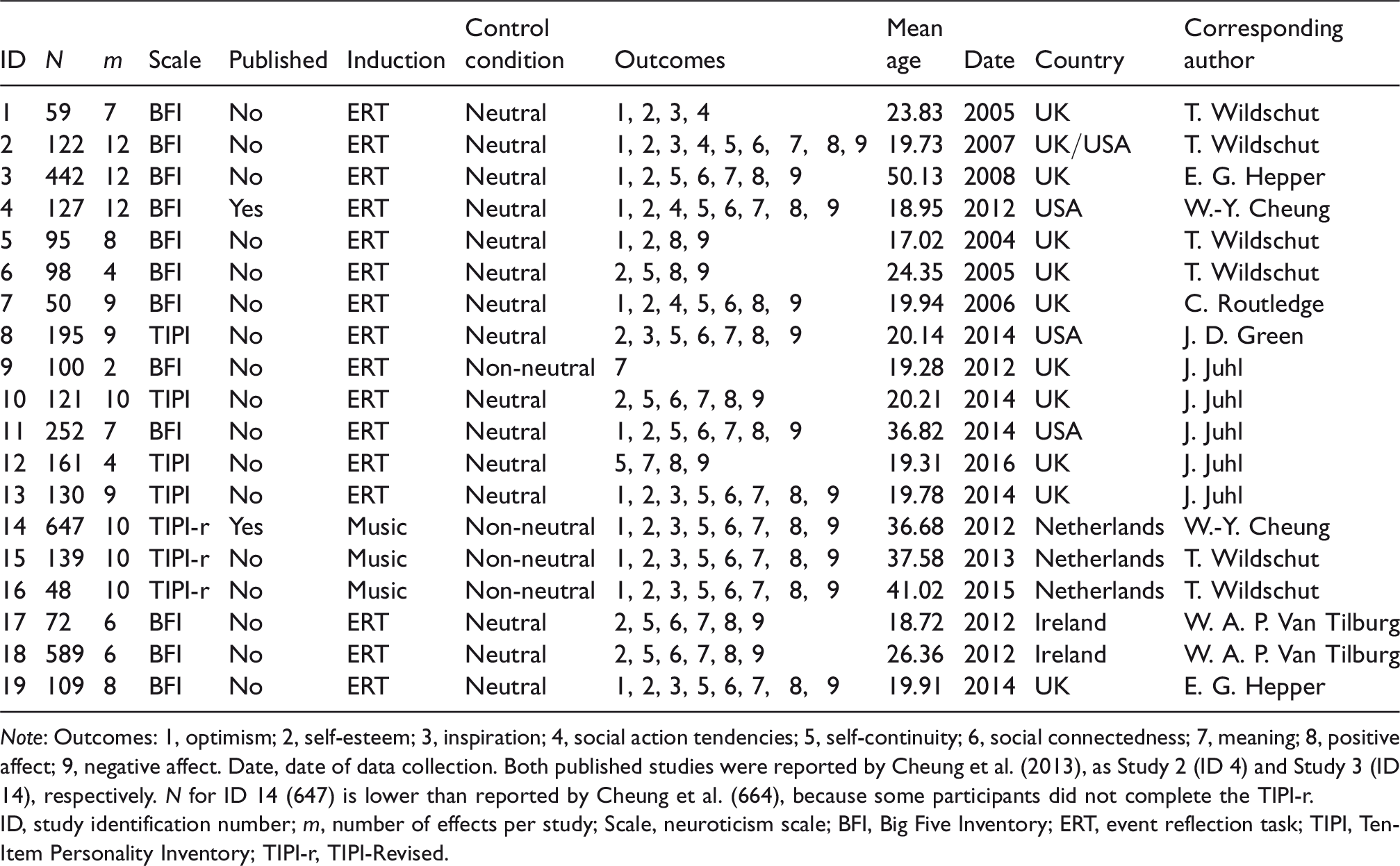
Note: Outcomes: 1, optimism; 2, self-esteem; 3, inspiration; 4, social action tendencies; 5, self-continuity; 6, social connectedness; 7, meaning; 8, positive affect; 9, negative affect. Date, date of data collection. Both published studies were reported by Cheung et al. (2013), as Study 2 (ID 4) and Study 3 (ID 14), respectively. N for ID 14 (647) is lower than reported by Cheung et al. (664), because some participants did not complete the TIPI-r.
ID, study identification number; m, number of effects per study; Scale, neuroticism scale; BFI, Big Five Inventory; ERT, event reflection task; TIPI, Ten-Item Personality Inventory; TIPI-r, TIPI-Revised.
Nostalgia functions
Nostalgia main effect
The overall nostalgia effect across self‐oriented, existential, and social functions was significant, d = 0.284, SE = 0.044, p < .001, CI95[0.190, 0.377]. Nostalgia manipulations induced an average increase of 0.284 standard deviations across the three superordinate autobiographical‐memory functions.
There was a substantial amount of effect‐size heterogeneity, I2 = 72.85, τ
2
= 0.063. I2 is interpreted as the percentage of true effect-size variance in the total variance. τ
2
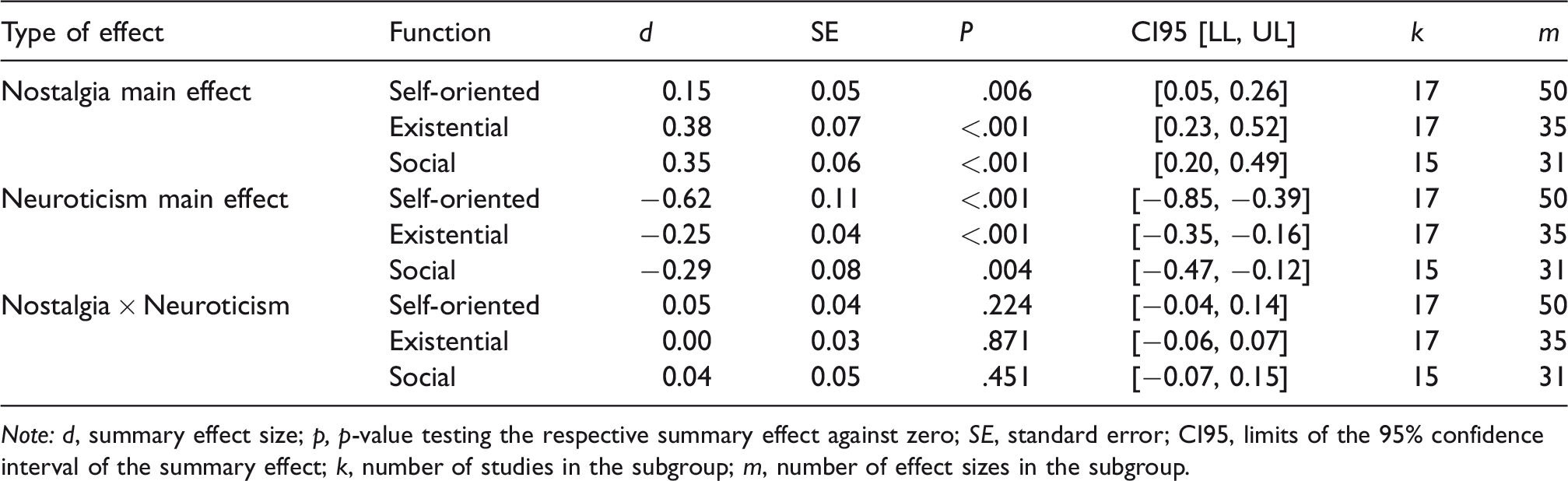
reflects the true variance of effect sizes in the metric of the effect size (i.e. one standard deviation). To test if the magnitude of the nostalgia effect differed between the three superordinate functions, we dummy coded the functions (self-oriented, existential, and social) and entered them as predictors in the model. Results of this analysis revealed that the nostalgia effect differed significantly among the three domain‐level functions, AHZ(14.57) = 9.02, p = .003, remaining I2 = 67.23 (Figure 1a). Although the nostalgia effect was larger for the existential and social functions than the self‐oriented function, it was statistically significant for all three of them (self‐oriented, d = 0.15, p = .006; existential, d = 0.38, p < .001; social, d = 0.35, p < .001). We summarise results of the subgroup analysis for autobiographical‐memory functions in Table 2.
Nostalgia main effects (a), neuroticism main effects (b), and Nostalgia × Neuroticism interaction effects (c) for autobiographical-memory functions. d, summary effect size; m, number of effect sizes per autobiographical-memory function. Effect-size magnitude is depicted on the y-axis, and the associated sample size for each effect size is depicted on the x-axis. Larger points indicate more weight. The thick black horizontal line represents the summary effect for the given autobiographical-memory function. Thin black horizontal lines represent the boundaries of the 95% confidence interval of the summary effect. The dashed grey line represents the null effect. Summary effects by nostalgia functions. Note: d, summary effect size; p, p-value testing the respective summary effect against zero; SE, standard error; CI95, limits of the 95% confidence interval of the summary effect; k, number of studies in the subgroup; m, number of effect sizes in the subgroup.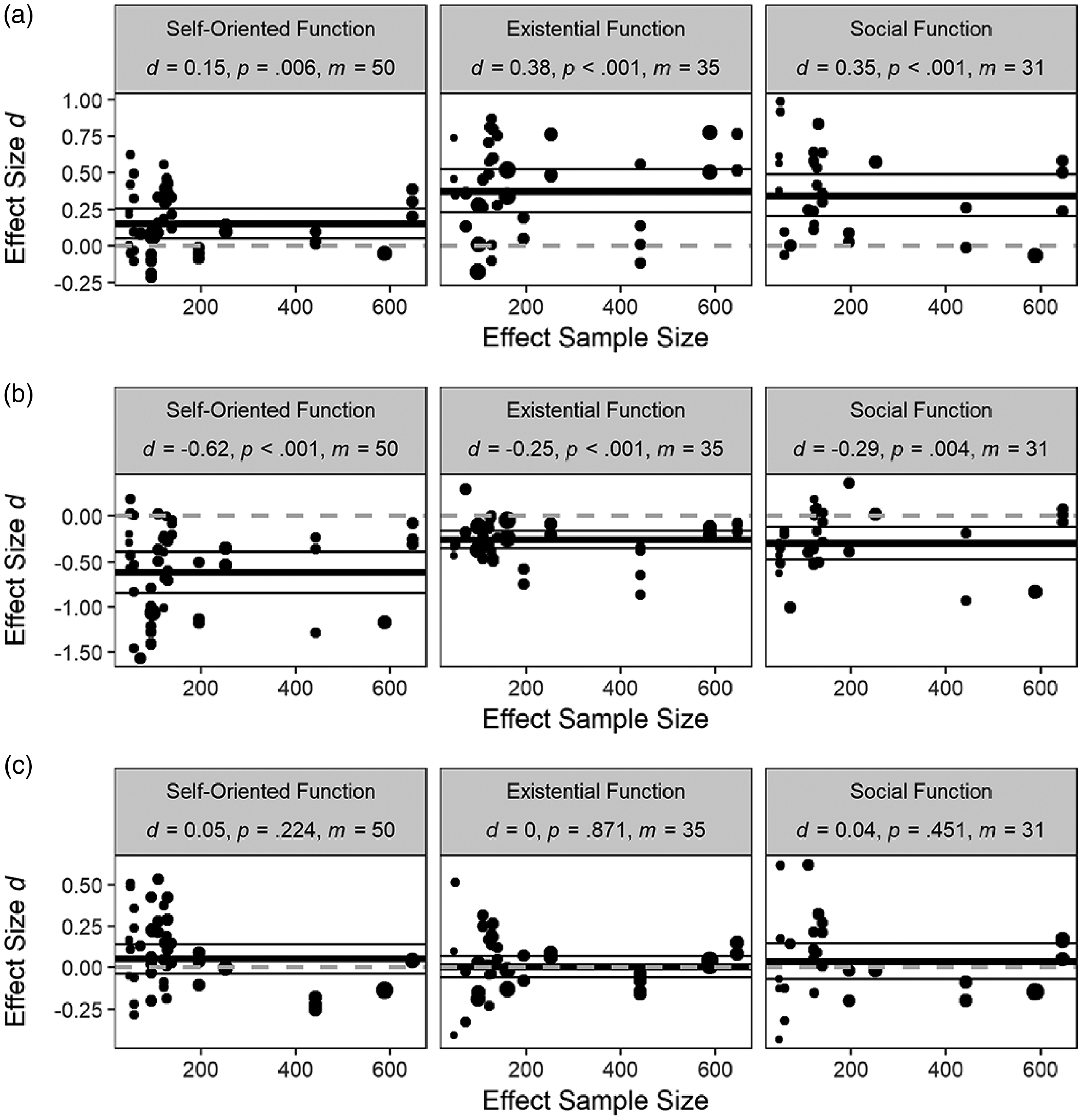
Summary effects for the main effects of the nostalgia manipulation by outcome subcategory.
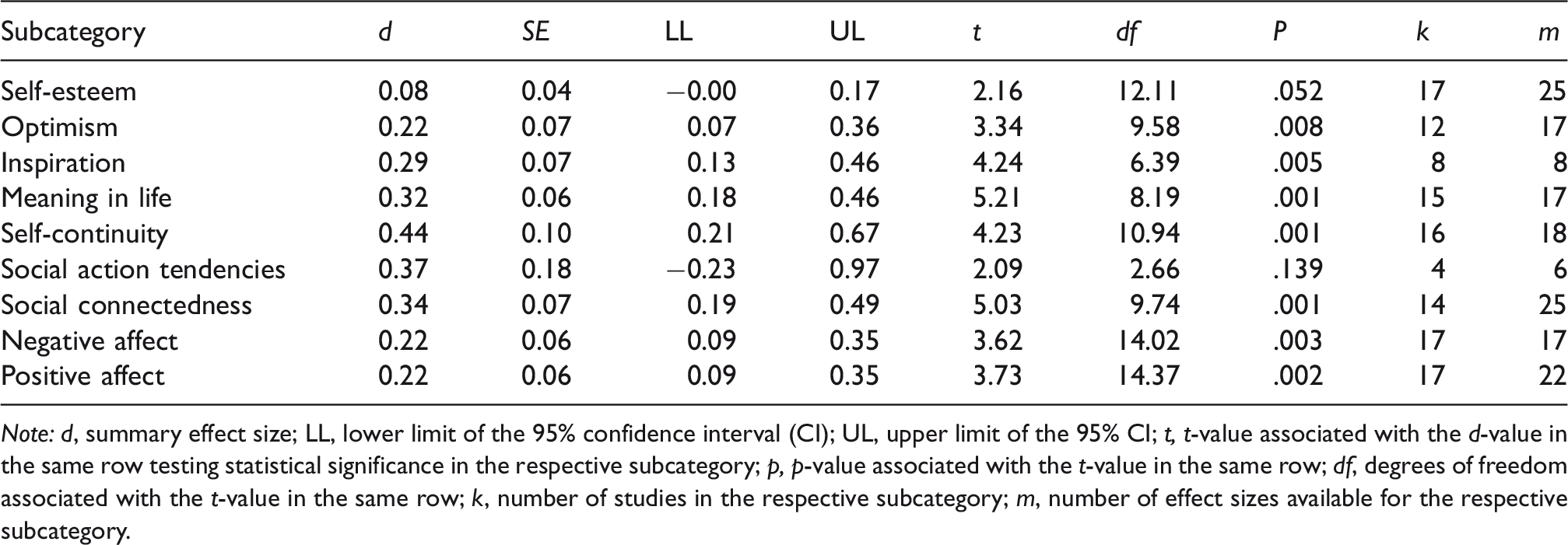
Note: d, summary effect size; LL, lower limit of the 95% confidence interval (CI); UL, upper limit of the 95% CI; t, t-value associated with the d-value in the same row testing statistical significance in the respective subcategory; p, p-value associated with the t-value in the same row; df, degrees of freedom associated with the t-value in the same row; k, number of studies in the respective subcategory; m, number of effect sizes available for the respective subcategory.
Neuroticism main effect
The overall neuroticism effect across self‐oriented, existential, and social functions was significant, d = −0.405, SE = 0.060, p < .001, CI95[−0.530, −0.279]. High (vs. low) neuroticism decreased scores across the three superordinate autobiographical-memory functions. Results revealed considerable effect‐size heterogeneity, I2 = 84.30, τ 2 = 0.135. To examine if the magnitude of the neuroticism effect varied among the self‐oriented, existential, and social domains, we entered these superordinate functions in the model as dummy-coded predictor variables. The neuroticism effect differed significantly among the domain-level functions, AHZ(15.15) = 5.43, p = .017, remaining I2 = 81.72 (Figure 1b). Neuroticism was most negatively related to the self‐riented function, yet all neuroticism effects were significant (self-oriented: d = −0.62, p < .001; existential: d = −0.25, p < .001; social: d = −0.29, p = .004; Table 2). 1
Summary effects for the main effects of neuroticism by outcome subcategory
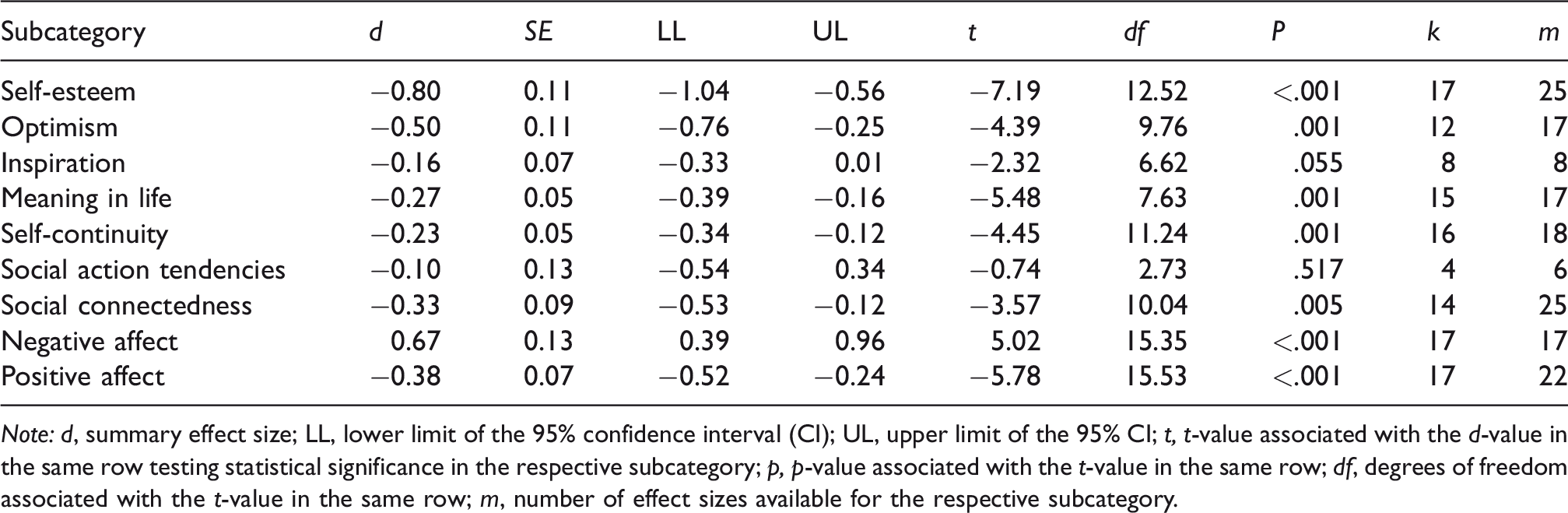
Note: d, summary effect size; LL, lower limit of the 95% confidence interval (CI); UL, upper limit of the 95% CI; t, t-value associated with the d-value in the same row testing statistical significance in the respective subcategory; p, p-value associated with the t-value in the same row; df, degrees of freedom associated with the t-value in the same row; m, number of effect sizes available for the respective subcategory.
Nostalgia × Neuroticism interaction
We now turn to our primary objective: the meta‐analysis of Nostalgia × Neuroticism interaction coefficients. We found no evidence for a Nostalgia × Neuroticism interaction effect across the self‐oriented, existential, and social autobiographical-memory functions, d = 0.030, SE = 0.033, p = .382, CI95[0.101, −0.042]. Hence, there is no general support for the idea that individuals who are high (vs. low) in neuroticism derive less psychological benefit from nostalgia inductions.
Effect‐size heterogeneity was small to moderate, I2 = 25.69, τ2 = 0.008. To test if the Nostalgia × Neuroticism effect size differed among the self‐oriented, existential, and social functions, we again entered these superordinate functions as dummy‐coded predictor variables. The size of the Nostalgia × Neuroticism interaction did not differ significantly among functions, AHZ(11.06) = 0.69, p = .522, remaining I2 = 26.80. Furthermore, the Nostalgia × Neuroticism interaction was not significant within any of the three superordinate functions (ps > .224; Table 2, Figure 1c).
Summary effects for the Nostalgia × Neuroticism interaction effects by outcome subcategory
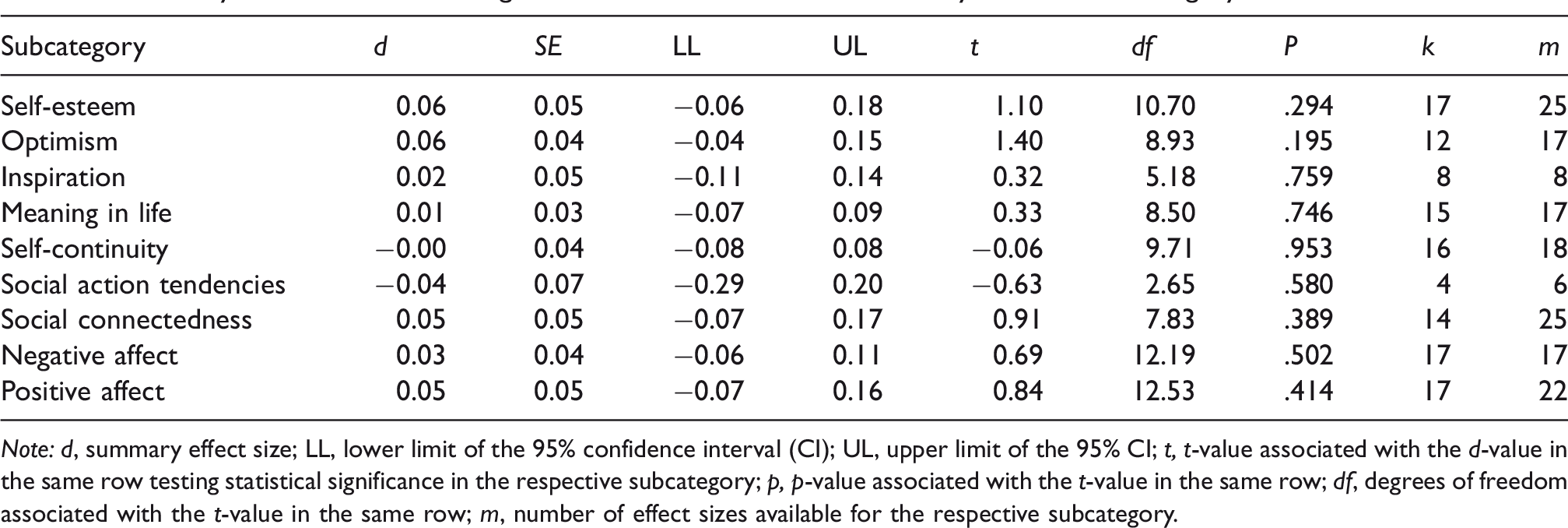
Note: d, summary effect size; LL, lower limit of the 95% confidence interval (CI); UL, upper limit of the 95% CI; t, t-value associated with the d-value in the same row testing statistical significance in the respective subcategory; p, p-value associated with the t-value in the same row; df, degrees of freedom associated with the t-value in the same row; m, number of effect sizes available for the respective subcategory.
Positive and negative affect
The nostalgia manipulations significantly increased both positive affect (d = 0.220, p = .002) and negative affect (d = 0.220, p = .003). Neuroticism was negatively associated with positive affect (d = −0.380, p < .001) and positively associated with negative affect (d = 0.670, p < .001). Finally, the Nostalgia × Neuroticism interaction effect was not significant for either positive affect (d = 0.050, p = .414) or negative affect (d = 0.030, p = .502). In summary, nostalgia manipulations increased both positive affect and negative affect, whereas high (vs. low) neuroticism predicted decreased positive affect and increased negative affect. We again obtained null results for the Nostalgia × Neuroticism interaction.
Meta-moderation by study characteristics
Summary of significance tests for meta‐moderation of the interaction effects
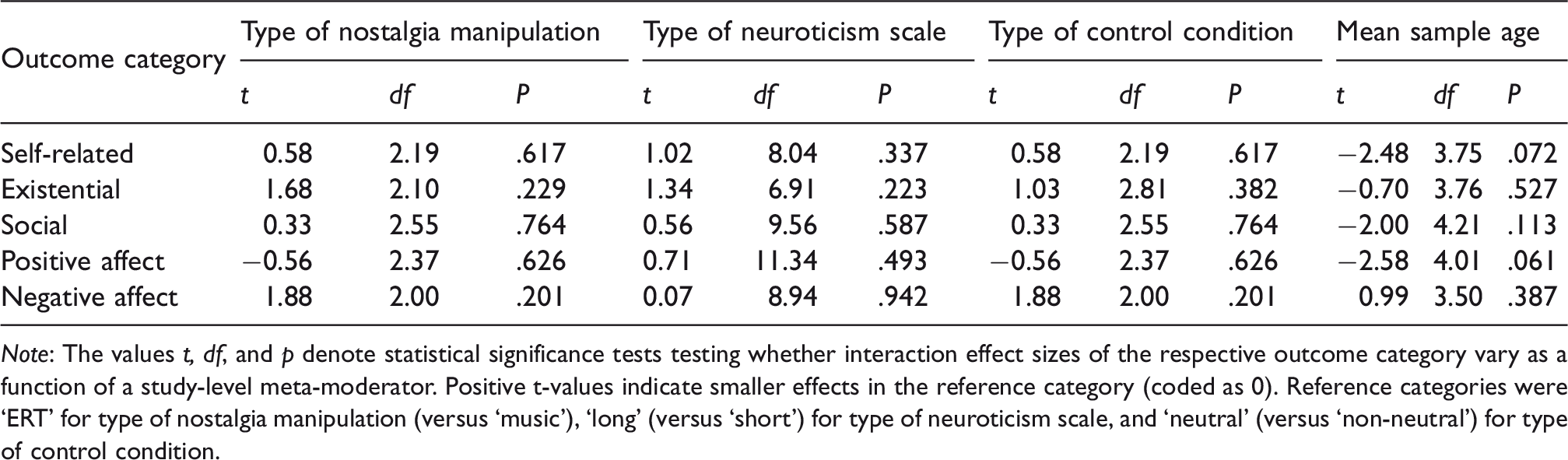
Note: The values t, df, and p denote statistical significance tests testing whether interaction effect sizes of the respective outcome category vary as a function of a study‐level meta‐moderator. Positive t‐values indicate smaller effects in the reference category (coded as 0). Reference categories were ‘ERT’ for type of nostalgia manipulation (versus ‘music’), ‘long’ (versus ‘short’) for type of neuroticism scale, and ‘neutral’ (versus ‘non‐neutral’) for type of control condition.
Sensitivity analyses
A common concern in meta-analysis is the presence of publication bias. Meta-analyses may overestimate effects, because studies reporting small, non-significant effect sizes are less likely to be submitted to, and published by, scientific journals (Ioannidis, 2008). We think it is unlikely that publication bias affected our findings, because only two of the included studies (out of 19) were published as of June 2019. For completeness, we applied a test for detecting small-study effects in the dataset (Sterne & Egger, 2005). For this test, effect sizes are regressed on standard errors of effect sizes in metaregression. A significant, positive slope indicates that effects are larger for smaller studies, which is often, but not always, due to publication bias. The test was non-significant for nostalgia main effects (b = −0.05, p = .945), neuroticism main effects (b = −1.44, p = .173), and Nostalgia × Neuroticism interaction effects (b = 0.60, p = .337). These results should, however, be treated with caution. Although the underlying logic is applicable, tests for small-study effects have not yet been validated within the RVE framework. Finally, we concluded the analysis with a visual inspection of the scatter plots for the autobiographical-memory functions (Figure 1). There were no signs of anomalies in the data. As would be expected, effects were more variable, but not consistently larger, for smaller studies.
Another potential source of bias is low quality in the primary studies. Not all studies included in our analysis have undergone peer review, so potential errors in experimental design and psychometric measurement may have gone unnoticed. We address four potential quality issues in the primary studies. (i) It is possible that the experiments were inadequately designed and conducted. However, we observed reliable main effects of the nostalgia inductions, which corresponded to those reported in the peer-reviewed literature (Sedikides, Wildschut, Routledge, & Arndt, 2015). (ii) It is possible that psychometric measurement of the outcomes was inadequate. Yet, across all studies, outcome measurements were highly reliable (Malpha = 0.87, Mdalpha = 0.89, SDalpha = 0.14) and sensitive to nostalgia inductions. (iii) Neuroticism measurements may have been inadequate. Still, neuroticism measures had adequate reliability (BFI: Malpha = 0.80, Mdalpha = 0.79, SDalpha = 0.05; TIPI: Malpha = 0.68, Mdalpha = 0.66, SDalpha = 0.04) and were robustly associated with the outcome variables. (iv) Primary studies could have inadvertently recruited samples that were uncommonly high or low in neuroticism (i.e. producing ceiling or floor effects, respectively). Overall, however, neuroticism scores (on a scale from 1 to 5) fell close to the scale midpoint (M = 2.81, Md = 2.81, SD = 0.14), and there were no signs of range restriction. The overall standard deviation within studies (MSD = 0.79, MdSD = 0.77) was comparable with standard deviations reported in the literature (e.g. SD = 0.82 in a large study by Srivastava, John, Gosling, & Potter, 2003). It is thus unlikely that neuroticism levels in the included samples were too extreme to detect moderation effects. In summary, we found no reason to suspect that Nostalgia × Neuroticism interaction effects were systematically masked or attenuated owing to poor data or study quality.
Statistical power for small, medium, and large effects at the level of nostalgia functions
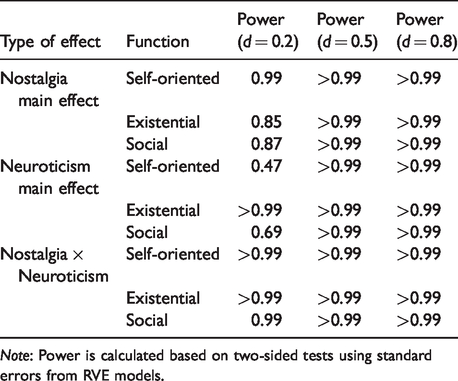
Note: Power is calculated based on two-sided tests using standard errors from RVE models.
In addition to power analysis, we conducted an equivalence test for meta-analysis to probe whether the interaction effect is practically equivalent to zero (Rogers, Howard, & Vessey, 1993), where ‘practically equivalent with zero’ was defined as effects that fall in the range between d = −0.2 and d = 0.2 (small effects). The hypothesis of non-equivalence is rejected if the 90% confidence interval around the summary effect includes either the lower (d = −0.2) or upper (d = 0.2) boundary of this range. For the summary effect of the interaction across all functions (d = 0.030), the confidence interval CI90[0.084, −0.024] does not include either boundary. We therefore conclude that the effect is practically equivalent to zero. These results and the findings from the power analysis are consistent with the conclusion that neuroticism does not moderate the beneficial effects of nostalgia inductions.
Discussion
Scrutinising the interplay between traits and experimentally induced states is promising in advancing theory and understanding of person-situation interactions. Yet comprehensive meta-analyses of study-level interactions are rare owing to inherent difficulties in comparing interactive patterns across different studies. We aimed to test the generalisability of nostalgia's psychological benefits by examining whether they are qualified by trait-level neuroticism. More precisely, we examined whether individuals high (vs. low) on neuroticism derived fewer psychological benefit from nostalgia. In a high-powered meta-analytic test (N = 3556, mfunctions = 116, maffect = 39), we found that neuroticism did not moderate the experimental influence of nostalgia on autobiographical memory functions (i.e. self-oriented, existential, and social) or on positive and negative affect. High statistical power, careful examination of potential bias, and high data quality lend confidence to this conclusion.
Beyond turning to the possibility that the psychological benefits of nostalgia are contingent upon neuroticism, we provided a synthesis of nostalgia's main effects on said benefits. Although the synthesis was incomplete, as it was limited to studies that included a measure of neuroticism, it was nevertheless consistent with the literature (Ismail et al., 2020; Sedikides, Wildschut, Routledge, & Arndt, 2015). As per our findings, nostalgia's self-oriented (inspiration and optimism), existential (meaning in life and self-continuity), and social (social connectedness) benefits were small to medium in magnitude and statistically significant. The influence of nostalgia on social action tendencies was small to medium, but not significant. However, this estimate was imprecise owing to the small number of pertinent effect sizes.
We note two other findings. First, the effect of nostalgia on self-esteem was small and marginal (d = 0.08, p = .052). This is surprising in light of prior evidence for nostalgia's positive impact on self-esteem (Cheung et al., 2013; Hepper et al., 2012; Stephan et al., 2014; Wildschut et al., 2006, 2010) but suggests that this effect is less robust than previously thought or is highly qualified. Consistent with the latter possibility, an ERT experiment by Cheung et al. (2016) showed that nostalgia increased self-esteem only among individuals who were high in dispositional nostalgia proneness, but not among those low in nostalgia proneness. Second, the meta-analytic effect of nostalgia on negative affect was significant (d = 0.220, p = .002). This was partly due to three large studies in which participants listened either to a nostalgic or happy song (Table S1); the nostalgic song gave rise to more negative affect than the happy song (dmusic = 0.51, pmusic < .001). In ERT studies with a neutral control condition, the nostalgia-induced rise in negative affect was smaller but also significant (dERT = 0.11, pERT = .005). To achieve 80% power for detecting an effect of this magnitude (twotailed, α = .05), 2597 participants are required. It is therefore unsurprising that such a small effect would remain undetected in primary studies.
Finally, we conducted a meta-analysis of the neuroticism main effects (i.e. the bivariate correlations of trait-level neuroticism scores with the state-level outcomes that were assessed following the nostalgia manipulation). High neurotics (compared with low neurotics) reported significantly lower self-esteem, inspiration, optimism, self-continuity, meaning in life, and social connectedness. Correlations were the strongest with constructs pertaining to the self-oriented function and weaker for the existential and social functions. Further, neuroticism was associated with less positive affect and more negative affect. These findings should be interpreted with caution, however, because they are based exclusively on studies that experimentally manipulated nostalgia and pertain exclusively to state-level (i.e. transient or momentary) outcomes.
Limitations and future directions
In recent years, the question of generality in the nostalgia literature has attracted increasing attention: Are nostalgia inductions more beneficial to some individuals than to others due to systematic variation in personality traits? Our decision to focus on the Big Five trait of neuroticism was, in part, predicated on prior evidence for the moderating roles of habitual worrying (Verplanken, 2012) and resilience (Wildschut et al., 2019). Worry is a cognitive marker of neuroticism and is positively associated with it (Muris et al., 2005; Segerstrom et al., 2000). Resilience entails reduced vulnerability to stress and, given that such vulnerability is a core facet of neuroticism, resilience is inversely related to neuroticism (Campbell-Sills et al., 2006). Yet whereas previous research directly implicated neuroticism, past findings involving worry and resilience seemingly misalign with ours. This apparent discrepancy has several implications for future research.
First, the large bandwidth of the Big Five traits comes at the cost of fidelity; information is lost as one moves up to hierarchy from specific traits (e.g. habitual worrying and resilience) to domain-level traits (John & Srivastava, 1999). Perhaps, then, the generality of nostalgia's benefits should be explored at lower, more specific levels in the hierarchy of personality descriptors. For example, resilience, rather than merely reflecting the absence of neuroticism, captures flexible and successful adaptation to stress and trauma (Bonanno, 2004; Rutter, 1987). Stressful and traumatic events thus represent trait-expressive situations (Fleeson, 2007) that catalyse the manifestation of trait-level resilience in an individual's thoughts, feelings, and actions. Highlighting the differences between neuroticism and resilience in this regard, Campbell-Sills et al. (2006) demonstrated that high (compared with low) resilience attenuated the link between childhood emotional neglect and current psychiatric symptoms, whereas low (compared with high) neuroticism did not. Resilient individuals' ability to withstand adversity may derive in part from their capacity to harness positive autobiographical memories so as to self-generate positive emotions in the context of experiences that induce sadness and anxiety (Philippe, Lecours, & Beaulieu-Pelletier, 2009). The capacity, under challenging circumstances, to draw strength from one's memories may explain why a nostalgia induction was more beneficial (and less costly) to forcibly displaced Syrian refugees who were high (compared with low) in resilience (Wildschut et al., 2019). The implication is that, to achieve maximum precision, future research should be concerned not only on specific (rather than domain-level) traits but, simultaneously, with the specific trait-expressive situations in which they are manifested most clearly.
Alternatively, rather than being too general, perhaps our focus was not general enough. Research on the interrelations among the Big Five traits indicates that they are subordinate to two higher-order meta traits: the Big Two (DeYoung, 2006; Digman, 1997). The first, labelled stability, captures the Big Five traits of neuroticism (reversed), agreeableness, and conscientiousness. The second, labelled plasticity, includes extraversion and openness. They refer, respectively, to the ability ‘to maintain stability and avoid disruption in emotional, social, and motivational domains’, and ‘to explore and engage flexibly with novelty, in both behavior and cognition’ (DeYoung, 2006, p. 1138). Although our unequivocal finding that neuroticism did not moderate the benefits of nostalgia inductions casts doubt on a potential role for the higher-order stability factor, it does not rule out this possibility. Still, the plasticity factor may offer a more promising target for future research, for two reasons. First, habitual worrying is indicative of a repetitive and automatic cognitive process (Verplanken et al., 2007), pointing to an inverse relation with plasticity. Resilience, in contrast, reflects flexibility in enhancing and suppressing emotional expression (Bonanno, Papa, Lalande, Westphal, & Coifman, 2004) and is positively associated with extraversion and openness— the constituent domain-level traits of plasticity (CampbellSills et al., 2006). Thus, prior evidence pertaining to the dependence of nostalgia effects by habitual worrying (Verplanken, 2012) and resilience (Wildschut et al., 2019) implicates plasticity. Second, examining plasticity may shed light on the finding that nostalgia inductions are more beneficial (and less costly) for individuals who are high (compared with low) in nostalgia proneness. Nostalgia proneness has also been linked with higher levels of both plasticity components: extraversion (Stephan et al., 2014) and openness (Newman, Sachs, Stone, & Schwarz, 2020). The plasticity meta trait, then, offers a tantalising prospect of broad theoretical and empirical integration.
An unanswered question relates to the availability, accessibility, and processing mechanisms that provided the theoretical foundation for the postulated Nostalgia × Neuroticism interaction effect. On the one hand, our failure to detect evidence for this interaction effect casts doubt on the proposed mechanisms. On the other hand, the highly robust neuroticism main effects lend them support, if one assumes (as the data indicate) that high neurotics (compared with low neurotics) were equally impaired when recalling nostalgic and ordinary autobiographical events. Future research could offer a more definitive answer by assessing the three mechanisms—for example, by coding the content and/or emotional tone of retrieved memories.
Our work is not without limitations. To begin, all participants were members of Western cultures. Despite the panculturality of nostalgia per se (Hepper et al., 2014), future research will need to test the generalisability of our findings in non-Western cultures. Also, our meta-analysis included mostly younger participants (in total: 30% over 33 years old, 20% over 44, 10% over 53, and 5% over 62; Figure S2). Our findings revealed that age did not moderate the effects of nostalgia or nostalgia's interactive effect with neuroticism, and prior research has suggested that psychological benefits of nostalgia (e.g. well-being) generalise across age (Hepper et al., 2020). Still, follow-up work will need to provide a more fine-grained analysis as to whether our findings are equally applicable to older and younger persons.
Our meta-analysis focused exclusively on studies that implemented experimental inductions of nostalgia. Irrespective of neuroticism, these brief nostalgia inductions had positive immediate effects, but a question arises about the duration of such effects. Recently, researchers have begun to address this question by focusing on implications of nostalgia in naturalistic settings (Kersten, Cox, & Van Enkevort, 2016; Iyer & Jetten, 2011; Newman et al., 2020; Van Dijke, Leunissen, Wildschut, & Sedikides, 2019; Wohl et al., 2018). For example, in a longitudinal study of students entering university, Iyer and Jetten (2011) showed that perceived identity continuity moderated the effects of nostalgia. Students who experienced high identity continuity (‘I have maintained strong ties with the same groups I belonged to before coming to university’) perceived fewer academic obstacles when nostalgia for their community was high (compared with low). However, when students experienced low identity continuity, they perceived more academic obstacles when nostalgia was high (compared with low). Future work would do well to test systematically moderation hypotheses in experimental and naturalistic contexts for safeguarding both internal and external validity.
Coda
Nostalgia comprises negative components, such as longing, loss, and wanting to return to the past. Neuroticism entails sensitivity to negativity and is strongly linked with psychopathology. Nonetheless, nostalgia yields key psychological benefits even for individuals high in neuroticism.
Footnotes
Declaration of conflicting interests
The author(s) declared no potential conflicts of interest with respect to the research, authorship, and/or publication of this article.
Funding
The author(s) disclosed no financial support for the research, authorship, and/or publication of this article.
Data accessibility statement
This article earned Open Data and Open materials badges through Open Practices Disclosure from the Center for Open Science: https://osf.io/tvyxz/wiki. The data are permanently and openly accessible at  . Author's disclosure form may also be found at the Supporting Information in the online version.
Supporting information
Additional supporting information may be found online in the Supporting Information section at the end of the article.
Notes
References
Supplementary Material
Please find the following supplemental material available below.
For Open Access articles published under a Creative Commons License, all supplemental material carries the same license as the article it is associated with.
For non-Open Access articles published, all supplemental material carries a non-exclusive license, and permission requests for re-use of supplemental material or any part of supplemental material shall be sent directly to the copyright owner as specified in the copyright notice associated with the article.
