






Abstract
When individuals strive towards personal goals, they may encounter obstacles that could compromise their goal progress and pose a challenge to self–regulation. Coping with obstacles first requires those obstacles to be identified. The purpose of the present studies was to apply an inter–individual approach to this important, but insufficiently studied self–regulatory aspect of goal striving. We therefore examined the role of self–awareness, that is, paying attention to one's own feelings, thoughts, and behaviours, for the identification of goal–related obstacles. We measured and manipulated self–awareness in two correlational and two experimental studies (one of them preregistered) and asked participants to identify obstacles to their goals. All studies confirmed the hypothesis that individuals with higher levels of dispositional and situational self–awareness identify more obstacles, both with regard to their idiosyncratic personal goals (Studies 1 and 2) and with regard to a goal in an assigned task during an experiment (Studies 3 and 4). The results indicate that self–awareness plays a crucial role for identifying obstacles. We discuss the implications of our findings for personality and self–regulation research.
Life is a continuous process of setting and striving for goals (Kruglanski et al., 2000). Whether in the fields of health, work, sports, or relationships, most human behaviour is, in fact, assumed to be goal driven. However, goal pursuit is not always free of complications; and coping with goal–related obstacles, that is, aspects that stand in the way of a goal that has been set (Oettingen et al., 2009), is regarded as being a key prerequisite for successful goal attainment (Baumeister & Vohs, 2007; Marguc, Förster, & Van Kleef, 2011).
A great deal of research has emphasized the importance of the way in which people cope with obstacles for their self–regulatory success and, for example, stressed the benefits of responding to obstacles strategically (Marguc et al., 2011), persisting despite their presence (Moeller, Troop–Gordon, & Robinson, 2015), and anticipating obstacles in the future (e.g. Oettingen, 1997; Zhang & Fishbach, 2010). One fundamental aspect of self–regulation in the context of obstacles that has been neglected so far is, however, the identification of obstacles and specifically the question of antecedents that turn an individual's attention towards potential obstacles during goal pursuit.
In the current research, we take a personality–psychological perspective and focus on individual differences in self–awareness, the tendency of a person to become the object of his or her own attention (Duval & Wicklund, 1972), as a potential antecedent of the identification of obstacles. By investigating self–awareness in the context of daily goal pursuit, we rely on literature emphasizing the importance of personality processes for investigating self–regulatory processes (Hoyle, 2010).
Later, we will elaborate in more detail why self–awareness should promote the identification of goal–related obstacles and therefore play a crucial role in self–regulation. We will do so by first explicating the importance of identifying obstacles in the process of goal pursuit before turning to the role of self–awareness in this process.
Identifying obstacles during goal pursuit
On the basis of propositions of the two–stage model of self–control (Myrseth & Fishbach, 2009), we consider two sequential steps to be crucial for coping successfully with goal–related obstacles: First, an individual needs to identify whether a goal–related aspect is in conflict with the unobstructed pursuit of his or her goal (conflict identification). Such obstacles may come in the shape of physical, mental, social, or situational hindrances (Marguc et al., 2011). What is identified as an obstacle is furthermore highly idiosyncratic: While one student may consider attending his or her mum's birthday party to be a problematic distraction that will steal his or her study time, another looks at the social event as a source of support that will keep up his or her spirits while preparing for exams.
Second, after identifying an obstacle as such, the individual needs to invoke effective strategies to deal with the conflict caused by the obstacle (conflict resolution). The student may, for example, simply decline the invitation to the party, decide to at least stay sober for the night, or make up for the time lost by skipping sports training that week. While both insufficient conflict identification and insufficient conflict resolution are likely to lead to reduced goal progress with regard to the goal at hand, the two causes may have different antecedents and should be considered distinct (Myrseth & Fishbach, 2009). In the current research, we focus on the first step in the model, the identification of obstacles.
The role of self–awareness in identifying obstacles
What does it take to identify an obstacle? We propose that, aside from potential situational factors that may affect identification (e.g. restraining environments like work or public settings; Hofmann, Baumeister, Förster, & Vohs, 2012), on the basis of their dispositions, some individuals are to more likely than others to identify obstacles during goal pursuit and that these are individuals with higher levels of self–awareness.
Specific definitions of self–awareness vary between theoretical contexts (Dewey, 1910; Duval & Wicklund, 1972; Fenigstein, Scheier, & Buss, 1975; Grant, Franklin, & Langford, 2002; Mezirow, 1990; Trapnell & Campbell, 1999; von Wright, 1992). Duval and Wicklund (1972) were the first to investigate self–awareness by describing objective self–awareness as a momentary state of heightened attention on aspects of the self. Further on, Fenigstein, Scheier, and Buss (1975) pointed out that people also differed dispositionally in their extent of being the object of their own attention. They furthermore distinguished the trait of private self–consciousness (also referred to as self–focused attention; the tendency to focus on one's own feelings, thoughts, and behaviour) from the trait of public self–consciousness (the tendency to focus on the more visible aspects of one's self, like one's gestures and appearance; Fenigstein et al., 1975). Measures for assessing private self–consciousness show high test–retest reliabilities (Fenigstein et al., 1975) and good validity (for an overview, refer to Smári, Ólason, & Ólafsson, 2008). Private self–consciousness moreover differs from other conceptualizations of self–awareness that deal, for example, with the motives that underlie the process of focusing attention to the self (i.e. rumination about the self following anxiety vs. reflection due to a stable interest in the self; Trapnell & Campbell, 1999). The differences in these conceptualizations become particularly apparent with regard to their relation with other personality dimensions: Self–awareness in the sense of rumination (Trapnell & Campbell, 1999) is conceptualized as a facet of neuroticism in the NEO–PI–R (Costa & McCrae, 1992), but self–awareness in the sense of private self–consciousness (Fenigstein et al., 1975) shows moderate associations with openness to experience and conscientiousness (Panah & Seif, 2014). More interestingly, although all conceptualizations of self–awareness differ in their theoretical accentuation, their measurement instruments are highly correlated (DaSilveira, DeSouza, & Gomes, 2015) as they all measure the extent that an individual pays attention to aspect of the self. In sum, self–awareness is a multifaceted and differently named construct that encompasses both dispositional (depending on author group called private self–consciousness, self–focused attention, reflection, or metacognitive self–reflection) and situational forms (called objective self–awareness). For the sake of simplicity, we decided to use in our research the broader term self–awareness and distinguish findings on inter–individual differences from findings on intra–individual differences by referring to dispositional or situational self–awareness, respectively.
Regardless of its specific conceptualization, the importance of self–awareness in goal striving has already been emphasized (Burwell & Shirk, 2007; Carver & Scheier, 1998; Donovan, Güss, & Naslund, 2015; Grant, Franklin, & Langford, 2002). Most crucially for our current argument, early work (e.g. Baumeister, Heatherton, & Tice, 1994; Carver & Scheier, 1998; Duval & Wicklund, 1972) proposed theoretically that a chronic or momentary state of heightened self–awareness leads people not only to be conscious of their thoughts, feelings, and behaviour but also to be more aware of their own goals (or so–called ideal state). Consequently, self–aware people are more inclined to compare those ideal states with their momentary, actual states within the goal striving process. Hence, being engaged in this comparison process, or so–called goal monitoring, motivates people to achieve conformity between those different states and therefore increases task focus, which has been shown empirically (Carver & Scheier, 1998). Thus, self–awareness ‘should promote closer self–regulation to the person's reference value’ (Carver & Scheier, 1998, p. 34).
Owing to this goal monitoring process, self–awareness differs from other well–researched constructs, that also focus on awareness, for example, mindfulness and self–monitoring. Mindfulness involves a different quality of awareness, which is non–judgmental and non–discursive and does not necessarily lead to goal monitoring but rather an acceptance of whatever is observed (for an overview, refer to Evans, Baer, & Segerstrom, 2009). Furthermore, self–monitoring characterizes individual differences in the monitoring of public appearances in the sense of a higher willingness to modify expressive behaviour to fit a given situation (Snyder, 1974) rather than the monitoring of private aspects as inner thoughts, feelings, and goal–related behaviour (e.g. Fenigstein et al., 1975).
The importance of goal monitoring is, in fact, stressed in various theoretical approaches (Carver & Scheier, 1982; Duval & Wicklund, 1972; Kluger & DeNisi, 1998; Latham & Locke, 1991; Lewin, 1951; Miller, Galanter, & Pribram, 1960). If one's own goal striving process is evaluated through goal monitoring, potential discrepancies between one's actual state and one's ideal state can be possibly detected. And detecting these discrepancies may, in turn, lead to the identification of obstacles as standing in the way of a goal that has been set (Oettingen et al., 2009), as a result of which efforts will be made to reduce the discrepancy. Otherwise ‘[…] self–regulation failure will become more likely when people cease to monitor themselves’ (Baumeister, Heatherton, & Tice, 1994, p. 33).
In sum, considering that self–awareness is closely linked to goal monitoring, and goal monitoring is the process that helps individuals to identify obstacles during goal pursuit, self–awareness should be a predictor of the identification of goal–related obstacles. This may, in fact, explain why heightened self–awareness is also associated with increased goal–directed effort (Cowden & Meyer–Weitz, 2016), an increased choice of problem–solving strategies (Burwell & Shirk, 2007), and better goal–related performance (Donovan, Güss, & Naslund, 2015).
The current research
As self–awareness is associated with increased goal monitoring (Carver & Scheier, 1998), which is a crucial process for conflict identification, we hypothesized that self–awareness promotes the identification of goal–related obstacles. In doing so, we examined the influence of people's dispositional self–awareness on the identification of obstacles in personal goal pursuit (Studies 1 and 2). We furthermore manipulated situational self–awareness to investigate our hypothesized effect experimentally (Studies 3 and 4). While showing that the effect of a (situationally evoked) state on an outcome cannot be direct evidence for how the (dispositionally stable) trait affects said outcome (Molenaar & Campbell, 2009), it may nevertheless further our understanding of how intra–individual processes, like the evocation of personality states, might mediate the effects of inter–individual differences on outcomes. Correlations and hierarchical multiple regressions were assessed using IBM® SPSS® Statistics software (Version 23). Mediation analyses (Studies 3 and 4) were conducted using the PROCESS macro for SPSS (Hayes, 2013). In view of recommendations regarding Open Science (Simmons, Nelson, & Simonsohn, 2012), we are reporting how we determined our sample sizes, all data exclusions (if any), all manipulations, and all measures in all studies that we conducted. 1 Furthermore, we preregistered our hypotheses, study design, and all the analyses of Study 4, which can be assessed at https://aspredicted.org/bk6hz.pdf. All study materials, including the verbatim wording of all major variables in all studies, are publicly available on the Open Science Framework (http://doi.org/10.17605/OSF.IO/XR32F). Unfortunately, the data cannot be made openly accessible, as our informed consent forms for the studies did not inform the participants of this possibility. The data are available on request.
Regarding issues of discriminant validity for dispositional self–awareness, we measured potential third variables (e.g. mindfulness, openness to experience, and need for cognition) across the studies. We furthermore assessed sociodemographic variables (age and sex), but as we did not find any correlations with our outcome variable across the studies, we will not include them as covariates. All study procedures conformed to the requirements of the local research ethics board.
Study 1
To investigate the relationship between self–awareness and the identification of obstacles, we conducted a first correlational study, in which we operationalized the identification of obstacles in two different ways. We furthermore assessed several potentially confounding third variables in order to assess the specific influence of self–awareness on the identification of obstacles above and beyond.
Method
Participants and procedure
As our research question was novel, we were unable to make effect size estimations for sample calculations on the basis of prior data. We therefore started by assuming a small to medium effect of r = .25 (Cohen, 1988), which we wanted to detect with a statistical power of 80% at a .05 criterion of statistical significance. A G*Power analysis (Faul, Erdfelder, Buchner, & Lang, 2009) indicated that a sample size of 123 was required. Participants were recruited for an online survey through mailing lists and participated in return for course credit. Our final sample included 123 university undergraduates with a mean age of 23.68 (SD = 7.10, 77% female).
In the survey, participants named one personal goal they were currently striving for. Afterwards, they were asked about the obstacles they had already identified regarding this goal. Finally, our predictor dispositional self–awareness was assessed. To assess the specific influence of self–awareness on the identification of obstacles, we moreover measured potentially confounding third variables. We measured mood, as previous research has shown that mood affects self–perception (Montgomery, Hodges, & Kaufman, 2004). Furthermore, we measured the experience of goal–related conflicts, which has shown to be associated with the identification of obstacles (Brandstätter & Schüler, 2013). Finally, we assessed traits, which are associated with self–awareness and might be crucial for the identification of obstacles owing to its role for self–regulation (conscientiousness, neuroticism, and openness to experience: for an overview, refer to Hoyle, 2010; rumination: Nolen–Hoeksema, Wisco, & Lyubomirsky, 2008). At the end, participants provided some sociodemographic background information and were debriefed.
Measures
Personal goal
After reading a description of the goal concept (Brunstein, 1993; Emmons, 1986), participants were asked to name a personal goal that was very important to them. We explicitly asked for a goal that they had been pursuing for 4 weeks and intended to strive towards for another 2 months in the future. Most of the participants named a goal concerning their studies (e.g. passing an exam) (n = 71) or a health goal (e.g. exercising more frequently) (n = 27), and the remaining participants listed goals from different areas, for example, family/friends (e.g. spending more time with other people) or hobbies (e.g. practising the viola more often).
Dispositional self–awareness
We measured dispositional self–awareness using the 12–item Self–Reflection subscale of the Self–Reflection and Insight Scale (Grant et al., 2002). This scale takes into account different aspects of self–awareness, namely, being self–aware of one's inner thoughts (e.g. ‘I frequently take time to reflect on my thoughts’), one's inner feelings (e.g. ‘I frequently examine my feelings’), and one's behaviour (e.g. ‘It is important for me to evaluate the things that I do’). All items were assessed on scales ranging from 1 (strongly disagree) to 6 (strongly agree). The internal reliability of the scale was excellent (α = .90), and its distribution was relatively normal (M = 4.68, SD = 0.78). 2
Identification of obstacles
We operationalized the identification of past obstacles in personal goal pursuit in two ways: as an item–based measure and in a free exploration task. All participants were first introduced to the concept of obstacles as ‘aspects that hinder the achievement of your goal’ (Oettingen et al., 2009). We used four items (adapted from Milyavskaya, Inzlicht, Hope, & Koestner, 2015 and Oettingen et al., 2009) to assess participants’ tendency to identify obstacles (e.g. ‘Over the past four weeks, I have encountered obstacles in the pursuit of my personal goal’) [scales from 1 (strongly disagree) to 7 (strongly agree)]. The internal reliability of the four items was acceptable (α = .76), and the distribution of their mean scores was relatively normal (M = 4.89, SD = 1.07).
We then measured the identification of obstacles in a free exploration task on the basis of Oettingen (1997). Participants were asked to take at least 2 minutes to think about their personal goals and to list in a large text box all thoughts that arose. We wanted to test if participants with higher self–awareness had already identified more obstacles in their goal pursuit and would, in turn, report more obstacles in this free exploration task.
Two raters were instructed to first separate individual written thoughts from each other and to then determine for each thought about a personal goal (e.g. preparing for an exam), whether it dealt with an obstacle (e.g. friend's birthday party the week before the exam), with a goal–related means (e.g. studying with a group of students), or with potential consequences of goal achievement (e.g. feeling proud after the exam). While the two raters took the first step of separating individual thoughts together, the subsequent coding was performed individually and independently. Both raters coded each thought. Intraclass correlation estimates and their 95% confidence intervals were calculated based on mean ratings (k = 2), absolute agreement, and two–way mixed–effects models. The intraclass correlation of 0.77 (95 % CI [0.48, 0.88]) for the two raters’ inter–rater reliability indicates good agreement (Koo & Li, 2016), F(122, 122) = 5.72, p < .001. Disagreements between the two raters were resolved by discussing them and considering the opinion of a third rater.
Participants named 8.26 thoughts on average (SD = 3.41) about their personal goals, with 2.38 (SD = 2.35) thoughts referring to obstacles, 2.71 (SD = 2.29) thoughts referring to goal means, and 2.37 (SD = 2.54) thoughts referring to the consequences of goal achievement. On average, 0.80 (SD = 1.25) thoughts were not assigned to one of these three categories. As might be expected, the item–based measure of obstacles and the number of obstacles reported in the free exploration task were positively correlated (r = .35, p < .001). In addition, we explored whether self–awareness was correlated with the use of the first person (e.g. Davis & Brock, 1975), which was also the case in this study (r = .19, p = .036, 95% CI = [0.01, 0.36]).
Negative mood
We measured participants’ negative mood over the previous 2 weeks using four items taken from the German translation of the Positive and Negative Affect Schedule (Watson, Clark, & Tellegen, 1988) and from Brunstein (1993). Participants were instructed to rate how often they had experienced the feeling ‘sad’, ‘worried’, ‘frustrated’, or ‘depressed’ on a scale ranging from 1 (never) to 7 (frequently). The internal reliability of the scale was acceptable (α = .79), and the distribution of participants’ average scores relatively normal (M = 3.72, SD = 1.25).
Rumination
The tendency to ruminate in stressful situations was measured using four items from the Individual Coping Questionnaire (INCOPE; Bodenmann, Perrez, Cina, & Widmer, 2002); for example, ‘My thoughts circle around the event for a long time’. Scales ranged from 1 (never) to 5 (often). The internal reliability of the scale was questionable (α = .61), and the distribution of participants’ average scores relatively normal (M = 3.36, SD = 0.68).
Neuroticism
Neuroticism was measured using the four items from the German short version of the Big Five Inventory (BFI–K; Rammstedt & John, 2005); for example, ‘I get nervous and insecure easily’. Scales ranged from 1 (strongly disagree) to 6 (strongly agree). The internal reliability of the scale was acceptable (α = .79), and the distribution of participants’ average scores relatively normal (M = 3.80, SD = 1.04).
Conscientiousness
Conscientiousness was measured using the four items from the BFI–K (Rammstedt & John, 2005); for example, ‘I complete tasks thoroughly’. Scales ranged from 1 (strongly disagree) to 6 (strongly agree). The internal reliability of the scale was acceptable (α = .73), and the distribution of participants’ average scores relatively normal (M = 4.07, SD = 0.86).
Openness to experience
Participants’ openness to experience was measured using the five items from the BFI–K (Rammstedt & John, 2005); for example, ‘I have an active imagination’. Scales ranged from 1 (strongly disagree) to 6 (strongly agree). The internal reliability of the scale was acceptable (α = .72), and the distribution of participants’ average scores relatively normal (M = 4.56, SD = 0.91).
Action crisis
The current experience of an action crisis, that is, being caught in an intra–psychic decisional conflict between disengagement and further pursuit of a personal goal, was measured using the six–item Action Crisis Scale (ACRISS; Brandstätter & Schüler, 2013). The Action Crisis Scale entails different aspects of the decisional conflict, for example, conflict (‘I doubt whether I should continue striving for my goal or disengage from it’) or implemental disorientation (‘When striving for this goal I am repeatedly confronted with situations in which I do not know how to continue’). Scales ranged from 1 (strongly disagree) to 7 (strongly agree). The internal reliability of the scale was acceptable (α = .78), and the distribution of participants’ average scores relatively normal (M = 3.41, SD = 1.16).
Results and Brief Discussion
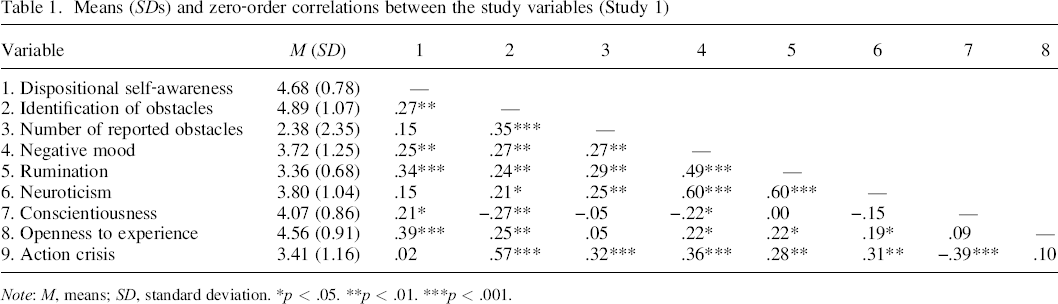
Correlations between all the study variables are shown in Table 1. In line with our hypothesis, the degree of dispositional self–awareness was positively correlated with the item–based measure of participants’ identification of obstacles (r = .27, p = .003, 95% CI = [0.10, 0.43]).
Means (SDs) and zero–order correlations between the study variables (Study 1)
Note: M, means; SD, standard deviation.
p < .05.
p < .01.
p < .001.
However, dispositional self–awareness was not significantly correlated with the number of reported obstacles in the free exploration task (r = .15, p = .089, 95% CI = [−0.03, 0.32]). 3
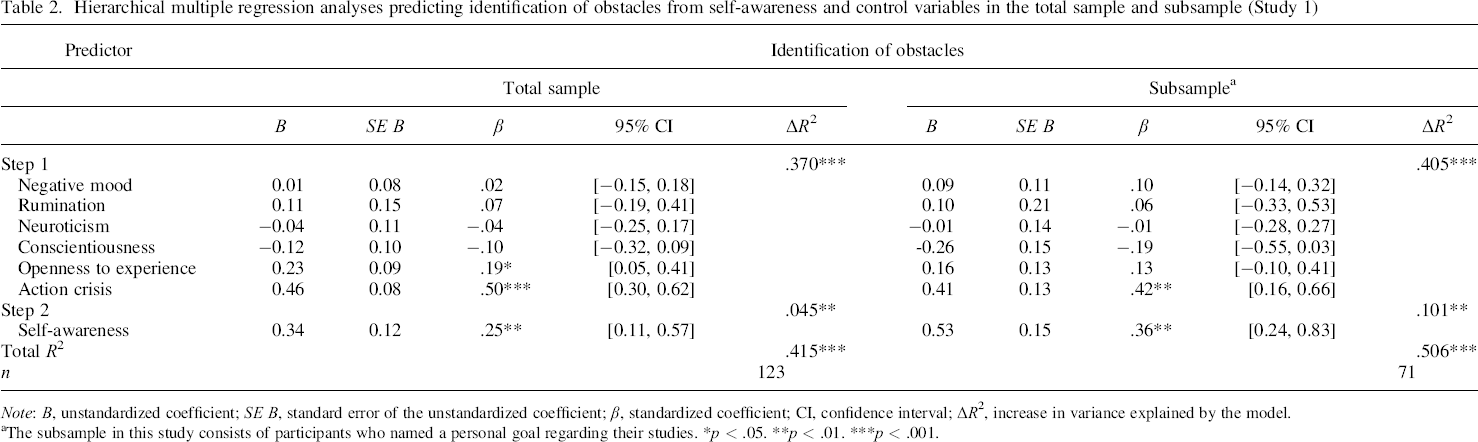
As a next step, we repeated analyses with the item–based measure of participants’ identification of obstacles, accounting for the potential influence of all covariates. The results are presented in Table 2. As can be seen, when controlling for these variables, self–awareness still explained additional variance in the identification of obstacles.
Hierarchical multiple regression analyses predicting identification of obstacles from self–awareness and control variables in the total sample and subsample (Study 1)
Note: B, unstandardized coefficient; SE B, standard error of the unstandardized coefficient; β, standardized coefficient; CI, confidence interval; ΔR2, increase in variance explained by the model.
The subsample in this study consists of participants who named a personal goal regarding their studies.
p < .05.
p < .01.
p < .001.
Finally, as another exploratory step, we repeated the correlation and hierarchical regression analyses for a subsample of n = 71 participants, all of whom had listed a goal related to their studies. We did so to account for the influence of goal content, as goals relating to different areas might conceivably be accompanied by a smaller or larger number of obstacles. In this subsample, the two operationalizations were also correlated (r = .35, p = .002, 95% CI = [0.13, 0.54]). Again, dispositional self–awareness was positively correlated with the item–based measure of participants’ identification of obstacles (r = .28, p = .019, 95% CI = [0.05, 0.48]), but not with the number of reported obstacles in the free exploration task (r = .18, p = .139, 95% CI = [−0.06, 0.40]). 3 Hierarchical multiple regression analyses controlling for crucial third variables in this partial sample confirmed the results of the complete sample (Table 2), but self–awareness explained even more variance in the partial sample.
The results of Study 1 provide first evidence that dispositional self–awareness is associated with the identification of goal–related obstacles, both in the total sample and in a subsample of participants, all of whom were pursuing the same type of goal. Even when third variables (e.g. negative mood, rumination, and neuroticism) were controlled for, dispositional self–awareness accounted for additional variance. However, the effect of dispositional self–awareness on the number of reported obstacles in the free exploration task was not shown. The non–significant findings might be due to two reasons. First, separating the participants’ personal thoughts from each other turned out to be difficult, as people differed in the way they described their thoughts (e.g. with the help of keywords or long sentences). Second, obstacles are mostly subjective (Marguc et al., 2011) and for this reason are rather difficult to code from the outside.
Study 2
As the free exploration task in Study 1 appeared like a rather unreliable operationalization of the identification of obstacles, the aim of Study 2 was to use a different operationalization. We decided to ask participants to list the obstacles they had experienced in their personal goal pursuit. We furthermore wanted to replicate the effect of self–awareness on the item–based measure while controlling for some potentially confounding third variables.
Method
Participants and procedure
According to a G*Power analysis (Faul et al., 2009), 105 participants were needed to replicate the correlational effect between dispositional self–awareness and participants’ identification of obstacles observed in Study 1. To further increase the explanatory power, we recruited as many participants as possible over a given period of 5 weeks. In the end, 169 participants (mostly university undergraduates, mean age 24.09, SD = 7.66, 66% female) took part in this online survey in return for course credit. Participants were recruited through mailing lists, flyers, and personal invitations issued during Psychology lectures. As in Study 1, participants first named a personal goal they were currently striving for. Afterwards, we assessed the obstacles that they had experienced while goal striving, as well as participants’ dispositional self–awareness. As in Study 1, we measured traits that are important for self–regulation and, therefore, we assume for self–awareness and the identification of obstacles (pessimism: Carver & Scheier, 2001; mindfulness: for an overview, refer to Hoyle, 2010; rumination: Nolen–Hoeksema et al., 2008). We again assessed participants’ experience of an action crisis (Brandstätter & Schüler, 2013) as a potential confounding third variable, which affected the identification of obstacles in Study 1. At the end of the study, participants provided some sociodemographic background information and were debriefed.
Measures
Personal goal
As in Study 1, participants were asked to name a personal goal that they were currently striving for. One hundred participants named a goal concerning their studies; the remaining participants named goals from different content areas, for example, work, health, or friends/family.
Dispositional self–awareness
Participants completed the same measure of dispositional self–awareness as in Study 1. The internal reliability of the scale was excellent (α = .91), and the distribution of participants’ average scores relatively normal (M = 4.61, SD = 0.79).
Identification of obstacles
We operationalized the identification of obstacles in two ways. First, we asked participants to indicate their recent identification of obstacles in their personal goal pursuit using the same four items as in Study 1. The reliability of the four items was acceptable (α = .79), and the distribution of their averages was relatively normal (M = 4.83, SD = 1.04). Our second operationalization of obstacles was adapted from Leduc–Cummings, Milyavskaya, and Peetz (2017). In the instructions to this free listing task, participants were provided with an informal definition of what an obstacle is (‘Obstacles are all things that stand in the way of reaching a goal’, Oettingen et al., 2009) and were then, in contrast to the free exploration task in Study 1, explicitly asked to list all the obstacles they had experienced while pursuing their personal goal so far. Participants had to take at least 1 minute for this task and were instructed to use a separate empty text box for each obstacle. Participants named between 0 and 14 obstacles with an average of 5.04 obstacles (SD = 2.38). The distribution was positively skewed (skewness of 0.93, SE = 0.19). We therefore used a log transformation to normalize the distribution, as recommended by Field (2013) (Mlog = 0.74, SDlog = 0.18, skewnesslog of −0.53, SElog = 0.19). The two operationalizations of obstacles were positively correlated (r = .24, p = .001).
Rumination
Rumination was measured using the same four items as in Study 1. Again as in Study 1, the internal reliability of the scale was questionable (α = .68), and the distribution of participants’ average scores relatively normal (M = 3.17, SD = 0.74).
Pessimism
We measured situational pessimism using the three items of the German form of the Life Orientation Test (LOT–R; Glaesmer, Hoyer, Klotsche, & Herzberg, 2008); for example, ‘If something can go wrong for me, then it surely will’. The response scale ranged from 1 (strongly disagree) to 5 (strongly agree). The internal reliability of the scale was questionable (α = .60), and the distribution of participants’ average scores relatively normal (M = 2.46, SD = 0.72).
Action crisis
The current experience of an action crisis was measured using the same items as in Study 1. The internal reliability of the scale was acceptable (α = .78), and the distribution of participants’ average scores relatively normal (M = 3.46, SD = 1.13).
Mindfulness
Mindfulness was measured using the German version (Michalak, Heidenreich, Ströhle, & Nachtigall, 2008) of the 15–item Mindful Attention Awareness Scale (Brown & Ryan, 2003). In this scale, participants indicated how often they experience mindless acting (e.g. ‘I find myself doing things without paying attention’). Scales ranged from 1 (almost never) to 6 (almost always). The internal reliability of the scale was good (α = .85), and the distribution of participants’ average scores relatively normal (M = 4.06, SD = 0.68).
Results and Brief Discussion
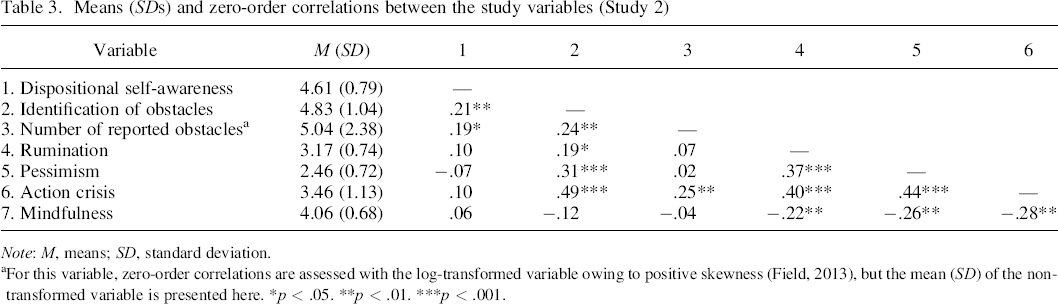
Table 3 shows the correlation coefficients between all the study variables. Dispositional self–awareness was positively correlated with the item–based measure of participants’ identification of obstacles (r = .21, p = .006, 95% CI = [0.06, 0.35]), confirming our hypothesis and replicating Study 1. Furthermore, it was positively correlated with the second operationalization, the number of obstacles named in the free listing task (r = .19, p = .012, 95% CI = [0.04, 0.33]).
Means (SDs) and zero–order correlations between the study variables (Study 2)
Note: M, means; SD, standard deviation.
For this variable, zero–order correlations are assessed with the log–transformed variable owing to positive skewness (Field, 2013), but the mean (SD) of the non–transformed variable is presented here.
p < .05.
p < .01.
p < .001.
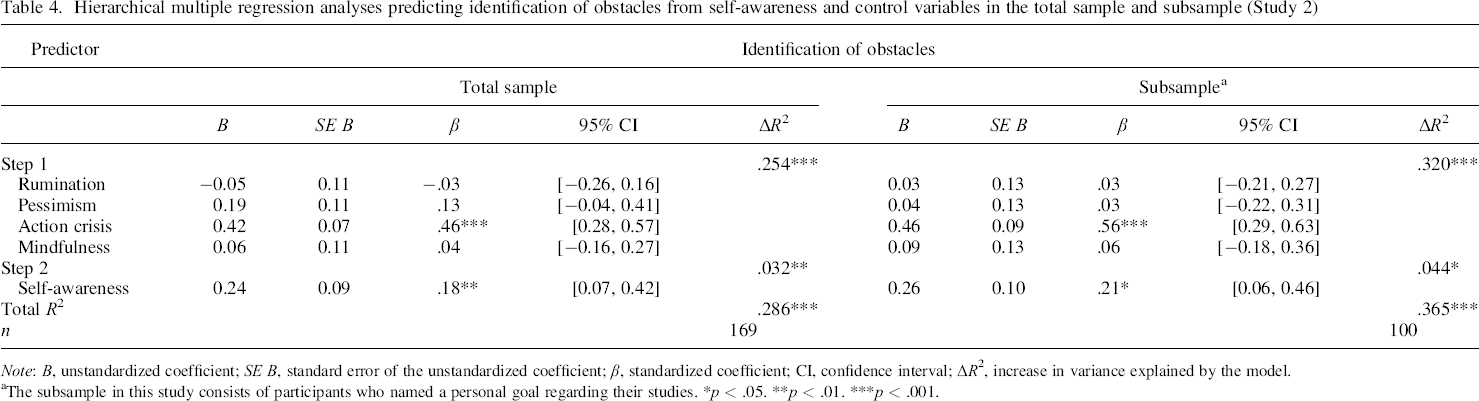
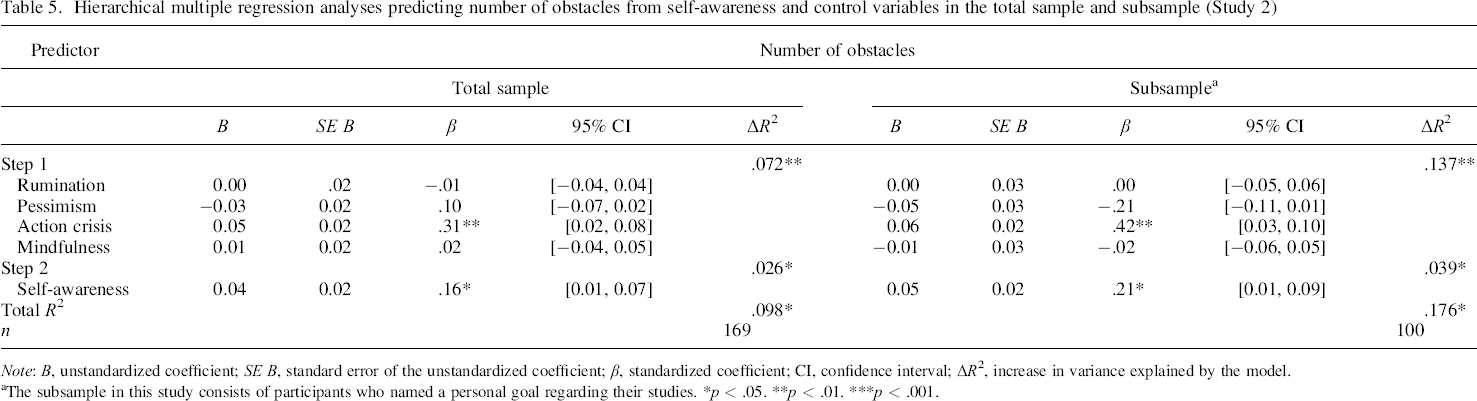
We again performed hierarchical multiple regression analyses to account for the influence of potential third variables like rumination, pessimism, mindfulness, and action crisis on the item–based measure of participants’ identification of obstacles (Table 4) and the number of obstacles in the free listing task (Table 5). As can be seen, when those covariates for the identification of obstacles were considered, dispositional self–awareness still explained additional variance in participants’ identification of obstacles, regardless of its operationalization.
Hierarchical multiple regression analyses predicting identification of obstacles from self–awareness and control variables in the total sample and subsample (Study 2)
Note: B, unstandardized coefficient; SE B, standard error of the unstandardized coefficient; β, standardized coefficient; CI, confidence interval; ΔR2, increase in variance explained by the model.
The subsample in this study consists of participants who named a personal goal regarding their studies.
p < .05.
p < .01.
p < .001.
Hierarchical multiple regression analyses predicting number of obstacles from self–awareness and control variables in the total sample and subsample (Study 2)
Note: B, unstandardized coefficient; SE B, standard error of the unstandardized coefficient; β, standardized coefficient; CI, confidence interval; ΔR2, increase in variance explained by the model.
The subsample in this study consists of participants who named a personal goal regarding their studies.
p < .05.
p < .01.
p < .001.
As in Study 1, we furthermore repeated correlation and hierarchical multiple regression analyses with a subsample of the n = 100 participants, who had all named a goal connected to their studies. All the results were replicated: in this subsample, too, dispositional self–awareness was positively correlated with both the item–based measure of participants’ identification of obstacles (r = .25, p = .013, 95% CI = [0.06, 0.43]) and the number of obstacles reported in the free listing task (r = .21, p = .034, 95% CI = [0.01, 0.39]). For the results of the hierarchical multiple regression analyses within the subsample, refer to Table 4 (for the effect of self–awareness on the item–based measure of participants’ identification of obstacles) and Table 5 (for its effect on the number of obstacles in the free listing task). As in Study 1, it was possible to replicate the results and self–awareness explained even more of the variance in the subsample.
In Study 2, we were able to successfully replicate the positive association between self–awareness and the item–based measure of participants’ identification of obstacles observed in Study 1. Additionally, we were able to show this association using a different type of operationalization for the identification of obstacles, namely, the number of obstacles named by participants when explicitly asked to list all previously encountered obstacles. Again, dispositional self–awareness explained additional variance after controlling for the effects of third variables (e.g. rumination, pessimism, and action crisis). It was again possible to replicate the results in a subsample of participants with a goal in the same content category. However, Studies 1 and 2 provide no evidence for the causality of the effect, as they are both correlational studies. Furthermore, we ran both studies with a measure of dispositional self–awareness and did not account for state differences in self–awareness.
Study 3
In order to look at whether self–awareness may have a causal effect on the identification of obstacles, we conducted Study 3 and manipulated situational self–awareness experimentally. Furthermore, to reduce error variance, we instructed all participants to pursue the same goal, namely, to complete a search task using the Internet (web browser task).
Method
Participants
According to a G*Power analysis (Faul et al., 2009), at least 215 participants were needed in order to replicate the effect of r = .19 found in Study 2 in the hypothesized correlation model with a statistical power of 80%. To increase the power, and in view of available funding, we aimed to recruit 240 participants from MTurk, an Internet–based platform that matches ‘workers’ with ‘requesters’ to engage in tasks in return for compensation. In line with best–practice recommendations, the survey was only available to USA–based workers with an approval rating of over 90% (Buhrmester, Kwang, & Gosling, 2011; Goodman, Cryder, & Cheema, 2013; Mason & Suri, 2012). Two hundred eighty–four participants started the questionnaire, of which 39 participants terminated early and did not submit data for any of the main study variables. The data for one participant, who provided nonsensical responses when asked to list goal–related obstacles, were excluded from the analyses. Because four participants completed the study but were not paid because they submitted their responses after the predefined 1–hour time limit, the final sample included 244 participants with a mean age of 35.03 (SD = 10.26, 53% female) and different educational backgrounds (22% high school or less; 33% college; 37% bachelor's degree; and 8% master's degree or more).
Procedure
The current study was designed as an experiment with one between–subjects factor (increased situational self–awareness vs. control condition). First, participants received information about the purpose and the content of the study. They then responded to a scale measuring their dispositional self–awareness. We furthermore assessed participants’ life satisfaction and current affect. Please note that the results of our analyses did not change when controlling for these third variables. This is why we present methods and results of these additional analyses in the supplemental materials on our OSF account. By random assignment, one half of participants then received a manipulation intended to increase their situational self–awareness. We designed this manipulation on the basis of the elements of self–awareness assessed in the Self–Reflection subscale of the Self–Reflection and Insight Scale (Grant et al., 2002), that is, the awareness of one's own inner thoughts, feelings, and behaviours. The main instruction was: ‘While you work on it [the following task], focus your attention on what you think, feel, and do’. In addition, participants who received this manipulation were reminded to be self–aware before each of the three knowledge questions, using the following instructions: ‘Please continue to observe yourself while working on this task’. The other half of participants (control condition) did not undergo such a manipulation.
To assess the number of obstacles experienced during goal striving, we then gave all participants a task requiring them to answer three knowledge questions with the help of an Internet search (the ‘web browser task’; see more detailed information later). Afterwards, they were asked to report which obstacles they had experienced while working on this task. At the end of the study, the situational self–awareness of the participants was assessed, and participants provided some sociodemographic background information. Finally, they were debriefed.
Measures
Dispositional self–awareness
Before the manipulation, all participants completed the same measure of dispositional self–awareness as in Studies 1 and 2 (α = .97). In comparison with Studies 1 and 2, the distribution of dispositional self–awareness in this study was negatively skewed (M = 4.43, SD = 1.23, skewness of −0.76, SE = 0.16). To reduce this skewness, we performed data transformation as recommended in the literature (Field, 2013) (Mlog = 1.42, SDlog = 0.21, skewnesslog of 0.12, SElog = 0.19). 5
Identification of obstacles
All participants were instructed to pursue the same task goal, which was to answer three questions with the help of their web browser. The questions were taken from Rodon and Meyer (2012). We chose two difficult questions (‘What proportion of population was jammed by flu during the 2003/2004 winter in France?’ and ‘What are the names of the first two spaceships that have ventured towards the external solar system?’) and one easy question (‘What did the Moors do to Raymond Lulle in 1315?’). Each question was presented individually. To make sure that participants would neither work on the task for too long (because on MTurk, the approximate study duration has to be revealed at the beginning) nor feel stressed by a time limit, each web browser question contained the note: ‘It is intended that you work on this task for just a couple of minutes’. Participants answered 0.78 web browser questions (SD = 0.71) correctly and did not differ in their performance depending on the condition, t(242) = 1.37, p = .173, d = 0.17 (Mexp = 0.72, SD = 0.68; Mcon = 0.84, SD = 0.74).
After answering the three questions, participants were asked to write down the obstacles they had experienced while working on the prior task (same operationalization as in Study 2). Participants named between 0 and 11 obstacles (M = 3.10, SD = 1.66). As in Study 2, the distribution was positively skewed (skewness of 1.29, SE = 0.16), and we used a log transformation to approach a more normal distribution (Mlog = 0.58, SDlog = 0.17, skewnesslog of −0.24, SElog = 0.16) (Field, 2013).
Situational self–awareness
Situational self–awareness was measured using two items from the Situational Self–Awareness Scale (Govern & Marsch, 2001). We chose the two items that assess a person's momentary awareness of his or her inner thoughts and feelings (‘Right now, I am aware of my innermost thoughts’ and ‘Right now, I am conscious of my inner feelings’) (α = .82). All items were assessed on scales ranging from 1 (strongly disagree) to 7 (strongly agree). The distribution of the mean situational self–awareness scores was relatively normal (M = 4.85, SD = 1.57). Dispositional self–awareness and situational self–awareness were highly correlated (r = .50, p < .001).
Study duration
It is likely that participants who found the task more difficult (e.g. because they are not as experienced in using web browsers), experienced and, in turn, reported more obstacles, irrespective of their self–awareness. Therefore, we entered study duration as a covariate in all our analyses as a useful proxy for task difficulty. Study duration was defined as the time (in minutes) that elapsed between the beginning and the end of the study participation (M = 15.02, SD = 8.22). This information was provided by
Further control questions
To account for possible influences of the manipulation in terms of experiencing the task as being more challenging or interesting, we considered differences in concentration (‘I was very focused while completing this study’) and interest (‘I find this study interesting’) between the two conditions. In order to obtain evidence for conscientious task processing, we furthermore assessed the participants’ honesty when answering the questions (‘I answered the questions in this study honestly’). All control questions were assessed on scales ranging from 1 (strongly disagree) to 7 (strongly agree). Overall, participants indicated that they were highly concentrated (M = 6.73, SD = 0.69), had answered very honestly (M = 6.85, SD = 0.45), and were very interested in this study (M = 5.97, SD = 1.43). Data showed that participants in the experimental and control conditions did not differ from each other with regard to their average concentration, t(222.71) = 1.26, p = .208, d = 0.16 (Mexp = 6.67, SD = 0.77; Mcon = 6.78, SD = 0.62),6 honesty, t(215.08) = 1.34, p = .181, d = 0.18 (Mexp = 6.81, SD = 0.51; Mcon = 6.89, SD = 0.38),6 and interest in the study, t(223.22) = 1.89, p = .060, d = 0.24 (Mexp = 5.79, SD = 1.57; Mcon = 6.13, SD = 1.27). 6
Results and Brief Discussion
To replicate the effect of Studies 1 and 2, we analysed the correlation between dispositional self–awareness and the number of obstacles reported. As before, dispositional self–awareness was positively correlated with the number of obstacles reported (r = .14, p = .028, 95% CI = [0.02, 0.26]). 7
To test whether the manipulation of self–awareness had the expected positive effect on situational self–awareness, we compared the experimental and the control condition with an independent–samples t–test. This manipulation check revealed that, as intended, participants in the experimental condition reported higher situational self–awareness (Mexp = 5.06, SD = 1.49) than did participants in the control condition (Mcon = 4.66, SD = 1.61), t(242) = 2.00, p = .047, d = 0.26, 95% CI = [−0.79, −0.01]. 8 There was no significant direct effect of the manipulation on the number of reported obstacles though, t(242) = −0.33, p = .740, d = 0.04, 95% CI = [−0.05, 0.04] (Mexp = 3.16, SD = 1.76; Mcon = 3.05, SD = 1.57).
As this result was unexpected, we followed it up with an additional, exploratory analysis: According to Kenny and Judd (2014), measures of compliance with an manipulation can essentially be used as mediator variables. As our measure of manipulation compliance was situational self–awareness, we therefore tested whether an increase in situational self–awareness mediated the effect of our experimental manipulation of self–awareness on the number of obstacles reported after the web browser task. 9 We computed a regression–based mediator analysis using 5000 bootstraps with the Hayes (2012, 2013) procedure using the PROCESS macro for SPSS. The data confirmed the expected mediation model (Figure 1). The predictor (0: no manipulation; 1: manipulation of situational self–awareness) had no significant effect on the mediator situational self–awareness (a path: β = .13, p = .053). But note that according to Hayes (2013), it is sufficient for a significant indirect effect that the a or b path comes close to a significance level of p = .5. Furthermore, the mediator situational self–awareness had a statistically significant effect on the dependent variable, that is, the number of obstacles (b path: β = .13, p = .046). The resulting standardized indirect effect (a path × b path) was β = .0159. Using bootstrapping procedures, we tested the significance of this indirect effect. Unstandardized indirect effects were computed for each of 5000 bootstrapped samples, and the 95% confidence interval was computed. The bootstrapped unstandardized indirect effect was 0.0055, and the 95% confidence interval ranged from 0.0001 to 0.0170. Therefore, the indirect effect was statistically significant. 10
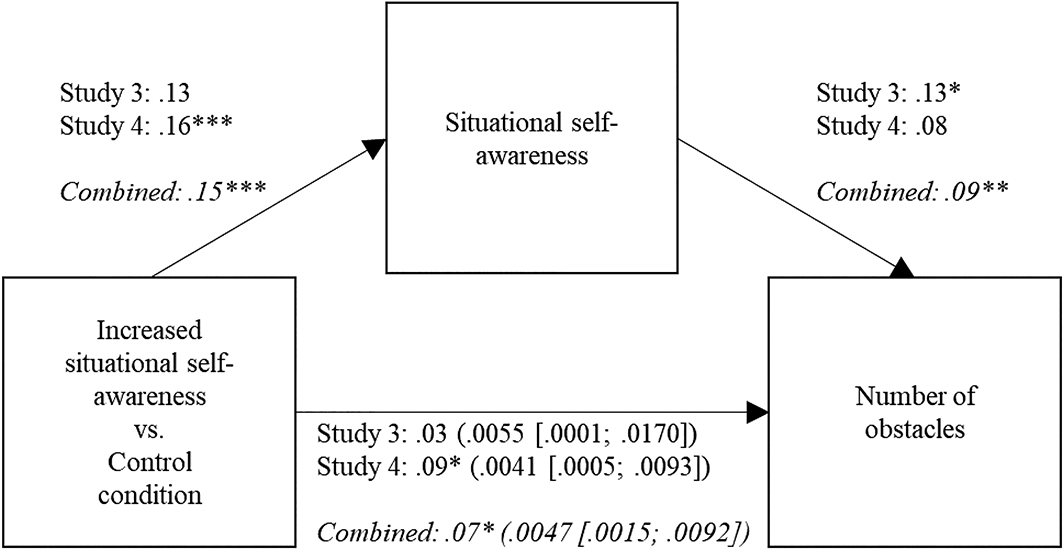
Mediation model and mega–analysis for Studies 3 and 4. All analyses are controlled for study duration. The coefficients are standardized regression weights. Coefficients in parentheses represent indirect effects [and confident intervals]. The 95% confidence intervals of the unstandardized indirect effects were calculated using bootstrapping (5000 samples). The average direct and indirect effects of the mega–analysis with the pooled data of Studies 3 and 4 (n = 894) are written in italic. *p < .05, **p < .01, ***p < .001.
In this study, we were again able to replicate the finding that dispositional self–awareness is correlated with the identification of goal–related obstacles. Furthermore, we were successful in manipulating self–awareness and were able to show that higher situational self–awareness due to a self–awareness–enhancing manipulation is associated with a higher identification of goal–related obstacles in a web browser task. Most importantly, by manipulating self–awareness and demonstrating an indirect effect of our manipulation on the identification of a larger number of obstacles, through heightened situational self–awareness, we have obtained first experimental evidence for our hypothesized effect. In sum, the study supports the idea that individuals with both higher dispositional and situational self–awareness do, in turn, identify more obstacles during goal pursuit.
One major limitation of our study is that we did not anticipate in advance that there would be no direct effect of our manipulation on the identification of obstacles. Only with hindsight did we decide to test the indirect effect on the basis of the mediational model, following considerations associated with manipulation compliance (Kenny & Judd, 2014). Hence, given that only our post–hoc analyses in Study 3 supported our mediation model, more statistical evidence for it is needed.
Study 4
Study 4 was conducted as a replication study to strengthen the results of Study 3, especially with regard to the experimental findings. Therefore, we preregistered Study 4 with the same design as Study 3 to replicate the indirect effect with a higher statistical power.
Method
Participants
On the basis of Kenny (2017), we expected that we would be able to replicate the small indirect effect in the hypothesized mediation model of Study 3 with a statistical power of 80% at a significance level of 5% using a sample of 647 participants. We therefore requested 650 participants from MTurk (mean age 37.46, SD = 10.46, 47% female; educational backgrounds: 24% high school or less, 24% college, 41% bachelor's degree, and 11% master's degree or more). As in Study 3, the survey was only available to USA–based workers with an approval rating of over 90%. We used an exclusion criterion to ensure that the same participants from Study 3 did not participate in Study 4.
Procedure and measures
Replication studies should be as close as possible to the original study, so that ideally the only difference between the two studies is the participants (Brandt et al., 2014). Hence, we conducted an exact replica of Study 3 with the same procedure and the same measures. Before running the study, we furthermore submitted a time–stamped preregistration (https://aspredicted.org/blind.php?x=ym7ku7).
The distribution of situational self–awareness in this study was relatively normal (M = 4.85, SD = 1.53, α = .82). As in Study 3, we used a (preregistered) data transformation to account for the negative skewness in the distribution of dispositional self–awareness (M = 4.40, SD = 1.20, skewness of −0.81, SE = 0.10, Mlog = 1.41, SDlog = 0.20, skewnesslog of 0.11, SElog = 0.10, α = .96) (Field, 2013). 11 Again, dispositional self–awareness and situational self–awareness were highly correlated (r = .53, p < .001). As in Studies 2 and 3, we used a (preregistered) log transformation to allow for the positive skewness in the distribution of named obstacles (range 0–15, M = 3.50, SD = 1.84, skewness of 1.63, SE = 0.10, Mlog = 0.62, SDlog = 0.17, skewnesslog of −0.13, SElog = 0.10) (Field, 2013). As in Study 3, participants were highly concentrated while working on the study (M = 6.70, SD = 0.68), very honest in answering the questions (M = 6.82, SD = 0.50), and highly interested in the study (M = 5.98, SD = 1.36). In this study, participants took 16.07 minutes (SD = 8.53) on average to complete the study and answered 1.05 web browser questions (SD = 0.62) correctly. The two experimental conditions did not differ from each other with regard to their average concentration, t(648) = 0.70, p = .487, d = 0.06 (Mexp = 6.68, SD = 0.73; Mcon = 6.72, SD = 0.64), honesty, t(647.86) = −1.23, p = .219, d = 0.08 (Mexp = 6.84, SD = 0.49; Mcon = 6.80, SD = 0.51),6 interest, t(648) = 0.46, p = .648, d = 0.04 (Mexp = 5.94, SD = 1.37; Mcon = 5.99, SD = 1.35), study duration, t(648) = −0.89, p = .376, d = 0.07 (Mexp = 16.37, SD = 8.57; Mcon = 15.78, SD = 8.49), or performance, t(645) = 1.27, p = .206, d = 0.10 (Mexp = 1.02, SD = 0.64; Mcon = 1.08, SD = 0.59).
Results and Brief Discussion
We were again able to replicate the positive correlation between dispositional self–awareness and the number of obstacles, r = .12, p = .002, 95% CI = [0.04, 0.20]. 12
The manipulation check revealed that, as intended, participants in the experimental condition reported higher situational self–awareness (Mexp = 5.11, SD = 1.28) than participants in the control condition (Mcon = 4.61, SD = 1.69), t(623.23) = −4.27, p < .001, d = 0.33, 95% CI = [−0.73, −0.27]. 13
This time, we also found the significant direct effect of the manipulation on the number of obstacles, t(648) = −2.75, p = .006, d = 0.22, 95% CI = [−0.06, −0.01]. As expected, participants in the experimental condition reported more obstacles (Mexp = 3.69, SD = 1.80) than did participants in the control condition (Mcon = 3.33, SD = 1.87).
To test for the indirect effect, we again computed a (preregistered) regression–based mediator analysis using 5000 bootstraps with the Hayes (2012, 2013) procedure to replicate the mediation hypothesis from Study 3. The predictor (0: no manipulation; 1: manipulation of self–awareness) had a significant effect on the mediator situational self–awareness (a path: β = .16, p < .001). However, the mediator had no significant effect on the dependent variable, the number of obstacles (β = .08, p = .057). Note again that only approaching significance with the a or b path is not a problem for demonstrating a significant indirect effect (Hayes, 2013). Using bootstrapping procedures, we tested the significance of the standardized indirect effect, which was β = .0121. The bootstrapped unstandardized indirect effect was B = 0.0041, 95% CI = [0.0005, 0.0093]. We were therefore able to replicate the statistically significant indirect effect of the hypothesized mediation model (Figure 1). 14
In Study 4, we again replicated both the hypothesized correlational effect of dispositional self–awareness on the number of reported obstacles and the mediation hypothesis, according to which higher situational self–awareness due to a self–awareness–enhancing manipulation leads to a higher identification of goal–related obstacles. Potentially owing to a larger power as a consequence of the bigger sample, we were also able to show a significant direct effect of the manipulation on the number of reported obstacles.
Internal mini meta–analyses and mega–analyses of all studies
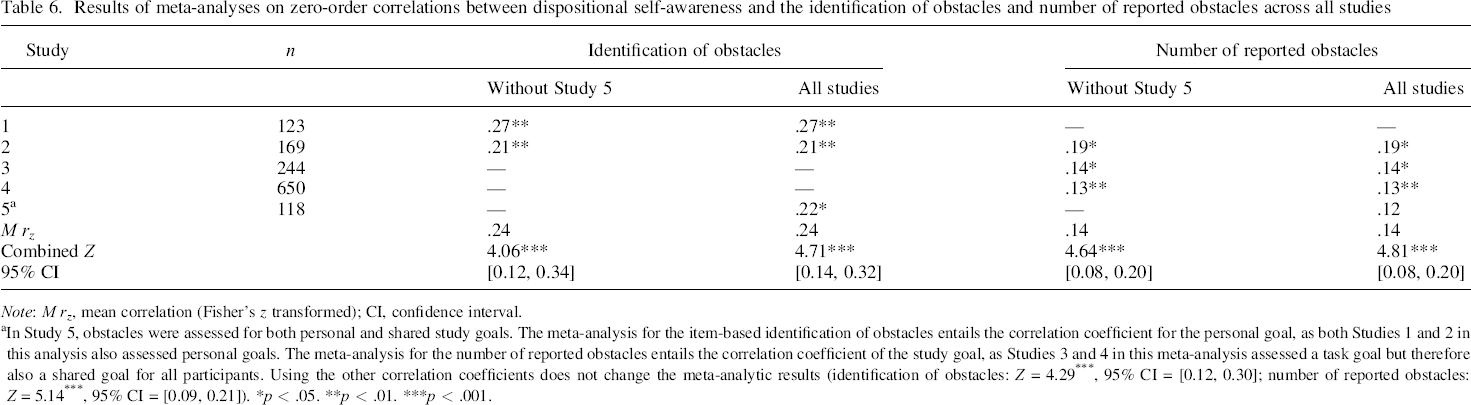
In order to assess the overall strength of our hypothesized effect, we conducted further analyses with our findings on dispositional and situational self–awareness. First, we meta–analysed our studies by assessing the overall mean correlation of dispositional self–awareness and the identification of obstacles. We conducted separate meta–analyses with and without Study 5, a study we have decided to move to the supplemental online materials owing to some major methodological problems. Furthermore, we conducted meta–analyses for both operationalizations of identifying obstacles: the item–based measure (Studies 1, 2, and 5) and the free listing task (Studies 2, 3, and 4). We separated those operationalizations, as using different measures of the same study for meta–analysing would give this study more weight than the other studies. In conducting meta–analyses, we followed recommendations from the literature (Goh, Hall, & Rosenthal, 2016). All single correlation coefficients were Fisher's z transformed for the analyses and weighted by sample size. As can be seen in Table 6, these analyses revealed an average effect size of r = .24 for the association of dispositional self–awareness and the identification of obstacles assessed using the four items. The overall effect of dispositional self–awareness on the number of reported obstacles in the free listing task was smaller, at r = .14. This effect size dropped sharply owing the smaller effect sizes that we observed in the two correlational studies. Furthermore, the mean correlation of dispositional self–awareness and both operationalizations of obstacle identification did not change when Study 5 was considered.
Results of meta–analyses on zero–order correlations between dispositional self–awareness and the identification of obstacles and number of reported obstacles across all studies
Note: M r z , mean correlation (Fisher's z transformed); CI, confidence interval.
In Study 5, obstacles were assessed for both personal and shared study goals. The meta–analysis for the item–based identification of obstacles entails the correlation coefficient for the personal goal, as both Studies 1 and 2 in this analysis also assessed personal goals. The meta–analysis for the number of reported obstacles entails the correlation coefficient of the study goal, as Studies 3 and 4 in this meta–analysis assessed a task goal but therefore also a shared goal for all participants. Using the other correlation coefficients does not change the meta–analytic results (identification of obstacles: Z = 4.29***, 95% CI = [0.12, 0.30]; number of reported obstacles: Z = 5.14***, 95% CI = [0.09, 0.21]).
p < .05.
p < .01.
p < .001.
Following the suggestions of a reviewer, we additionally conducted a mega–analysis by data pooling to obtain an average effect of the experimental manipulation on the identification of obstacles. Figure 1 shows that the average indirect effect of the experimental manipulation on the identification of obstacles via situational self–awareness remains significant, when analysing the effect with the pooled data of both datasets (n = 894), B = 0.0047, 95% CI = [0.0015, 0.0092]. Furthermore, data of this mega–analysis revealed an average significant direct effect of the experimental manipulation on the identification of obstacles, β = .07, p = .033. In sum, these meta–analyses and mega–analyses revealed a significant link between both dispositional and experimentally induced self–awareness and the identification of obstacles.
General Discussion
In pursuing their personal goals, people now and then come across obstacles that may hinder the successful attainment of those goals. Overcoming obstacles requires the use of self–regulatory strategies (Myrseth & Fishbach, 2009) but first, and even more importantly, the identification of an obstacle as an interfering force (Higgins, 2006; Myrseth & Fishbach, 2009). Identifying an obstacle as standing in the way of a set goal requires self–awareness (Carver & Scheier, 1998). This is because paying attention to aspects of the self, like one's own goals, promotes the process of comparing ideal states with actual states in goal striving. In this research, we highlight the importance of individual differences for investigating self–regulatory processes by addressing the role of self–awareness for the identification of goal–related obstacles. Furthermore, we took a combined approach of assessing both inter–individual and intra–individual differences. The effect of a (situationally manipulated) state on an outcome cannot be direct evidence of how the trait affects this outcome (Molenaar & Campbell, 2009), but it contributes to our understanding of how intra–individual processes might mediate the effects of inter–individual differences on outcomes.
In Study 1, participants with higher dispositional self–awareness reported a higher tendency to identify obstacles regarding their personal goals. In Study 2, we were able to replicate this finding. In addition, participants with higher dispositional self–awareness reported more obstacles in a free listing task. In both studies, we were able to show that dispositional self–awareness was associated with the identification of obstacles even controlling for additional predictors that might be related to the identification of obstacles during goal pursuit (e.g. negative mood, action crisis, and pessimism) or to self–awareness itself (e.g. mindfulness, rumination, neuroticism, conscientiousness, and openness to experience). To account for goal content, we replicated the results with a (more homogenous) subsample of participants, all of whom were pursuing a goal related to their studies.
To obtain experimental evidence for the effect of self–awareness on the identification of obstacles, we then conducted Studies 3 and 4 as experimental studies. In Study 3, we experimentally manipulated situational self–awareness and were able to show that an increase in situational self–awareness increased the number of reported obstacles during the pursuit of a goal, in this case the task of answering three questions with the help of a web browser. We replicated this finding in Study 4, which had higher statistical power and was preregistered. We furthermore found causal evidence for the effect by showing a significant direct effect of the self–awareness–enhancing manipulation on the identification of obstacles. Please note that we found the hypothesized effect to be larger in Study 4 than in Study 3. As Study 4 was an exact replication of Study 3 with a bigger sample size and therefore a more precise estimation of parameters, it is possible that the indirect effect was underestimated in Study 3. In these experimental studies, we were furthermore able to replicate the correlational effect of dispositional self–awareness and the identification of obstacles already found in Studies 1 and 2. Additionally, we conducted meta–analyses to assess the overall strength of the hypothesized effect, even taking into consideration the additional Study 5, which produced mixed findings and is reported in the supplemental materials owing to methodological problems. These meta–analyses supported the robustness of the association between dispositional self–awareness and the identification of obstacles. Lastly, we conducted a mega–analysis in order to assess an average effect of experimentally induced situational self–awareness on the identification of obstacles, which was again significant. Considering those meta–analyses and mega–analyses, the data from these studies provide strong evidence that self–awareness is associated with the identification of obstacles.
Theoretical implications
The findings of this research will be informative regarding the effects of individual differences on self–regulation. While commonly studied self–regulatory traits like conscientiousness, trait self–control, or grit have previously been looked at predictors of self–regulatory outcomes (Duckworth, Peterson, Matthews, & Kelly, 2007; Moffitt et al., 2011; Tangney, Baumeister, & Boone, 2004), less attention has been devoted to understanding the processes that link self–regulatory traits to self–regulatory outcomes (Hoyle, 2010). In our research, we highlight the importance of individual differences in self–awareness, which have been shown to play a key role in self–regulation (Baumeister et al., 1994; Carver & Scheier, 1998; Duval & Wicklund, 1972) for predicting such self–regulatory processes, and in turn, self–regulatory outcomes.
Moreover, our research contributes to an ongoing debate on the merits of narrow, lower–order personality traits (i.e. facets of the Big Five) in contrast to broader, higher–order personality traits (e.g. the Big Five) (Paunonen & Ashton, 2001). In the NEO–PI–R (Costa & McCrae, 1992), self–awareness in the sense of rumination (Trapnell & Campbell, 1999) is conceptualized as a facet of neuroticism. On the contrary, self–awareness in the sense of private self–consciousness (Fenigstein et al., 1975; Grant et al., 2002) is associated with openness to experience and conscientiousness (Panah & Seif, 2014). Accordingly, we found a zero relationship between dispositional self–awareness and neuroticism but a positive connection to openness to experience and conscientiousness in our data (Study 1). Most importantly, we were able to show the incremental validity of self–awareness when predicting the identification of obstacles above and beyond these global traits (neuroticism; Costa & McCrae, 1992; openness to experience, conscientiousness, Panah & Seif, 2014) and above and beyond a similar, narrow trait with conceptual overlap (mindfulness, Evans, Baer, & Segerstrom, 2009). These findings suggest that considering individual facets of personality allows for a more fine–grained analysis of personality processes (Paunonen & Ashton, 2001). Thus, future research should focus more on the meaningfulness of individual facets of personality. For example, Grant et al. (2002) suggested to differentiate between a more adaptive solution–focused self–reflection, in which individuals reflect on how to reach their goals best, and a more maladaptive self–focused self–reflection whereby individuals attempt more to understand their negative emotional, cognitive, and behavioural reactions. It could be assumed that both of these facets of self–awareness are associated with an increased identification of obstacles, but that the obstacles they identify differ in their nature (e.g. content or severity). Future research should investigate the role of these facets of self–awareness for the identification of obstacles in goal pursuit.
Is identifying more obstacles adaptive?
At the outset, we stressed the important role of obstacle identification for goal attainment. If individuals identify obstacles as standing in the way of a set goal, they then can respond accordingly, for example, by identifying compensatory means for dealing with the obstacle (Carver & Scheier, 1998; Myrseth & Fishbach, 2009; Oettingen, 1997).
It is certainly true that identifying obstacles that require compensatory action is, overall, an adaptive process. However, the current research furnished no direct evidence that an increase in the identification of obstacles does indeed foster eventual goal attainment. As we did not find any differences in performance between the experimental and control groups in Studies 3 and 4, it seems that the identification of obstacles neither impairs nor promotes goal performance in the short term.
However, in the long run, the identification of obstacles could impact goal performance in quite different ways. On the one hand, individuals who constantly identify a large number of obstacles may actually be overwhelmed by this experience and therefore be at a disadvantage. They may come to feel that they are less competent or less in control of their goal pursuit or that the expectancy of eventually attaining the goal is too low to justify investing further effort (Oettingen, 2000). These subjective experiences may foster the maladaptive side of self–awareness, which is rumination, and therefore the experience of an action crisis during goal pursuit (Brandstätter & Schüler, 2013; Lyubomirsky & Nolen–Hoeksema, 1995), or could even hinder disengagement from unattainable goals (van Randenborgh, Hüffmeier, LeMoult, & Joormann, 2010).
On the other hand, individuals who do not acknowledge the presence of real obstacles are certainly not well equipped for goal attainment either, as they lack the possibility of adapting their behaviour when necessary. Next to identifying real obstacles, another crucial process for self–regulation is the anticipation of future obstacles (Oettingen, 1997; Zhang & Fishbach, 2010), because anticipated obstacles are perceived as being more controllable than past obstacles (Leduc–Cummings et al., 2017). For example, without the anticipation of obstacles, individuals are unable to capitalize on counteractive self–control strategies, like increased effort (Fishbach & Trope, 2005; Zhang & Fishbach, 2010), or to begin focusing on the more controllable aspects of the situation (Ferrante, Girotto, Stragà, & Walsh, 2013). Hence, future research should investigate whether self–awareness also leads to a higher anticipation of obstacles.
Ideally, individuals should be well calibrated in their sensitivity to what constitutes an actual obstacle that requires behavioural adaptation. They should not see obstacles where there are none, but they should acknowledge the presence of obstacle that matter. To get a better grasp of what ‘well calibrated’ means, future research could experimentally vary the presence of actual obstacles in a laboratory task and see how well people with low or higher levels of self–awareness calibrate their identification of obstacles to their objective presence. If their identification of obstacles was sensitive to their objective presence, this would confirm our assumption that self–awareness promotes goal striving through the identification of obstacles.
What else can be monitored?
In this research, we focused on goal monitoring as an underlying process of the relationship between self–awareness and the identification of goal–related obstacles. Research has shown that monitoring progress is a fundamental self–regulatory skill (Hoyle & Gallagher, 2015; Inzlicht, Legault, & Teper, 2014) and promotes task performance (Oaten & Cheng, 2007) and hence that insufficient goal monitoring leads to self–regulatory deficits (Baumeister et al., 1994). In Studies 1 and 2, we assessed obstacles in personal goal pursuit, the identification of which presumably was based on an individual's usual monitoring process. In Studies 3 and 4, however, we assessed obstacles in the pursuit of an experimental goal unfamiliar to participants, in which individuals could therefore not rely on their experience in monitoring goal pursuit. Indeed, results of meta–analyses and mega–analyses show that the overall strength of the effect dropped in the experimental studies. It is very conceivable that the identification of obstacles relies not only on a frequent monitoring of one's own goal pursuit but also on the resulting knowledge about personal goal striving. Self–awareness is associated with greater self–knowledge (Martin & Tesser, 1996; Trapnell & Campbell, 1999), which is why self–aware people can be assumed to know more about their goal striving and goal–related aspects, that is, obstacles, as a result of goal monitoring. Consequently, self–aware people would report more obstacles to their personal goal pursuits than while monitoring an induced web browser task.
If goal monitoring promotes knowledge about obstacles, the question arises if it also promotes knowledge about facilitators. As research has shown, successful goal pursuit relies not only on the identification of obstacles but also on the identification of facilitating aspects, such as suitable opportunities (Gollwitzer, 1999), resources (Hobfoll, 1989), or instrumental means (Kruglanski et al., 2002). It could certainly be the case that self–awareness is also associated with an improved identification of facilitators of goal pursuit, for example, original means that may ultimately help to circumvent or overcome the obstacles (Marguc, Van Kleef, & Förster, 2015). Such an association seems likely given that self–awareness is also associated with adaptive coping strategies (e.g. problem solving) in contrast to more maladaptive strategies (e.g. avoidance; Burwell & Shirk, 2007), which might result in the choice of more instrumental means.
Strengths and limitations
This research has some strengths that should be considered. An important component of cumulative science is replication (Asendorpf et al., 2013; Brandt et al., 2014; Jasny, Chin, Chong, & Vignieri, 2011; Nosek, 2013; Schmidt, 2009). We successfully replicated the effect of dispositional self–awareness on the identification of goal–related obstacles of Study 1 in all other studies. Moreover, for the sake of internal replication, we quantified the hypothesized effect with different measures of the identification of obstacles. Furthermore, we demonstrated the effect experimentally in Study 3 and replicated it in Study 4, which was preregistered to increase the transparency, rigour, and reproducibility of our research. Regarding constraints of generalizability, we were furthermore able to show the hypothesized effect in both student samples (Studies 1 and 2) and, potentially more diverse (Goodman et al., 2013), MTurk samples (Studies 3 and 4). Finally, we meta–analysed and mega–analysed our studies in order to assess an overall effect size of our hypothesized effect.
Nevertheless, this research is not without limitations. First, participants in the control conditions in Studies 3 and 4 did not receive any instructions matching the self–awareness instructions in the experimental conditions. We decided to use such ‘non–active’ control groups because we were concerned about unpredictable effects caused by alternative instructions. The lack of an active control group, however, may be problematic insofar as we cannot exclude that giving participants a second instruction may have made the web browser task more difficult. This could, of course, impact the identification of obstacles. We therefore assessed the participants’ study duration and concentration as useful proxies for task difficulty by suggesting that participants who found the web browser task more difficult would work longer on it and would report more concentration as long as the task was perceived as being solvable (e.g. Gendolla, Richter, & Silvia, 2008). However, data revealed that participants did not differ significantly either in their study duration or in their concentration. We take this as an indication that the self–awareness–enhancing manipulation did not impose additional cognitive load in the experimental condition that might have increased task difficulty. Furthermore, we asked participants about their interest in order to assess whether the self–enhancing manipulation would make the task more interesting and would therefore increase task motivation. Note, however, that the data for both studies revealed no differences in interest between the groups. We therefore conclude that the manipulation had neither a beneficial effect nor a detrimental effect on the participants’ processing of the web browser task.
A second limitation lies in the fact that the effects of experimentally induced situational self–awareness on the identification of obstacles were much smaller than the effects of dispositional self–awareness. This discrepancy might be due to methodological reasons, as our manipulation might have been too weak to show effects of a similar size. We manipulated self–awareness on the basis of its definition (Grant et al., 2002) by telling participants in our experimental studies to put their attention on their thoughts, feelings, and behaviour while doing the experimental (web browser) task. In addition, we reminded participants to be self–aware each time they started a new of a total of three task questions. In doing so, we avoided formerly used manipulations of self–awareness (e.g. mirrors and cameras; for an overview, refer to Morin, 2011) and tried to induce a situational state, which is most similar to the way of assessing the trait. As we found a significant effect on our manipulation check (which is situational self–awareness measured by a questionnaire; Govern & Marsch, 2001), we conclude that our manipulation enhances self–awareness as we intended. However, as participants were working on this experimental task for a longer time (on average 15 minutes), it could be that the strength of the manipulation has diminished over time, which, in turn, resulted in a weaker correlation with the outcome variable. Hence, it would be fruitful for future research to either use experimental tasks of a shorter duration in order to make the manipulation more effective by assessing its short–time effects on the expected outcome or to search for alternative ways for manipulating situational self–awareness.
Finally, all our results rely on self–reported data. Self–reported data contain several potential sources of bias, such as selective memory or social desirability (Brenner & DeLamater, 2016). Selective memory could potentially be problematic in our studies, as we cannot exclude that participants did not remember all the obstacles they experienced. Note, however, that in Studies 3 and 4, the retrieval interval between the task and the reporting of obstacles for the task was short. Social desirability might be a bigger problem in our studies. As being self–aware might be viewed as a valued skill, participants might have provided inflated reports of their own levels of self–awareness. In this case, however, the distribution of self–awareness would display ceiling effects. The actual data were normally distributed in Studies 1 and 2 but negatively skewed in the MTurk Studies 3 and 4. It could be that MTurk workers are in fact more self–aware because they are encouraged more often to think about themselves through their regular study participation.
Conclusion
The present paper has tested the hypothesis that self–awareness, the state in which a person becomes the object of his or her own attention (Duval & Wicklund, 1972), positively predicts the identification of goal–related obstacles. Across several studies that both measured dispositional self–awareness and experimentally manipulated situational self–awareness and across various operationalizations of the identification of obstacles, we were able to find converging evidence for this hypothesis. The effect of dispositional self–awareness furthermore remained present when controlling for additional variables, for example, negative mood, rumination, neuroticism, and action crisis, variables that may all have an impact on the identification of obstacles. In sum, this research provides first insights into a person factor as an antecedent condition that contributes to the identification of obstacles, a key element in the self–regulatory processes of goal pursuit.
Acknowledgement
This research was supported by a grant from the Foundation of Suzanne and Hans Biaesch for the Advancement of Applied Psychology awarded to Antonia Kreibich (2017–30).
Supporting info item
Supporting info item, per2234-sup-0001-Open Science Disclosure Form - The Effect of Self–Awareness on the Identification of Goal–Related Obstacles
Supporting info item, per2234-sup-0001-Open Science Disclosure Form for The Effect of Self–Awareness on the Identification of Goal–Related Obstacles by Kreibich Antonia, Hennecke Marie, Brandstätter Veronika and Wrzus Cornelia in European Journal of Personality
Open Science Disclosure Form
Footnotes
Notes
References
Supplementary Material
Please find the following supplemental material available below.
For Open Access articles published under a Creative Commons License, all supplemental material carries the same license as the article it is associated with.
For non-Open Access articles published, all supplemental material carries a non-exclusive license, and permission requests for re-use of supplemental material or any part of supplemental material shall be sent directly to the copyright owner as specified in the copyright notice associated with the article.
