






Abstract
The constructs grit and conscientiousness are closely connected. However, this relationship has not been analysed while accounting for the complex structure of conscientiousness and the multifaceted conception of grit (perseverance of effort; consistency of interest). In this study, we analysed the connection while considering the hierarchical structure of conscientiousness, differentiating between a superordinate factor, a first–level common factor (industriousness), and lower level unique factors. Drawing on two samples (N = 413, Mage = 15.29, and N = 530, Mage = 31.75), we applied an extension procedure for confirmatory factor analysis that enables a simultaneous investigation of the relationships on all levels. The perseverance facet of grit was tightly aligned to the common factors (95% shared variance) and was strongly related to the industriousness factor. Consistency shared less variance with the common factors of conscientiousness (53%), but it was additionally correlated with the self–discipline facet. The results for the global grit scale were most similar to the results for perseverance. Grit appears to be a construct that combines the superordinate and industrious aspects of conscientiousness and shares the unique aspect of the self–discipline facet; this suggests that grit and its facets can be fully integrated into the hierarchical structure of conscientiousness.
Keywords
Grit has received much attention from scientific as well as non–scientific outlets as it has been found to predict success in a variety of domains. Since the start of research into the grit construct, there has been strong empirical evidence for a close relation between measures of grit and conscientiousness (e.g. Credé, Tynan, & Harms, 2016; Duckworth & Quinn, 2009). However, the question of whether grit or its subfacets (perseverance of effort and consistency of interest) can be differentiated from conscientiousness, a construct in personality psychology with great utility (Poropat, 2009), still remains open (e.g. Ivcevic & Brackett, 2014; Roberts, Donnellan, & Hill, 2012). One reason for this might be that the connections between conscientiousness and grit have rarely been analysed while taking the complex structure of conscientiousness and the multifaceted conception of grit into account. Up until now, the majority of research has investigated correlations between compound measures of conscientiousness and grit (for an overview, see Credé et al., 2016), neglecting the multifaceted nature of both constructs.
In the present article, we address this lacuna by considering the hierarchical structure of conscientiousness proposed by Roberts, Chernyshenko, Stark, and Goldberg (2005) to test our assumptions. The authors identified a number of common factors located at different levels in the conscientiousness hierarchy. On the higher level, conscientiousness can be divided into proactive and inhibitive aspects of conscientiousness. On the lower level of proactive conscientiousness, they identified industriousness. Industrious individuals are hardworking, they aspire to excellence and are persistent in the face of challenges (Roberts et al., 2012); this definition is conceptually similar to the definition of grit, especially its perseverance of effort facet. The industriousness factor is embedded in different measurement instruments but is probably best represented by the revised NEO personality inventory (NEO PI–R, Costa & McCrae, 1992). More specifically, four of the six NEO PI–R facet scales have been found to load primarily on this factor (Roberts et al., 2005). In our study, we aimed to decompose the relationships of the global grit scale and of its facet scales perseverance of effort (perseverance) and consistency of interest (consistency) with the factors underlying the facets of conscientiousness as assessed by the NEO PI–R. These are (i) the superordinate conscientiousness factor, (ii) the first–order industriousness factor, and (iii) the lower level unique factors pertaining to each facet of the NEO PI–R's conscientiousness scale. We used a newly developed extension procedure for confirmatory factor analysis (CFA; Nagy, Brunner, Lüdtke, & Greiff, 2016) that makes it possible to simultaneously investigate the relations between grit and conscientiousness on all hierarchical levels. To cross–validate our findings, we replicated our results in two independent samples taken from distinct populations (i.e. a student sample and a more heterogeneous sample of adults).
The current status of grit research
So far, the vast majority of research on grit has investigated the relationship between compound measures of grit and important achievement outcomes. In summary, global grit has been found to predict a variety of academic and vocational outcomes over and above domain–specific skills or intelligence (Duckworth, Peterson, Matthews, & Kelly, 2007; Duckworth & Seligman, 2006; Fleckenstein, Schmidt, & Möller, 2014; Zimmermann & Schunk, 2011). It has been associated with higher educational attainment (Datu, Yuen, & Chen, 2017) and fewer career changes, higher retention rates for cadets at the United States Military Academy, as well as final round attainment for Scripps National Spelling Bee competitors (Duckworth & Quinn, 2009). Robertson–Kraft and Duckworth (2014) showed that grittier novice teachers were less likely to leave a teaching programme prematurely and lead to higher achievement of their students. University students’ grit scores were positively correlated with grades and negatively correlated with procrastination (Schmidt, Fleckenstein, Retelsdorf, Eskreis–Winkler, & Möller, 2017). Global grit predicted the academic success of Black students in a primarily White school even after controlling for prior achievement and achievement aspirations (Strayhorn, 2014).
Whereas most research has used global measures of grit, the recent meta–analysis by Credé et al. (2016) showed that the two facets of grit (i.e. perseverance and consistency) differ in their utility for predicting achievement outcomes. Compared with consistency, perseverance explained a substantially larger amount of variance in academic performance, high school grade point average (GPA), and college GPA. This suggests that the predictive power of global measures of grit is mainly due to the perseverance aspect of grit. This finding highlights the importance of differentiating between the perseverance and the consistency facets of grit.
From the beginning of grit research, there has been an ongoing discussion about how to localize grit in the nomological network of existing psychological constructs. The global grit construct has been categorized as a noncognitive skill (Farrington et al., 2012; Strayhorn, 2014), as a narrower facet of personality (Duckworth et al., 2007; Muenks, Wigfield, Yang, & O'Neal, 2017; Rimfeld, Kovas, Dale, & Plomin, 2016), and as a lower level personality trait in the domain of conscientiousness (Ivcevic & Brackett, 2014). These diverse approaches towards a categorization of grit point to a lack of studies investigating the relationship of grit to conceptually related constructs—the most relevant being conscientiousness. Indeed, Roberts et al. (2012) argued that, even though grit was developed mainly independent from conscientiousness, there are clear connections between the two. In their opinion, grit should be viewed as a measure of the broader conscientiousness domain or at least as a facet of conscientiousness.
In their very first publication on grit, Duckworth et al. (2007) indicated the possibility of grit being a narrow facet of the Big Five factors. The authors went on to compare it to the achievement aspects of conscientiousness, emphasizing the long–term stamina of grit in comparison with the short–term intensity relevant to most of the conceptions of conscientiousness. The long–term aspect of goal–oriented behaviour is more closely reflected in the consistency facet of grit, whereas the perseverance facet highlights diligence and persistence in the face of challenges, an aspect that is also at the core of most conceptualizations and measures of conscientiousness (Credé et al., 2016; Roberts et al., 2005). Following this line of reasoning, the question emerges as to whether the facets of grit show differential relations to the construct domain of conscientiousness and whether consistency is the differentiating factor between grit and conscientiousness (cf. Duckworth et al., 2007) and if grit can be differentiated from conscientiousness to a degree that allows regarding it as a unique construct, or fully incorporating grit into the hierarchy of conscientiousness and thereby identifying yet another construct that falls victim of the jangle fallacy.
The relation between grit and conscientiousness
Conscientiousness can be defined as a spectrum of constructs describing individual differences in the tendency to be self–controlled, responsible to others, hardworking, orderly, and rule abiding (Roberts, Jackson, Fayard, Edmonds, & Meints, 2009). This view contrasts the view that measures of conscientiousness reflect a unitary construct, such as a homogenous superordinate factor. Getting a clear understanding of conscientiousness is often problematic, because different models of personality define and assess conscientiousness differently, which may lead to varying results regarding the relations to external criteria (MacCann, Duckworth, & Roberts, 2009). Nevertheless, there seems to be a consensus on the conception of conscientiousness as a broad multifaceted personality trait (Roberts et al., 2009). Conscientiousness was divided into two broader domains on the higher level: one tapping achievement or proactive aspects of conscientiousness and the other tapping dependability aspects or inhibitive aspects (Costa & McCrae, 1998; Hough, 1992; Mount & Barrick, 1995). A broad set of facets has been identified on the lower level of conscientiousness (MacCann et al., 2009; Roberts et al., 2005). In accordance, some of these facets are more similar to the conception of grit than others.
A number of studies have investigated the relative contribution of global measures of conscientiousness and grit towards predictions of real–life outcomes. Taken together, the results are rather mixed. On the one hand, some studies found global grit to account for additional variance in achievement (Duckworth et al., 2007) and educational attainment (Duckworth & Quinn, 2009) over and above conscientiousness. On the other hand, Weston (2015) concluded that neither global measures of grit nor conscientiousness were significant predictors of literacy skills when they were considered simultaneously, and Dumfart and Neubauer (2016) found that global grit did not explain additional variance in GPA when controlling for conscientiousness. One reasonable explanation for these heterogeneous results is that researchers used measures of conscientiousness that differ in their sensitivity to the various factors that structure the conscientiousness construct.
The findings concerning the correlations between measures of conscientiousness and global grit varied substantially. The recent meta–analysis by Credé et al. (2016) found global grit scores to be strongly correlated with conscientiousness after controlling for sample sizes and reliabilities of the measures used to assess conscientiousness. However, this study did not account for differences in the conceptions or aspects of conscientiousness assessed in the primary investigations. Following our review of the literature, correlations for global grit measures and conscientiousness varied between r = 0.40 in the study by Morris (2011) and r = 0.77 in the studies by Meriac, Slifka, and LaBat (2015) and Duckworth et al. (2007). On the subfacet level of grit, the correlations with conscientiousness ranged from r = 0.42 (Cooper, 2014) to r = 0.74 (Duckworth & Quinn, 2009) for perseverance and from r = 0.27 (Muenks et al., 2017) to r = 0.64 (Duckworth & Quinn, 2009) for consistency. Credé et al. (2016) found a stronger corrected mean correlation of ρ = 0.83 for perseverance than for consistency (ρ = 0.63). Hence, the perseverance facet of grit is not only the key predictor of real–life outcomes but is also most closely related to the conscientiousness domain.
The findings by Credé et al. (2016) and Roberts et al. (2005) taken together suggest that the similarities in the predictive power of perseverance and conscientiousness are due to the fact that both measures reflect the same underlying constructs that capture individual differences in proactive aspects of behaviour. Furthermore, the inconsistent findings on the incremental effects of grit over and above conscientiousness may be explained by the sensitivity of the conscientiousness measures used to specify the relevant latent variables. Indeed, the majority of studies in this context have used different short scales of conscientiousness that vary between 2 and 10 items. Grit, on the other hand, has been assessed almost exclusively with the Grit Scale and its translations. In many of these studies, the Big Five Inventory (John & Srivastava, 1999) with nine items was applied (e.g. Duckworth et al., 2007; Duckworth & Quinn, 2009). However, some studies used even shorter measures, for example, with four (e.g. Fleckenstein et al., 2014) or even two items (e.g. Muenks et al., 2017).
We are aware of only two studies that used broader measures of conscientiousness (Dumfart & Neubauer, 2016; MacCann & Roberts, 2010). Only MacCann and Roberts (2010) took a closer look at the relationships between the facets of conscientiousness and grit scores. They found perseverance to be more strongly correlated with conscientiousness than consistency. In addition, perseverance was found to be most strongly related to the industriousness facet of conscientiousness included in the instrument (MacCann et al., 2009), which suggests that grit should also be strongly related to the industriousness aspect introduced by Roberts et al. (2005); this will be discussed in the following.
Due to the lack of a well–established lower order taxonomy of conscientiousness facets, Roberts et al. (2005) compared seven major personality questionnaires and noted that there is a broad range of self–report measures, tapping a wide range of the facets of conscientiousness that were developed under different theoretical considerations. They identified a hierarchical structure with six first–order factors: industriousness, order, self–control, responsibility, traditionalism, and virtue (see Figure 1). Interestingly, none of the seven questionnaire's lower order facets loaded on more than three of the identified six factors.
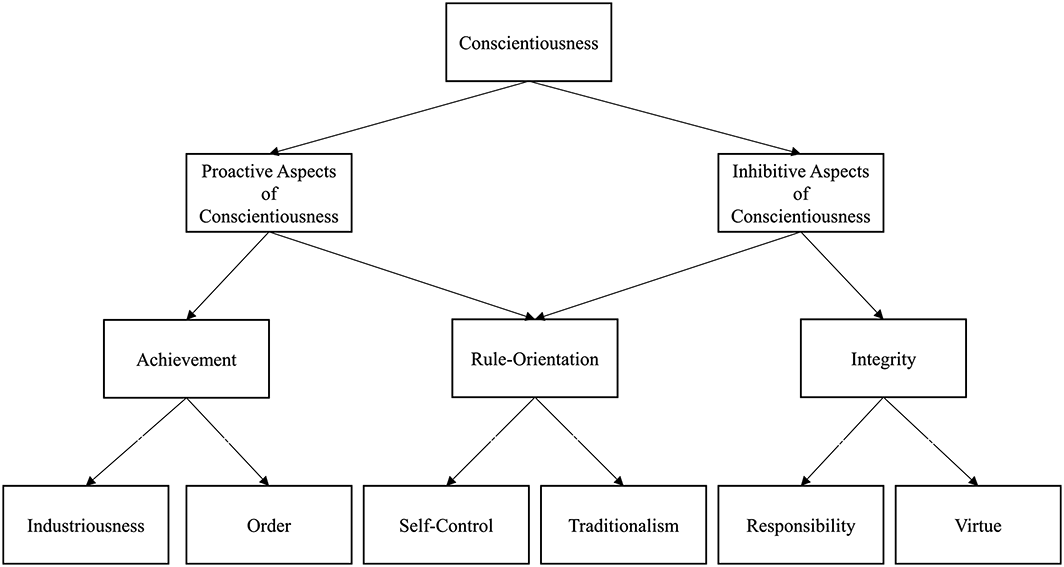
Adapted hierarchical structure of conscientiousness by Roberts et al. (2005).
Industriousness has been shown to be one core aspect of proactive conscientiousness (MacCann et al., 2009; Roberts et al., 2005; Roberts et al., 2012; Roberts, Lejuez, Krueger, Richards, & Hill, 2014). Individuals scoring high on the industriousness factor are supposed to be hardworking, ambitious, confident, resourceful, and persistent in the face of challenges (Roberts et al., 2005; Roberts et al., 2012). Hence, on a conceptual level, the industriousness aspect of conscientiousness appears to be very similar to grit, especially to its perseverance facet. Due to the close relatedness between these aspects of conscientiousness and grit, one could reasonably assume that grit does not add incrementally to the canon of constructs in personality psychology. However, the relationship between grit and its facets with industriousness over and above general conscientiousness has not been investigated empirically yet. The extent to which the close but varying relationship between grit and conscientiousness can be attributed to industriousness still needs to be inquired. For the first time, we aimed to address this desideratum as it will help to better understand the grit construct and its relation to conscientiousness.
The present study
In light of the aforementioned background, the following question remains unresolved: to what extent is the relationship between grit, its facets, and conscientiousness due (i) to the superordinate conscientiousness factor, (ii) to a first–order factor that is conceptually most similar to the perseverance facet of grit (i.e. industriousness), and (iii) to the facet scores located on the lowest level of the conscientiousness hierarchy? To address this lacuna, we investigated the relationship by using a conscientiousness measure that stands in close theoretical proximity to grit and that includes an identifiable industriousness factor (Roberts et al., 2005) that is most similar to grit on a conceptual level.
We used the German NEO PI–R (Ostendorf & Angleitner, 2004; original Costa & McCrae, 1992) to measure conscientiousness. In previous research, four of the six conscientiousness facets of the NEO PI–R loaded primarily on the industriousness factor (Roberts et al., 2005), namely, competence, dutifulness, achievement striving, and self–discipline. The remaining two facets were order and deliberation. It has to be noted that deliberation in contrast to the other facets included in the NEO PI–R represents inhibitive aspects of conscientiousness (Costa & McCrae, 1992).
In order to identify the role of the theoretically relevant factors included in the hierarchy proposed by Roberts et al. (2005), we disentangled the factors by means of a nested factor model (Brunner, Nagy, & Wilhelm, 2012). In this model, we distinguished between three kinds of factors namely, (i) a superordinate conscientiousness factor, (ii) a nested industriousness factor that accounted for the correlations between facet scales that were not accounted for by the general factor, and (iii) unique factors pertaining to each facet scale representing (reliable) variance that was not accounted for by the common factors. In order to study the relationships between conscientiousness and grit, we extended the nested factor model by including grit (a global score as well as facet scores). Building upon a recently proposed extension procedure for CFA (Nagy et al., 2016), our model allowed us to assess these relationships simultaneously.
The extension procedure was based on a nested factor representation of the NEO PI–R conscientiousness instrument combined with the measures of grit, as depicted in Figure 2 (details are given in the Method section). Our model has several desirable properties that are not provided by the conventional structural modelling approach (SEM) used for studying the correlates of common factors. First, the extension procedure ensures that the common factors identified on the basis of the NEO PI–R do not change their meaning once additional variables are included into the model—a problem that is known as interpretational confounding (Burt, 1976) in the literature. Second, as shown in the path diagram, our model allowed all of the relationships between all of the common and unique factors and the grit scales to be estimated simultaneously. Conventional SEM procedures do not offer this possibility because they require at least some of the factors’ correlations to be fixed to some pre–specified values (typically zero). Third, our model included a correction of random measurement error so that the relationships of the unique factors and grit facets are considered to be corrected for unreliability. Fourth, the model used allowed a straightforward decomposition of the (reliability–corrected) variance that the grit measures shared with the common and unique conscientiousness factors. This feature enabled us to quantify the importance of the different factors for understanding the relationship between conscientiousness, as assessed by the NEO PI–R, with grit. Fifth, the model containing the facet scores of grit allowed us to derive the reliability–corrected correlations between the conscientiousness factors and the global grit score, defined as the sum of the facet scores. The pattern of results provides important insights into the basis of the relationship between conscientiousness and grit. Support for the view that the relationship is based solely on a superordinate conscientiousness factor requires a statistically significant correlation between grit scales and the general factor, accompanied by negligible correlations between the measures of grit and the nested industriousness factor, as well as between grit and the unique factors pertaining to each facet scale. A finding that demonstrates that the nested industriousness factor is, in addition, significantly related to the grit scales would indicate that the superordinate factor cannot adequately account for the relationship alone. Furthermore, our model made it possible to identify whether the unique factors pertaining to each measured facet of conscientiousness were, in addition to the common factors, related to the measures of grit.
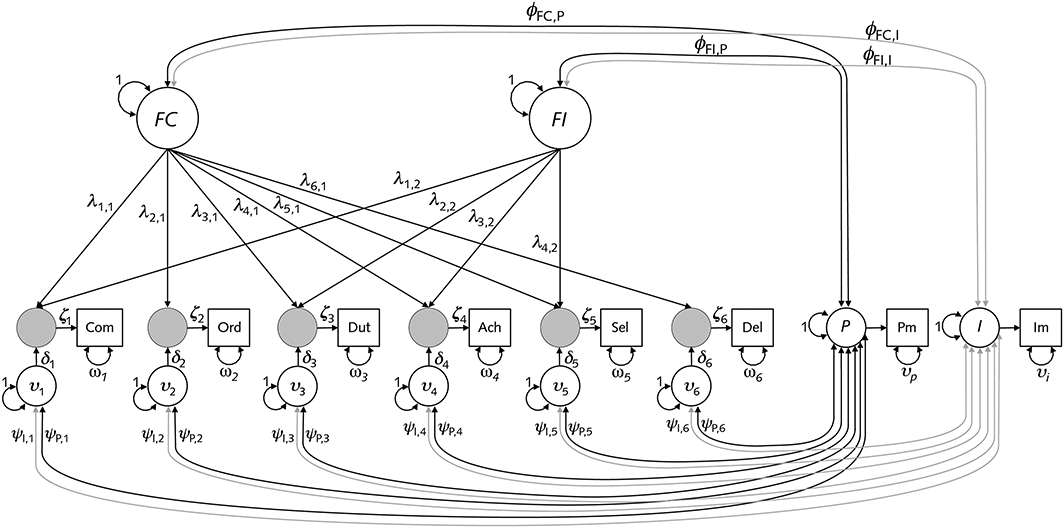
Path diagram of the extended confirmatory factor analysis model used in the present investigation. Directed arrows represent factor loadings, and bidirectional arrows stand for correlations and variances. The variances of the common and unique factors were fixed to 1. FC, overarching conscientiousness factor; FI, industriousness factor; cr j , unique factors; greyed out, node variables; Com, competence facet scores; Ord, order facet score; Dut, dutifulness facet score; Ach, achievement striving facet score; Sel, self–discipline facet score; Del, deliberation facet score; δ j , unique factor loadings; λ j,f , standardized factor loadings; ϕ f , correlations between grit and common factors; ψ, correlations between grit and unique factors, for a better distinguishability correlations with consistency of interest in grey; Pm, perseverance score; P, standardized perseverance score; Im, consistency of interest score; I, standardized consistency of interest score; ω j , random error variances.
Because the broad empirical body of research has shown strong connections between grit and several broad measures of conscientiousness (Credé et al., 2016), we expected (i) to find strong relationships between the superordinate conscientiousness factor and both facets of grit. It appeared reasonable to assume that perseverance would be more strongly correlated with this factor because research has documented stronger relationships between global scores of conscientiousness and perseverance than with consistency (Credé et al., 2016; MacCann & Roberts, 2010). As we expected both facets of grit to be related to the superordinate factor, we expected the factor to also be strongly correlated with the global grit score.
Because of the close correspondence between the conceptualizations of industriousness and grit, we expected (ii) the nested factor to be highly correlated with grit even after accounting for the relationship of grit with the superordinate conscientiousness factor. However, because industriousness and perseverance both highlight diligence and persistence in the face of challenges, we expected (iii) perseverance to be more strongly related to industriousness than consistency. From these expectations, it follows that global grit should also be strongly related to the industriousness facet.
On the facet level of conscientiousness (i.e. the level of unique factors), it was difficult to derive concrete hypotheses due to the lack of an elaborated theoretical background and prior studies to build upon. Nevertheless, it appeared reasonable to expect that (iv) self–discipline would be related to grit, especially due to the consistency aspect of grit, because both highlight the long–term aspect of goal–oriented behaviour. More specifically, self–discipline is defined as the capacity to begin tasks and follow through to completion despite boredom or distractions: a specification that shares some similarities with the consistency facet of grit (Duckworth et al., 2007).
Method
A list of all measures used in the two research projects, the data and data analysis scripts needed to reproduce all of our reported results, is open and available to download (Schmidt, 2018). The hypotheses investigated in this study were not preregistered.
Samples
We collected data from two heterogeneous samples, in order to cross–validate our findings. The sizes of the two samples were sufficiently large (i.e. N > 400) to reliably estimate SEMs with modest factor loadings and relatively small effects sizes (Wolf, Harrington, Clark, & Miller, 2013). Modest factor loadings are typically encountered in the case of nested factors (i.e. the industriousness factor in our case), and small effect sizes appeared plausible in the case of the associations between the unique factors and the facets of grit. The first sample comprised data from N = 413 secondary school students in Grade 8 (n = 89; 21.3%), Grade 9 (n = 80; 19.2%), Grade 10 (n = 30; 7.2%), Grade 11 (n = 91; 22.3%), Grade 12 (n = 81; 19.4%), and Grade 13 (n = 42; 10.1%) at three academic track schools (Gymnasium) in the federal state of Schleswig–Holstein, Germany. Their average age was M = 15.29 (SD = 1.75), and 49.6% were female. The data were collected during regular lessons. The administration of the questionnaire took approximately 30 minutes.
The second sample consisted of N = 530 adults. Their average age was M = 31.75 (SD = 11.86), and 79.3% were female. This heterogeneous sample was subdivided as follows: 39.2% employed, 26.2% university students, 4.9% school students, 3.7% apprentices, 2.5% unemployed, 2.5% pensioners, 0.45% on a voluntary social year, and 20.5% did not give any information. For the subgroup that completed their school education, 74.4% did so in an academic track. The questionnaire was administered online as part of a larger study. The sample was acquired by invitation via email lists and social media platforms.
Measures
Grit was measured using the BISS–8 Scale (ω = 0.74/0.77) by Schmidt et al. (2017), a German version of the Grit–S by Duckworth and Quinn (2009). The scale consists of four items each for the subscales consistency of interest (ω = 0.56/0.67; e.g. ‘I often set a goal but later choose to pursue a different one’) and perseverance of effort (ω = 0.71/0.75; e.g. ‘I am diligent’). A 5–point Likert–type scale was chosen as the response format (1 = not at all like me to 5 = very much like me).
Conscientiousness was assessed using the six conscientiousness facets from the German version of the NEO PI–R (Ostendorf & Angleitner, 2004). Each facet was measured by eight items. The facets are defined as follows: competence refers to the belief in one's own self–efficacy (e.g. ‘I'm a very competent person’), order stands for personal organization (e.g. ‘I keep my belongings neat and clean’), dutifulness places an emphasis on the importance of fulfilling moral obligations (e.g. ‘I adhere strictly to my ethical principles’), achievement striving is defined as the need for personal achievement and a sense of direction (e.g. ‘I strive hard to achieve all I can’), self–discipline is defined as the capacity to begin tasks and follow through to completion despite boredom or distractions (e.g. ‘I have a lot of self–discipline’), and deliberation is defined as the tendency to think things through before acting or speaking (e.g. ‘I rarely make hasty decisions’). The reliabilities were sufficient (ω = 0.64 to 0.85). Again, a 5–point Likert–type scale was chosen as the response format (1 = not at all like me to 5 = very much like me).
Statistical procedures
All analyses were conducted within the SEM framework. The main analyses were divided into two parts. In the first step, we investigated the factor structure of the NEO PI–R conscientiousness scale by means of a nested factor model (Brunner et al., 2012) that is a special type of CFA. In the second step, we extended the nested factor model to include the grit scale. To this end, the CFA extension procedure proposed by Nagy et al. (2016) was applied.
Nested factor model for conscientiousness
In the nested factor model, the J = 6 facet scales (j = 1, 2, …, 6) served as indicators of two common factors, with the first factor representing a superordinate conscientiousness factor, FC (see Figure 2), and the second factor, FI, being specified as a nested factor (Brunner et al., 2012), representing the industriousness factor as proposed by Roberts et al. (2005). FC and FI were specified to be uncorrelated. FI captures the variance shared by the four facet scales—competence, dutifulness, achievement striving, and self–discipline—that cannot be attributed to FC. The nested factor model also included the unique factors (υj) that pertain to each indicator variable (i.e. to each facet scale). Under the standard specification, the unique factors are each composed of random error variance and a reliable part representing the variables’ unique facet variance that cannot be attributed to the underlying common factors FC and FI. However, we separated random error variance from the reliable variance included in the unique factors. As is common in CFA, the unique factors were specified to be uncorrelated with each other, as well as with the common factors.
The CFA model was specified for the two–group case, assuming invariance of standardized loadings on common (λj,f) and unique factors (δj). As our specification included only orthogonal factors, the invariance of standardized loadings implies group invariance of the partitioning of the facet scales’ variance terms attributed to the different common and unique factors. Note that the invariance assumptions imposed on our model could be relaxed but were included in the model because the results to be presented indicated cross–group invariance of the correlation matrices of the facet scores.
In the CFA model, an individual's i (i = 1, 2, …, N) vector of facet scores

The CFA model included an additional component represented by a vector of the error term,
Extension procedure for relating conscientiousness to grit
In the second step, the CFA was extended to include either the grit facet scales or a single global measure of grit. As we were interested in whether the measures of grit were correlated with the unique factors besides the common factors conscientiousness and industriousness, the CFA extension procedure was applied. More specifically, we adopted the minimum complexity criterion that seeks for the correlations of unique factors in such a way that most correlations are close to zero. This procedure made it possible to identify the unique factors that were correlated with the grit measures, while simultaneously allowing the common factors to be correlated with grit (Figure 2).
Here, an individual's i vector of grit facet scores

Each standardized variable

By also being specified on the level of grit facets, our model makes it possible to estimate the correlations of the common and unique factors with the global grit score. Here, we defined the global grit score as the sum of reliability–adjusted facet scores. The correlation of a common factor d (d = 1, 2) with the global grit score in group g, ϕ
kdg
, can be derived as
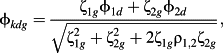
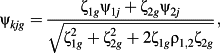
The model specification enables a straightforward decomposition of the variance that the grit scales shared with the common and unique factors underlying the conscientiousness scales. Because all of the common and unique factors were specified to be orthogonal to each other, the proportion of shared variance (i.e. the squared multiple correlation) is given by the sum of squared correlations of each common and unique factor embedded in the nested factor model. In addition, each factor's squared correlation coefficient represents its contribution to the squared multiple correlation.
Model estimation
All models were estimated in Mplus, Version 7.4 (Muthén & Muthén, 1998), using the full information maximum likelihood estimator. Several indices of fit have been suggested to evaluate the goodness of fit for SEM (e.g. Marsh, 2007; West, Taylor, & Wu, 2012). For the present analyses, we considered the root mean square error of approximation (RMSEA), the Tucker–Lewis index (TLI), the comparative fit index (CFI), and the standardized root mean square residual (SRMR). TLI and CFI values greater than 0.90 or 0.95, respectively, are typically interpreted to reflect an acceptable or excellent fit to the data. RMSEA values lower than 0.05, 0.06, or 0.08 and SRMR values lower than 0.08 or 0.10 are typically interpreted to reflect a close or a reasonable fit to the data (Marsh, 2007; West et al., 2012). We used the goodness–of–fit χ2 values as obtained for the more restricted models to test for significant deviations in model fit.
Results
The results are presented in three parts. In the first part, we examine the cross–group invariance of the reliability–adjusted correlation matrices. This analysis indicates if the scales work similarly in the two samples used in our study and, thus, gives an indication of validity of our findings. Results that support the invariance assumption suggest a cross–group invariance of the parameters of the measurement models (i.e. the nested factor model of Equation ) and of the extension part of the factor model. To this end, we applied a two–group single indicator model in which the correlations were specified to be invariant across groups (see Equation ). Results accompanied by a non–significant χ2 goodness–of–fit measure support the invariance assumption.
In the second part, we examine the proposed nested factor model for the conscientiousness facets, as assessed by the NEO PI–R in both samples (Figure 2). Thereby, we investigate if the industriousness factor found in the study by Roberts et al. (2005) can be identified in our data as well. In order to judge the suitability of the proposed nested factor model for the facet scales of conscientiousness, we first fitted a single factor model that included only the superordinate conscientiousness factor. In the next step, we investigated whether the inclusion of an additional nested industriousness factor led to a statistically significant improvement in the model–data fit.
In the third part, we investigate the relationships between the common and unique factors underlying the conscientiousness facet scores and grit. Here, we extended the nested factor model of conscientiousness by the two grit facet scores. The results provided by these models were used to estimate and decompose the shared variance between the grit facets and the common and unique factors included in the CFA model of conscientiousness and to estimate the relationships between the conscientiousness factors and global grit. Because all the analyses were adjusted for the impact of random measurement error as described in the Statistical Procedures section of this article, we also repeated all of the analyses by disregarding measurement error (i.e. ω–parameters in Figure 2 fixed to zero). These analyses revealed the same pattern of results and led to the same conclusions, although the relationships were weaker, as was to be expected (the results are open and available for download; see Schmidt, 2018).
Cross–group invariance of correlation matrices
First, we tested whether the reliability–adjusted correlation matrices (see Equation ) of the facets of the NEO PI–R differed across samples. The results supported the invariance assumption as even the χ2 goodness–of–fit test was not statistically significant: χ2(21) = 31.22, p = 0.070. These analyses were then repeated on the basis of the correlation matrices of the conscientiousness facets augmented by the grit facet scores that indicated that the full correlation matrix can be set to be invariant across samples [χ2(28) = 38.08, p = 0.097, CFI = 0.99, TLI = 0.99, RMSEA = 0.03, SRMR = 0.07]. In sum, these results strongly indicate the existence of cross–group invariance of relationships between the conscientiousness facets, as well as between the conscientiousness facets and the measures of grit. In other words, the results show that the interrelationships between the facets of conscientiousness and grit do not differ across the two samples. As such, we employed SEMs in which the focal parameters (i.e. factor loadings and correlations) were set to be invariant across groups.
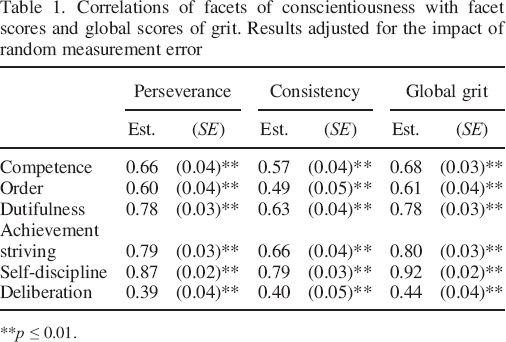
The correlations of the facets scores of conscientiousness with the grit facets adjusted for reliability are reported in Table 1. Table 1 also includes the correlations between conscientiousness and the global grit score that were derived based on the reliability–adjusted facet scores (see Equations and ). However, as the analysis revealed no differences between the correlations and the corresponding standard errors across the two samples, Table 1 includes only one set of correlations.
Correlations of facets of conscientiousness with facet scores and global scores of grit. Results adjusted for the impact of random measurement error
p ≤ 0.01.
As shown in Table 1, both facets of grit showed strong relationships with the facets of conscientiousness. With the exception of the deliberation facet representing the inhibitive aspects of conscientiousness in the NEO PI–R, which correlated equally strong with both facets of grit, perseverance tended to be more closely related to the conscientiousness facets. As expected, the conscientiousness facets that were hypothesized to be sensitive to the industriousness factor (i.e. competence, dutifulness, achievement striving, and self–discipline) showed stronger relationships with both facets of grit. Interestingly, all of the correlations of perseverance with these facet scores were stronger than the reliability–adjusted correlation with consistency (
In sum, the correlations reported in Table 1 suggest that both facets of grit are related to the common factors hypothesized to underlie the conscientiousness instrument, indicating that perseverance is likely to be more closely linked to the common factors. In addition, the particularly strong correlation of the global grit score with self–discipline points to the possibility that grit is additionally related to the self–discipline facet of conscientiousness.
Nested factor model for conscientiousness
Next, we conducted a CFA with the six facets: competence, order, dutifulness, achievement striving, self–discipline, and deliberation, loading on the single superordinate conscientiousness factor. The model showed an acceptable fit to the data [χ2(24) = 84.72, p < 0.001, CFI = 0.97, TLI = 0.96, RMSEA = 0.08, SRMR = 0.07], but the model fit was significantly improved when the nested industriousness factor as proposed in the study by Roberts et al. (2005) was added to the model: Δχ2(4) = 27.86, p < 0.001. The nested factor model showed a good fit to the data [χ2(20) = 56.86, p < 0.001, CFI = 0.98, TLI = 0.97, RMSEA = 0.06, SRMR = 0.07] and supported the findings of Roberts et al. (2005), indicating that four of the conscientiousness facet scales of the NEO PI–R reflect the industriousness aspect of conscientiousness besides a superordinate factor. Hence, we accepted the nested factor model with group–invariant standardized loadings as our final CFA model (we discuss model residuals for the full model in Table 3).
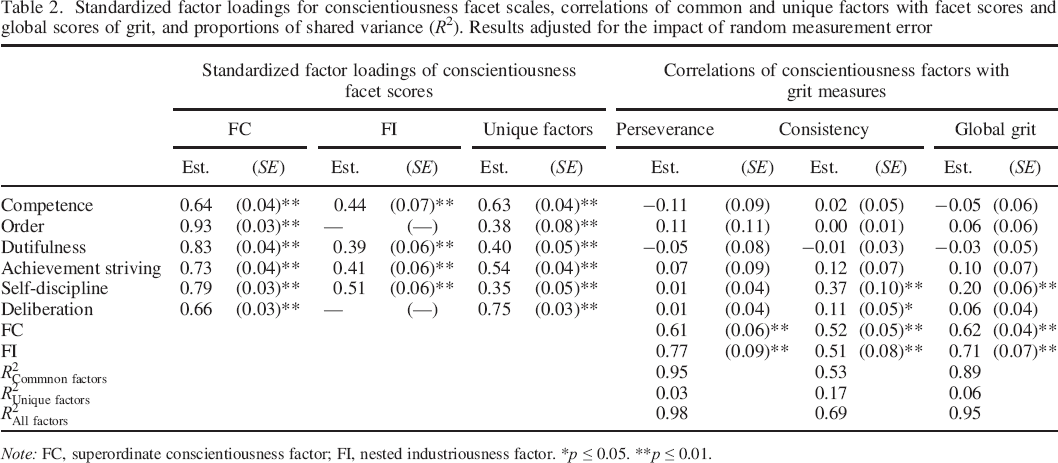
The standardized factor loadings of the nested factor model are presented in Table 2. It shows that the superordinate conscientiousness factor was most closely related to the order facet of conscientiousness, with 86% of the variance (i.e.
Standardized factor loadings for conscientiousness facet scales, correlations of common and unique factors with facet scores and global scores of grit, and proportions of shared variance (R2). Results adjusted for the impact of random measurement error
Note: FC, superordinate conscientiousness factor; FI, nested industriousness factor.
p ≤ 0.05.
p ≤ 0.01.
The loadings on the nested industriousness factor were quite homogenous. Only the dutifulness facet scale showed a relatively weak loading, indicating that only 15% of the scale's variance could be attributed to industriousness over and above the superordinate factor. For competence, achievement striving, and self–discipline, our model indicated that the nested industriousness factor accounted for 18% to 25% of the scale's variance over and above the superordinate factor.
Regarding the unique factor loadings, the results show that the deliberation and competence facets were least strongly determined by the common factors, as the unique factors accounted for 56% and 40% of the facet scores’ variance, respectively. In contrast, the facet scores for order, dutifulness, and self–discipline were most strongly determined by the common factors, as the unique factors accounted for only about 15% of the scales’ variances.
Extension of the confirmatory measurement model for conscientiousness
We now turn to the correlations between the facets of grit and the facets of conscientiousness (for a full intercorrelation matrix, see Table 4). We first present the results of the extension of the confirmatory measurement model for conscientiousness. As we expected, the factor loadings of the conscientiousness facets on their common and unique factors did not change once the grit facets were included in the model; thus, the meaning of the conscientiousness factors was not affected by the additional variables being included in the model. This is one of the main advantages of the extension procedure introduced by Nagy et al. (2016).
As shown in Table 2, both grit facets were strongly related to the common factors. Perseverance shared 95% of its variance in total with the superordinate conscientiousness factor and the nested industriousness factor. Consequently, the relationships between perseverance and the unique factors turned out to be negligible. None of the correlation coefficients turned out to be statistically significant, and perseverance shared only 3% of this variance with the unique factors in total. Hence, the results suggest that the perseverance facet of grit cannot be separated from the common factors underlying the NEO PI–R conscientiousness scales. A closer look at the relationships with the common factors shows that perseverance had a strong overlap with the industriousness factor (59% shared variance) and a weaker relationship with the superordinate factor (37% shared variance). This result shows that perseverance shared even more variance with the industriousness factor than any conscientiousness facet that served as an indicator of this factor (15% to 26% shared variance with industriousness). In contrast to the conscientiousness facets, however, perseverance had less variance in common with the superordinate factor (41% to 87% shared variance with conscientiousness facets). Nevertheless, perseverance appeared as a purer measure of the common factors underlying the conscientiousness facets, because these shared a maximum of 88% variance with the common factors (i.e. self–discipline), whereas perseverance reflected these factors almost purely (95% shared variance).
The results for the consistency facet of grit were somewhat different. This facet shared 53% of its variance with the common factors of conscientiousness and, in addition, shared 17% of its variance with the unique factors (69% shared variance with all factors). The relationship between consistency and the industriousness factor was stronger than the average non–zero loadings of the indicators of the corresponding factor. Finally, the correlations between consistency and the unique factors reported in Table 2 show that consistency is relatively strongly related to the unique factor underlying the self–discipline facet of conscientiousness. Consistency shared about the same amount of variance with this unique factor as the self–discipline facet did (14% and 13%).
Taken together, the results appear to support our expectations about the relationships between the grit facets and the factors underlying the battery of conscientiousness measures. Although perseverance showed a stronger correlation with the superordinate common factor than consistency, the difference was not statistically significant [Wald–χ2 (df = 1) = 1.58, p = 0.209]. However, as we expected, perseverance correlated more strongly with the industriousness factor [Wald–χ2 (df = 1) = 4.03, p = 0.045]. In addition, we found support for our expectation that consistency is related to the unique factor underlying the self–discipline facet, whereas perseverance is not, as the difference in the correlations reported in Table 1 was found to be reliable [Wald–χ2 (df = 1) = 10.91, p = 0.001]. No other correlation of the unique factors was found to differ reliably between the facet scores of grit. Consequently, the statistically significant unique correlation between consistency and deliberation should not be interpreted substantively.
All in all, the analyses presented indicate subtle but nevertheless theoretically meaningful differences in the relationships between the facets of grit and the conscientiousness factors. Perseverance appears as a rather pure measure of the common factors envisaged in our application that can hardly be differentiated from proactive conscientiousness, whereas consistency additionally captures specific aspects of the self–discipline facet. Hence, the question emerges as to how the global measure of grit relates to the factors underlying the measures of conscientiousness. Table 2 reports the respective correlations that were derived on the basis of previous findings. Global grit showed relationships with the common factors that were highly similar to the correlations of the perseverance facet (89% shared variance). In addition, global grit was found to be significantly related to the self–discipline facet, although the correlation was weaker than in the case of consistency. In total, global grit shared 95% of its variance with the common and unique factors underlying the conscientiousness scales. Our results thus show that the compound grit measure cannot be easily separated from the mainly proactive conscientiousness domain as measured by the NEO PI–R.
Discussion
The aim of this study was to contribute to the ongoing discussion concerning the similarities and differences between grit and conscientiousness. In their meta–analysis, Credé et al. (2016) gave an overview of the current status of research on the relationship between grit and conscientiousness. Their study provided empirical evidence for the strong relatedness of grit and conscientiousness, thereby corroborating a widely proclaimed assumption. In addition, they stressed the need to investigate grit on the facet level as well as on the global level. Nonetheless, the effect that different conceptions of conscientiousness may have and the heterogeneity of the measures applied to assess conscientiousness were not examined in their or any other study. Up until now, an in–depth investigation of the relationship between grit and the non–unitary conscientiousness construct has been lacking; it was the aim of this study to fill this gap.
We based our approach to this research desideratum on the hierarchical structure of conscientiousness introduced by Roberts et al. (2005). We analysed the relationship between grit and different factors underlying the facet scales of conscientiousness assessed by the NEO PI–R instrument that were modelled by means of a nested factor model: the broader domain, represented by the superordinate conscientiousness factor; the proactive aspect of conscientiousness, which was assessed by means of a nested factor; and the lower facet level, which was represented by unique factors. We applied a novel statistical approach that enabled us to investigate these relationships simultaneously and has numerous advantages over commonly used strategies, the extension procedure for CFA by Nagy et al. (2016).
We expected that both facets of grit, perseverance and consistency, would be related to the superordinate conscientiousness factor and the more specific proactive industriousness factor, although it seemed reasonable to expect stronger associations for the perseverance facet (Credé et al., 2016). Due to the strong resemblance between the definitions of perseverance and industriousness, we expected to find the strongest relationship between these factors. In addition, we investigated whether the unique factors pertaining to the different facets of conscientiousness assessed by the NEO PI–R instrument are also related to grit. We speculated that the unique self–discipline factor would most likely be related to the consistency facet of grit because both measures tap the long–term aspect of goal–directed behaviour. In addition, our approach enabled us to provide insides into the differentiability of grit and conscientiousness and, thus, give an impetus on the question of whether grit can be separated empirically from the more established concept of proactive conscientiousness.
Summary of results
Our analyses documented a remarkable invariance of the scale's interrelationships between quite different samples of school students and adults. Furthermore, the results of the nested factor model support the assumption that the NEO PI–R conscientiousness instrument is sensitive to the industriousness factor, as suggested by the hierarchical structure of conscientiousness introduced by Roberts et al. (2005). These findings created a sound basis for the subsequent analyses. The results provided by the extension procedure by Nagy et al. (2016) corroborate that the two common factors—the superordinate conscientiousness factor and the nested industriousness factor—as well as the unique factors derived from the facets of the NEO PI–R are differentially related to grit.
Perseverance and consistency were both strongly related to the common factors, but perseverance clearly showed a stronger relationship with the industriousness factor. The consistency facet of grit was not as strongly related to the common factors but, in addition, shared variance with the unique aspect of the self–discipline facet. Despite these differences, the global grit score was found to be more sensitive to the common factors of conscientiousness than any other conscientiousness facet included in the NEO PI–R, although the global measure shared some variance with self–discipline that could not be explained by the common factors. In the following, we will discuss the results pertaining to the two facets of grit, perseverance and conscientiousness.
Relationship between perseverance and conscientiousness
The results on the relationship between perseverance and conscientiousness are rather straight forward. In total, perseverance shared 95% of its variance with the superordinate factors. Hence, our results strongly suggest that perseverance can be considered a rather pure reflection of the proactive aspect of conscientiousness (Roberts et al., 2005). The strong relationship between perseverance and the common conscientiousness factors is especially interesting, as our analytical approach ensured that the grit measures did not define common factors included in the model (i.e. the common factors extracted on the basis of the NEO PI–R were the same regardless of whether they were or were not included in the analysis; Nagy et al., 2016). An interesting result was that, after the impact of random measurement error was taken into account, perseverance appeared to be a purer measure of the common factors of conscientiousness than any conscientiousness facet included in the NEO PI–R instrument. This means that the perseverance facet of grit can be assumed to be a better and more parsimonious measure to assess the superordinate conscientiousness factor and the nested industriousness factor than any facet included in the NEO PI–R. Overall, the results strongly suggest that perseverance cannot be differentiated from proactive conscientiousness.
For the first time, our study offers a differentiated picture of the relationship between grit and proactive conscientiousness on the common factor level and on the facet level. Our findings indicate that the grit facet perseverance has an almost perfect overlap with the measures that we chose to assess conscientiousness. Thereby, we were able to show that perseverance and industriousness—or rather proactive conscientiousness—are inseparable constructs. Thus, the label perseverance might be redundant and an unnecessary addition to the canon of facets in the conscientiousness domain. Even though the study by MacCann et al. (2009) identified perseverance as one of the facets constituting conscientiousness, the authors showed that industriousness has been found to be a facet in the conscientiousness domain numerous times in the preceding research literature. To waive the use of some of the redundant labels would enhance the clarity and consistency of research in personality psychology.
Relationship between consistency and conscientiousness
In contrast to perseverance, the findings concerning consistency were more complex. Consistency shared 69% of its variance in total with the conscientiousness factors. Thereby, it appeared to consist of a unique component that cannot be fully explained by conscientiousness. Nevertheless, the unique component of the consistency facet (31%) was found to be within the range of the unique components of the conscientiousness facets. In other words, the proportion of unique variance pertaining to consistency is similar to the proportion of unique variance of the facets of conscientiousness not explained by the common factors. On the one hand, this could mean that consistency of interests may be conceptually considered as the facet of conscientiousness that is most similar to self–discipline but contains, like any other facet of conscientiousness, a unique aspect (Roberts et al., 2005). On the other hand, one could argue that consistency—rather than representing a facet of conscientiousness—reflects a personality trait apart from conscientiousness.
The impulsiveness facet of neuroticism from the NEO PI–R, for example, is defined as the tendency to act on ravings and urges rather than reining them in and delaying gratification (Costa & McCrae, 1992). Whiteside and Lynam (2001) argued that the neuroticism facet impulsivity is somewhat idiosyncratic to the conscientiousness facet self–discipline. Consequently, impulsiveness (reversed) stands in close proximity to the definition of consistency of interest.
Similarly, the facet openness to actions (reversed) in the NEO PI–R resembles the consistency facet closely. Openness to actions is defined as the openness to new experiences on a practical level (Costa & McCrae, 1992). It entails a stick–to–it–iveness and to be set in one's own ways—two aspects that resemble the consistency facet to a large extend. Including these facets could shed light on the differential functioning of the consistency facet and give an impetus to the question on why consistency shared less variance with conscientiousness than perseverance did.
We would like to stress that the decision whether to subsume the consistency facet of grit under the umbrella of the construct domain of conscientiousness should not solely be based on factor analytic results. The decision should also be guided by theory and additional results underscoring the merits of considering consistency as a construct in its own right.
Up until now, there is a debate on how to best conceptualize grit. The results of the meta–analysis by Credé et al. (2016) speak against viewing consistency as a separate construct or considering it in the grit conception at all, as studies showed that it did not predict real–life outcomes over and above perseverance. Muenks et al. (2017) on the other hand showed that a bifactor model comprising a primary grit factor and two orthogonal (uncorrelated) secondary factors (consistency and perseverance) fit the data best in a college sample. The results of our study once again show that the facets of grit differ notably. More research is clearly needed in which consistency is related to other facets in personality research and more heterogeneous external criteria such as long–term outcomes besides achievement–related measures. It would be interesting to know the extent to which consistency can have effects on long–term goals apart from perseverance.
Locating grit in the hierarchy of conscientiousness
In conclusion, we argue that the relationships between grit and conscientiousness are more complicated than they appear to be at first glance because they clearly depend on the facets of grit and conscientiousness used in the respective study. Perseverance appeared as a measure most sensitive to the proactive aspect of conscientiousness, which means that it can be fully integrated into a higher level of the conscientiousness hierarchy (see Roberts et al., 2005). In contrast, consistency could be integrated into a lower level of the hierarchical conscientiousness approach, partly due to the substantial amount of unique variance that was not shared with the common and unique factors of conscientiousness. Grit showed similar relationships with conscientiousness as perseverance did. Thus, the implications of the redundancy of perseverance largely pertain to general grit as well.
Our findings are in line with Roberts et al. (2014), who stress that a detailed investigation of related constructs may be helpful in order to incorporate these into the broader conscientiousness domain and thereby reduce redundancy in the broad canon of labels used in the conscientiousness domain. The definitions and ways to assess the construct conscientiousness itself vary substantially. In our study, we adhered to this fact and investigated the relationships between grit and an aspect of conscientiousness that is theoretically most similar to grit, namely, proactive conscientiousness. Credé et al. (2016) and others claimed that grit is just conscientiousness, a claim that seems shortsighted in light of the broad body of empirical findings on the heterogeneity of conscientiousness. Claiming that grit is just proactive conscientiousness or industriousness, however, would stand in accordance with our findings.
We think that much could be learned from further investigations on the communalities and differences between the facets of conscientiousness and grit as similar analyses using other measures of conscientiousness could help to achieve a deeper understanding of these construct domains. Preferably, these should be broader measures with more heterogeneous facets and a better representation of the inhibitive aspects of conscientiousness, such as the conscientiousness scale by MacCann et al. (2009) that uses items from the international personality item pool. Such analyses could provide further support for the assertion that the consistency facet of grit can be integrated under the construct umbrella of conscientiousness (Roberts et al., 2009). However, even if future results likewise do not support a separation of grit and conscientiousness, the existing instruments for measuring grit could be regarded as useful from a pragmatic point of view: They might turn out to be one of the most efficient measures of the proactive aspect of conscientiousness. On a related note, the close relationship between grit and conscientiousness as measured using the NEO PI–R could allow to use the facets of the NEO PI–R as a proxy for grit. As our results suggest, by and large, the two measures assess the same construct after all.
Potential of the applied confirmatory factor analysis extension approach
Relating covariates to existing trait hierarchies represented by factor analytic models imposes challenges that up until today were not well covered by existing statistical techniques. The main issue that needs to be resolved is that all variables located at the different levels of a hierarchy contain a unique component that could be related to the covariates under study. These relationships are crucial because they provide key information about the locations of these covariates. However, in order to keep the analysis model identified, not all relationships of unique and common factors can be estimated simultaneously. Most often, this issue is resolved by a priory assuming zero relationships between covariates and some unique factors. This approach is counterintuitive because it conflicts with the aim of identifying relationships of unique factors in situations where no or only tentative knowledge about such relationships exists.
The extension procedure for CFA (Nagy et al., 2016) is a promising tool that could resolve this dilemma. Instead of fixing correlations of some unique factors to zero, the method imposes a pattern restriction on the unique factors relationships with covariates. The restriction we have imposed shares similarities with the simple structure ideal imposed on most factor rotation strategies seeking an unknown but ‘simple’ pattern of relationships (for an alternative identification strategy, see Nagy et al., 2016). As such, that extension procedure for CFA combines a confirmatory measurement model with an exploratory extension model. Because of its exploratory nature, the results provided should optimally be scrutinized by cross–validating them in independent sample, as performed in this article.
We strongly believe that the method can be fruitfully used in any research area in which factor analysis is applied. Examples include the hierarchical model of academic self–concepts and its relationship with school achievement (e.g. Brunner, Lüdtke, & Trautwein, 2008), relationships of dark personality features with interpersonal behaviour (e.g. Southard, Noser, Pollock, Mercer, & Zeigler–Hill, 2015), and models of cognitive abilities, such as the two factor theory of intelligence (Spearman, 1904), and their correlations with school success, among others. Furthermore, the CFA extension can also be applied in situations where traits are assessed by multiple methods, such as multiple informants (e.g. self–reports, peers, parents, and teachers). The combination of a trait and the method by which it was assessed (e.g. extroversion rated by parents) can be considered as a facet of an overarching construct, and researchers might be interested in the informants’ unique trait perceptions (e.g. unique aspects of parents’ ratings) relationships with covariates (e.g. Lance, Hoffman, Gentry, & Baranik, 2008). The list of examples can be extended to various construct domains for which multifaceted mutimethod typed assessments are available. As such, the CFA extension appears as a viable alternative to existing methods that do not allow estimating all relationships of unique factors with covariates.
Limitations and further research
Finally, some limitations of the present study need to be addressed. It could be assumed that the close relation between the two constructs is a result of undistinguishable items in the measures used to assess them. To avoid an overestimation of the relationship between the constructs due to items from the NEO PI–R being similar to the items in the scale we used to assess grit, we asked four informed raters to identify items which were indistinguishable. Two out of the 48 items from the NEO PI–R were identified by the raters. We excluded the items from the NEO PI–R and repeated the analyses. There were no noteworthy deviations from the results presented. Hence, our results were not affected by the similar wording of items included in the two measures.
Another limitation of the study is that we investigated only one instrument used to measure conscientiousness. Our decision to use the NEO PI–R was based on the fact that this instrument provides a solid representation of the industriousness factor and simultaneously allows a relatively broad assessment of the construct. However, a drawback of the NEO PI–R is that it covers only some aspects of the conscientiousness domain and that the superordinate conscientiousness factor may be weakly defined. More specifically, our analyses indicated that the superordinate factor is most closely aligned to the order facet of conscientiousness. Hence, the NEO PI–R may result in a biased estimate of the relationship between the superordinate conscientiousness factor and grit because the order facet is classified as belonging to the proactive aspect of conscientiousness (Roberts et al., 2005). In addition, the deliberation facet of the NEO PI–R is the only facet pertaining to inhibitive conscientiousness. The unique deliberation factor possibly combines two components in our model: a reliable inhibitive conscientiousness term and a unique deliberation term. The NEO PI–R does not allow separating these components. Nevertheless, the relationship between grit and the unique deliberation factor represents a first indicator of the relationship between grit and inhibitive conscientiousness.
Even though the NEO PI–R has been found to emphasize the proactive aspects of conscientiousness, we do not believe that the main conclusions drawn in our study would be affected by augmenting the facet scales included in the NEO PI–R with additional facets. We rather expect factor analyses to identify additional common factors but not to reduce the estimates of the proportion of variance shared between grit and the common factors. Future studies should use even broader instruments, especially measures that assess the inhibitive aspects of conscientiousness to assess the multifaceted construct of conscientiousness that optimally allow for a full representation of the hierarchical model of conscientiousness. Thereby, the weaker relationship between consistency and conscientiousness could be investigated in a more thorough manner.
Finally, our findings must be treated with caution because of the caveats that arise due to the uneven distribution of negatively worded items in the measures we used to assess conscientiousness and grit. The consistency facet, for example, composes of only negatively worded items, whereas the perseverance facet comprises only positively worded items. One has to consider the possibility that the two grit factors identified were an artefact of positively and negatively scored items due to their perfect confounding with differences in item wording. In addition, some facets of the NEO PI–R contain more negatively worded items than other facets. This may have led to artificially inflated correlations between consistency and the facets with more negatively worded items and artificially deflated other correlations. Using larger sample sizes to model the factors using items could enable future research to control for the wording of the items.
Conclusion
Up until now, the majority of research that found substantial correlations between conscientiousness and grit neglected the multifaceted nature of both constructs. To address this lacuna, we investigated the relationship by using a broad multifaceted conscientiousness measure that stands in close theoretical proximity to grit and that enabled us to identify the industriousness factor (Roberts et al., 2005), which is most similar to grit on a conceptual level. Using a novel statistical approach that allowed us to investigate these relationships simultaneously, we found grit and its facet perseverance to be nearly identical to proactive conscientiousness. Consistency also shared a substantial amount of variance with conscientiousness, but to a lesser extent. Future research is needed to localize consistency in personality psychology more comprehensively.
All in all, the results show that grit represents yet another contribution to the common problem of redundant labelling of constructs in personality psychology (cf. Pfattheicher, Geiger, Hartung, Weiss, & Schindler, 2017). However, the measure to assess grit could possibly represent one of the most economic ways to assess proactive conscientiousness that is currently available.
Acknowledgement
We would like to thank Gráinne Newcombe for her editorial support during preparation of this article.
Supporting info item
Supporting info item, per2171-sup-0001-Open_Practices_Disclosure_Form - Same Same, but Different? Relations between Facets of Conscientiousness and Grit
Supporting info item, per2171-sup-0001-Open_Practices_Disclosure_Form for Same Same, but Different? Relations between Facets of Conscientiousness and Grit by Schmidt Fabian T.C., Nagy Gabriel, Fleckenstein Johanna, Möller Jens, Retelsdorf Jan and Back Mitja in European Journal of Personality
Open Practices Disclosure
Footnotes
References
Supplementary Material
Please find the following supplemental material available below.
For Open Access articles published under a Creative Commons License, all supplemental material carries the same license as the article it is associated with.
For non-Open Access articles published, all supplemental material carries a non-exclusive license, and permission requests for re-use of supplemental material or any part of supplemental material shall be sent directly to the copyright owner as specified in the copyright notice associated with the article.
